
- 170+ on-site battery energy storage systems (BESS) deployed by Electrify America
- 65,000+ kilowatt-hours (kWh) of collective energy capacity in the BESS network
- 50% jump in charging sessions in 2024 for Electrify America
Experts agree that Electrify America's deployment of battery energy storage systems is a critical innovation for overcoming grid limitations, accelerating EV adoption, and ensuring reliable charging infrastructure.
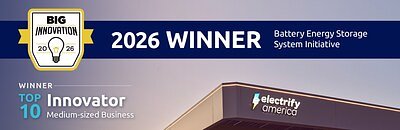
Electrify America Wins Big by Storing Power for the EV Grid
RESTON, VA – January 15, 2026 – Electrify America has been named a top innovator in the Business Intelligence Group's 2026 BIG Innovation Awards for a strategy that directly confronts one of the biggest roadblocks to a fully electric vehicle future: the limitations of the nation's power grid. The company's national deployment of more than 170 on-site battery energy storage systems (BESS) earned it a coveted spot in the Top 10 Innovation category, highlighting a crucial technological solution that is accelerating the expansion of Hyper-Fast EV charging.
These battery systems act as a buffer, storing electricity during low-demand periods and releasing it when multiple EVs plug in for a high-speed charge. This innovation allows the company to deploy its signature 350 kW chargers in locations where the local electrical infrastructure would otherwise be unable to handle the intense power demand.
"This recognition highlights how Electrify America continues to deploy battery energy storage as a solution to one of EV charging's biggest challenges— grid capacity," said Robert Barrosa, president and CEO of Electrify America. "By integrating BESS into our network, we're able to bring Hyper-Fast charging to the places drivers need it most, even where the grid alone may not support it."
Beyond the Grid: How Battery Storage Supercharges EV Charging
The challenge is simple, but the scale is immense. Hyper-Fast chargers, which can add hundreds of miles of range in under 30 minutes, draw a massive amount of power, equivalent to powering dozens of homes simultaneously. In many areas, especially rural and remote locations, the local grid simply wasn't designed for such intense, intermittent spikes in demand. This creates a significant bottleneck, slowing the rollout of essential charging infrastructure.
Electrify America's solution is to bring the power source on-site. The company has quietly become a leader in this space, deploying the largest network of on-site, behind-the-meter battery storage coupled with ultra-fast chargers in North America. With over 170 BESS units now operational, the network holds a collective energy capacity of more than 65,000 kilowatt-hours (kWh). This stored energy ensures that drivers experience consistent, reliable charging speeds, even during peak times, without over-stressing the local utility.
A prime example of this strategy in action is the charging station in Baker, California, a critical stop for drivers traveling between Los Angeles and Las Vegas. The site features Electrify America's first megawatt-level storage system, pairing approximately 1.5 megawatts (3 MWh) of battery storage with a 66 kW solar canopy. This powerful combination supports twelve Hyper-Fast chargers, an expansion that would have been difficult or impossible with the area's existing utility constraints. When fully charged, the energy stored at the Baker station alone could power an average American household for three months.
Beyond ensuring charging availability, the BESS strategy offers significant economic advantages. By drawing power from the grid during off-peak hours when electricity is cheaper and storing it for later use, Electrify America can mitigate exposure to expensive "demand charges" that utilities levy for high-power consumption during peak periods. This helps stabilize operational costs and, by extension, pricing for consumers.
In California, the company has taken this a step further, operating its BESS deployments as the largest Virtual Power Plant (VPP) of its kind. The network has participated in over 190 demand-response events, selling stored energy back to the grid during times of extreme stress and shifting over 125 MWh of energy consumption to off-peak hours. This not only supports grid stability for all Californians but also integrates the charging network as an active, helpful participant in the state's broader energy ecosystem.
The Grid's Growing Pains: A Bottleneck for an Electric Future
The problem Electrify America is tackling is not a minor one. According to industry reports, a staggering 75% of EV charging station developers identify grid limitations as a primary barrier to deployment. Experts warn that the U.S. grid is significantly undersized for the projected demand of the coming decades, strained not only by the millions of EVs expected on the roads but also by the voracious energy needs of new technologies like AI data centers.
Without solutions like BESS, the risk of unmanaged EV charging overwhelming local distribution networks is substantial. This could lead to grid instability, blackouts, and a slowdown in the energy transition. The traditional solution—comprehensive grid upgrades—is a slow and monumentally expensive process, often taking years of planning and construction for a single project. This timeline is out of sync with the rapid pace of EV adoption.
While other strategies like managed charging (shifting charging sessions to off-peak hours through software) and Vehicle-to-Grid (V2G) technology show promise, they often rely on changing consumer behavior or require vehicles with bidirectional charging capabilities. Electrify America's BESS deployment is a direct, hardware-based solution that works seamlessly in the background, requiring no extra steps from the driver.
"The 2026 winners are not celebrating experimentation for its own sake," noted Russ Fordyce, Chief Recognition Officer at the Business Intelligence Group, which vets its award winners with a panel of business leaders and practitioners. "They are operationalizing advanced analytics, automation, and intelligent systems... They are not just riding the AI wave, they are architecting the operating models that will define the next decade of global business performance."
A Strategic Power Play in a Competitive Market
In the highly competitive EV charging landscape, this technological foresight provides a powerful strategic advantage. While Tesla's Supercharger network remains the market leader by port count, Electrify America has solidified its position as the largest open Hyper-Fast network, serving all compatible EV brands. The company's aggressive growth saw a 50% jump in charging sessions in 2024 and the dispensing of over 600 GWh of electricity.
The BESS strategy is a key pillar of this growth. It allows the company to be more agile in its expansion, shortening deployment timelines by sidestepping lengthy grid interconnection studies and upgrade negotiations. This agility enables Electrify America to establish a presence in underserved markets and along crucial highway corridors faster than competitors who rely solely on available grid capacity.
This approach not only expands the network's physical footprint but also enhances its brand reputation for reliability. By guaranteeing Hyper-Fast speeds regardless of grid conditions, the company directly addresses a common frustration among EV drivers: arriving at a charger only to find it delivering power at a much slower rate than advertised. This focus on a consistent, high-quality user experience is critical for building driver loyalty.
As the industry matures, BESS-integrated charging is widely expected to become the standard for future-proofing charging infrastructure. Electrify America's early and large-scale investment positions it as a first-mover and a leader in building a resilient, next-generation network.
Charging for All: Democratizing the Electric Revolution
Ultimately, the most significant impact of this innovation extends beyond corporate strategy and technical specifications. By decoupling charging speed from grid strength, battery storage is a democratizing force for EV adoption. It ensures that access to the best charging technology is not limited to dense urban centers with modern, robust electrical systems.
This technology makes it viable to install Hyper-Fast charging in smaller towns, rural communities, and remote rest stops, effectively eliminating "charging deserts" that currently make long-distance electric travel daunting for many. It helps fulfill the promise of a coast-to-coast network that serves all drivers, not just those in major metropolitan areas.
For the average person considering the switch to an EV, the visible and reliable presence of high-speed chargers is one of the most powerful motivators. It replaces range anxiety with confidence. By creating its own power reserves on-site, Electrify America is not just building charging stations; it is building confidence in an electric future, ensuring that the power to go anywhere is available to everyone, regardless of what the local grid can support.