
- $100 billion investment in Saudi Arabia's aviation sector by 2030
- 330 million annual passenger traffic goal by 2030
- $37 billion order for Boeing Dreamliners, the fifth-largest in Boeing's history
Experts would likely conclude that Riyadh Air's launch represents a bold, high-stakes move to disrupt global aviation, with significant potential for economic impact but substantial operational and competitive challenges ahead.
Riyadh Air's Dreamliners Land, Launching Saudi Arabia's Aviation Gambit
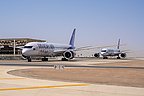
RIYADH, Saudi Arabia – June 05, 2026 – The distinctive silhouette of two Boeing 787-9 Dreamliners, painted in a striking indigo and lavender livery, cut through the haze as they touched down at King Khalid International Airport today. This was not just the arrival of new aircraft; it was the physical manifestation of Saudi Arabia's colossal ambition to rewrite the global aviation map. For Riyadh Air, the Kingdom's new national carrier, this delivery marks a pivotal milestone as it prepares to challenge the established order of global air travel.
The delivery from Boeing is the first tangible hardware in a strategy years in the making. "To see our very first custom-built 787 Dreamliner airplanes touch down in Riyadh is a historic moment for us, and a momentous day for Saudi aviation," said Riyadh Air CEO Tony Douglas in a statement. The airline is now poised for its public commercial launch on July 1, 2026, with an inaugural flight connecting Riyadh to London Heathrow, a route it has been testing with leased aircraft on an invite-only basis since late 2025.
The Engine of Vision 2030
The creation of Riyadh Air is the spear tip of Saudi Arabia's National Aviation Strategy, a core pillar of its sweeping Vision 2030 plan to diversify its economy away from oil. The Kingdom is injecting over $100 billion into its aviation sector by 2030, a figure that underscores the scale of its intent. The goals are staggering: to increase annual passenger traffic to 330 million, attract 150 million tourists annually, and connect the country to more than 250 destinations worldwide.
Riyadh Air, backed by the nation's sovereign Public Investment Fund (PIF), is designed to be a full-service, premium carrier aimed directly at the "super-connector" model perfected by its Gulf neighbors in Dubai, Doha, and Abu Dhabi. The plan is to leverage Riyadh's geographic position to funnel significant indirect traffic, particularly from the high-growth markets of South Asia. The airline aims to serve over 100 destinations by 2030, with initial routes already filed for major hubs including Paris, Dubai, Mumbai, and Bangkok.
To achieve this, the airline is branding itself as the world's first "digital and AI-native airline," forging partnerships with tech giants like IBM and Huawei to build a seamless, data-driven passenger experience. Its loyalty program, "Sfeer," launched in late 2025, is already being marketed with unique features designed to attract frequent flyers from day one. This aggressive push is not just about building an airline; it's about creating an entire ecosystem that will generate an estimated 200,000 jobs and contribute over $75 billion to the national economy.
A Strategic Victory for Boeing
For Boeing, this delivery is a much-needed strategic victory. The combined order from Riyadh Air and existing Saudi carrier Saudia for up to 121 Dreamliners, valued at an estimated $37 billion, represents the fifth-largest commercial order by value in the American aerospace giant's history. It provides a significant boost to the 787 program, which has been beset by production halts and quality control issues in recent years, causing the initial delivery to Riyadh Air to be delayed by over a year.
"The 787 Dreamliner gives Riyadh Air unmatched efficiency, flexibility across routes and a beautiful interior that will deliver a phenomenal travel experience," noted Stephanie Pope, president and CEO of Boeing Commercial Airplanes. The aircraft's efficiency is a key selling point. Composed of lightweight carbon fiber materials and powered by new-generation engines, the 787 is roughly 20-25% more fuel-efficient than the older aircraft it replaces. This aligns with Riyadh Air's stated commitment to sustainability, having joined the UN Global Compact and pledging to integrate ESG principles across its operations. The airline is even utilizing GE Aerospace software to meticulously track and optimize fuel consumption.
Securing a marquee, state-backed startup with such ambitious growth plans provides Boeing with a critical anchor in the lucrative Middle Eastern market for wide-body jets. The deal not only fills order books but also serves as a powerful endorsement of the 787's capabilities as the ideal platform for a new long-haul carrier aiming to compete on both cost and passenger experience.
Navigating a Crowded Airspace
Despite the fanfare and financial backing, Riyadh Air faces a turbulent path ahead. It is entering one of the world's most competitive aviation markets, going head-to-head with behemoths like Emirates and Qatar Airways, which have spent decades building their global networks, brand loyalty, and operational expertise. These established players will not cede market share lightly. The new airline will have to fight for every passenger, every route, and every airport slot.
The operational challenges of launching a mega-airline from scratch are immense, ranging from recruiting and training thousands of skilled pilots, cabin crew, and technicians to navigating the complex web of international air service agreements. The geopolitical landscape adds another layer of uncertainty, with regional conflicts capable of disrupting flight paths and elevating operating costs overnight.
Beyond its 39 firm orders for the 787-9, Riyadh Air has also ordered 60 Airbus A321neos for regional routes and 25 Airbus A350-1000s for future long-haul growth, signaling a multi-faceted fleet strategy. The airline is also actively seeking alliances, recently signing an agreement with Air India to explore codeshare opportunities. These moves show a clear understanding that to succeed, it must build not just a fleet, but a network of partners. The arrival of these first two Dreamliners is a powerful symbol of intent, but the true test will be in the execution of one of the most ambitious airline launches in history.