
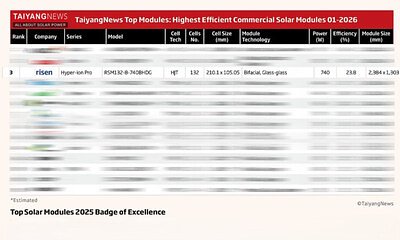
- Top-3 Global Ranking: Risen Energy's Hyper-ion Pro modules secured a top-three position in the 2026 TOP SOLAR MODULES list by TaiyangNews.
- Efficiency & Power: Modules achieve a 23.8% conversion efficiency and a 740Wp mass-production power rating.
- Global Reach: Cumulative shipments of the Hyper-ion series surpassed 12 gigawatts (GW) by the end of 2025, reaching over 80 countries.
Experts view Risen Energy's technological advancements as a significant milestone in the solar industry, positioning the company as a leader in both terrestrial and space-based solar power solutions.
Risen Energy Hits Top Tier in Solar, Sets Sights on Space
NINGBO, China – January 23, 2026 – Risen Energy has secured a top-three global ranking for its advanced solar module technology, a significant achievement that comes as the company navigates a turbulent market while simultaneously pursuing ambitious long-term goals in space-based solar power.
The company’s Hyper-ion Pro heterojunction (HJT) modules were recognized in the inaugural 2026 TOP SOLAR MODULES list by global photovoltaic (PV) authority TaiyangNews. The placement was earned on the back of a mass-production power rating of 740 watts peak (Wp) and a conversion efficiency of 23.8%, placing it at the forefront of commercially available solar technology.
This distinction highlights not only a technological milestone for Risen Energy but also underscores the intense innovation race defining the modern solar industry, where manufacturers are pushing the physical limits of silicon to power both terrestrial grids and future off-world endeavors.
The New Benchmark for Efficiency
The TaiyangNews ranking is considered a credible industry benchmark due to its stringent inclusion criteria. Unlike lists that feature laboratory prototypes, it focuses exclusively on commercially mass-produced PV modules with publicly available technical data and a minimum conversion efficiency of 21.5%. This focus on real-world, scalable products gives the ranking significant weight for industry analysts, investors, and procurement managers.
Risen Energy's Hyper-ion Pro modules achieve their high performance by integrating several core technologies. The HJT cell structure, which combines crystalline silicon with amorphous silicon thin-films, is known for its superior passivation and high voltage, leading to greater efficiency. This is enhanced by the use of OBB (Open Bus Bar) cell technology and Hyper-link stress-free interconnection, which improve electrical conductivity and durability while reducing material costs.
Beyond the headline efficiency number, the modules boast features critical for real-world energy generation. An ultra-high bifaciality of 90% (±5%) allows the panels to capture significant amounts of reflected light on their rear side, boosting total energy yield, particularly in ground-mounted utility-scale projects. Furthermore, an ultra-low temperature coefficient of -0.24%/°C ensures the modules suffer less performance degradation in hot climates, a key advantage as global temperatures rise. By the end of 2025, cumulative shipments of the Hyper-ion series had already surpassed 12 gigawatts (GW), reaching over 80 countries.
Navigating a Fiercely Competitive Market
Risen Energy's achievement is set against the backdrop of a fiercely competitive global solar market. The industry is in the midst of a major technological shift away from older p-type PERC (Passivated Emitter and Rear Cell) technology towards higher-efficiency n-type cells, primarily TOPCon (Tunnel Oxide Passivated Contact) and HJT.
While Risen’s 23.8% efficiency is at the apex of mass-produced HJT modules, it faces intense competition. Other technologies, such as All Back Contact (ABC) modules from manufacturers like AIKO Solar and LONGi, have demonstrated efficiencies exceeding 24% in commercial products. Meanwhile, TOPCon technology has gained significant market share due to a more favorable cost-to-performance ratio, with major players like Jinko Solar and JA Solar also pushing efficiencies toward the 24% mark.
HJT has historically faced challenges with higher manufacturing costs compared to TOPCon. However, Risen Energy's ability to mass-produce a 740Wp module indicates significant progress in making the technology more scalable and cost-effective. The company's continued investment in HJT, with 6 GW of cell and 10 GW of module capacity, signals a strategic bet that the superior performance characteristics of HJT will ultimately carve out a significant share of the high-end market.
From Grid to Galaxy: A Dual-Pronged Strategy
Perhaps the most forward-looking aspect of Risen Energy's strategy is its expansion beyond the terrestrial solar market. The company is actively positioning itself as a key technology provider for the burgeoning space economy, leveraging its expertise in advanced cell technology to develop solutions for orbital and interstellar applications.
A cornerstone of this initiative is the successful batch delivery of its self-developed 50-micrometer (μm) ultra-thin p-type HJT cells. These cells are engineered for the harsh environment of space, offering superior performance in lightweight design and radiation resistance. Their compatibility with flexible solar arrays makes them ideal for satellites, space stations, and other spacecraft where mass and durability are critical constraints.
Further solidifying its deep-tech credentials, Risen Energy's research and development on perovskite/silicon HJT tandem solar cells has yielded a laboratory conversion efficiency of 30.99%. Tandem cells, which stack different photovoltaic materials to capture a wider portion of the solar spectrum, are widely seen as the next frontier for solar efficiency. This breakthrough opens up what the company calls "vast room for efficiency evolution in future space photovoltaics," laying the groundwork for a new generation of ultra-high-performance solar power for humanity's expansion into space.
Innovation Amidst Industry Headwinds
This push for technological leadership comes at a challenging time for the global PV industry. Risen Energy, like many of its peers, faced significant financial headwinds in 2024. The company reported a substantial revenue decline and a net loss, which it attributed to a global mismatch in supply and demand that led to intense price pressure across the entire value chain. The company's market share contracted both in its domestic Chinese market and overseas.
In response to these market conditions, the company has made strategic adjustments, including exiting the polysilicon business and extending deadlines for new manufacturing projects. Yet, its commitment to innovation remains unwavering. The establishment of a Global Photovoltaic Research Institute in late 2023 and its continued breakthroughs in HJT and tandem cell technology demonstrate a clear long-term strategy: to navigate short-term market volatility by establishing an unassailable lead in next-generation technology.
By simultaneously pushing the boundaries of mass-produced terrestrial modules and pioneering novel solutions for space, Risen Energy is executing a dual strategy. This approach aims to solidify its position in today's highly competitive grid-tied market while building the scientific foundation for the energy systems of tomorrow, redefining the boundaries of solar power from ground-based plants to the vast expanse of the cosmos.
Topics & Related
Expansion
Related Company Pulse