
- 26.75 square kilometers: Area covered by REV's 3D seismic survey in Montana.
- US$390 per thousand cubic feet (mcf): Average price for Grade-A helium in 2023, up 26% year-over-year.
- 14,000 acres: REV's total land position across Montana and Alberta for helium and hydrogen exploration.
Experts would likely conclude that REV's strategic pivot to helium and natural hydrogen exploration in Montana is a high-risk, high-reward bet, leveraging advanced seismic technology and favorable market conditions to potentially unlock critical energy resources.
REV’s High-Stakes Bet on Montana's Untapped Helium and Hydrogen Future
VANCOUVER, British Columbia – June 17, 2026 – In a move that underscores the intensifying global search for critical resources, REV Exploration Corp. has launched a high-tech seismic survey at its West Butte project in Montana. The operation is not just another exploration play; it represents a calculated bet on unlocking a domestic supply of two increasingly vital gases: helium and natural hydrogen.
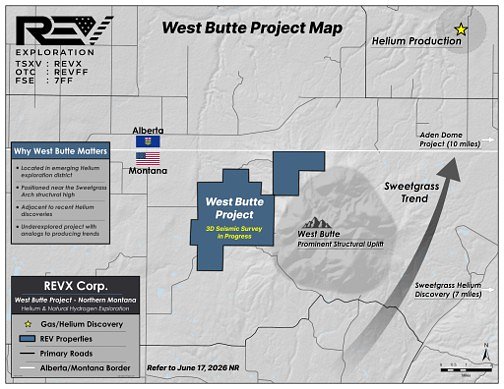
The company announced today the commencement of a 26.75 square kilometer 3D Seismic Survey, a sophisticated underground imaging project that will pave the way for a first-ever drilling program in the area. This initiative places REV at the heart of a new energy frontier, where geological data and financial strategy converge to target resources essential for everything from semiconductor manufacturing to the future of clean energy.
The Technology Behind the Treasure Hunt
At the core of REV's Montana campaign is the deployment of advanced 3D seismic imaging, conducted by the globally recognized firm Tetra Tech. This is the same technology and team that recently supported MAX Power Mining's landmark Lawson Natural Hydrogen Discovery in Saskatchewan, a connection that lends significant technical credibility to the West Butte endeavor. REV is a major shareholder in MAX Power, and the shared geological expertise is a cornerstone of its strategy.
Unlike traditional two-dimensional surveys, 3D seismic technology creates a detailed, cube-like model of the subsurface geology. This allows geoscientists to precisely map the deep basement structures and complex fault systems that act as conduits and traps for gases migrating from the Earth's mantle. For helium and natural hydrogen, which are lighter and more elusive than conventional hydrocarbons, this level of precision is critical for de-risking multi-million dollar drilling decisions.
The survey at West Butte aims to confirm structural closures capable of holding vast quantities of these gases in stacked Cambrian and Devonian reservoirs. "What makes this opportunity at West Butte truly compelling is the combination of proven discovery success nearby and the scale of the geological system we now control," stated REV CEO Jordan Potts. His comment highlights the belief that they are not chasing a single prospect, but tapping into a regional-scale system.
Montana's Buried Promise: A New Frontier for Critical Gases
The timing of REV's push into Montana could not be more critical. Helium, once a cheap byproduct of natural gas production, is now a strategic commodity with a soaring price tag. The U.S. Geological Survey reported an average price for Grade-A helium of US$390 per thousand cubic feet (mcf) in 2023, a 26% year-over-year increase, with some spot prices commanding significant premiums. Its irreplaceable role in cooling MRI magnets, manufacturing fiber optics, and enabling space exploration has made securing a stable domestic supply a matter of national and economic security.
Montana, along with neighboring southern Alberta, is emerging as a key North American hotspot for helium. REV's West Butte project is situated along a prospective structural corridor that hosts other recent discoveries. Competitors like Avanti Energy and Global Helium Corp. have already validated the region's potential with successful wells, transforming previously overlooked geological formations into high-value assets. Avanti's Sweetgrass project, for instance, is targeting production by mid-2026, while Global Helium is advancing plans for a purification facility in the state. This flurry of activity suggests that the geological thesis—that ancient basement faults are leaking high-concentration helium into shallower, trappable reservoirs—is sound.
A District-Scale Vision Fueled by Strategic Capital
REV Exploration's focus on West Butte is a key part of a much larger corporate transformation. Over the past two years, the company has methodically pivoted away from its legacy in gold mining to become a pure-play explorer in the helium and natural hydrogen space. This strategic shift was cemented by the divestment of its Quebec gold assets, a move that unlocked capital and management focus for its new energy ambitions.
The company's vision has attracted significant financial backing. Prominent mining investor Eric Sprott has led recent financing rounds, injecting nearly C$10 million into the company in 2026 alone. This capital is being deployed to execute what CEO Jordan Potts describes as a "district-scale opportunity." REV's portfolio is not limited to West Butte; it includes approximately 14,000 acres across Montana and the drill-ready Aden Dome project just across the border in Alberta, which is believed to be an extension of the same geological trend.
This strategy of consolidating a large land position across a prospective fairway, backed by technical expertise from proven discoveries and robust financing, positions the company not merely as an explorer, but as an aspiring regional powerhouse in a sector with high barriers to entry.
The Dual Prize: Helium and the Dawn of Natural Hydrogen
While helium provides a compelling, near-term economic driver, the potential discovery of natural hydrogen at West Butte represents a longer-term, transformative prize. Often called "gold" or "white" hydrogen, this naturally occurring gas is generated through geological processes within the Earth's crust, offering the promise of a clean energy source without the carbon footprint or high energy cost of conventional "grey" or "green" hydrogen production.
The global hydrogen market is projected to grow exponentially as industries and governments pursue decarbonization, with demand expected to increase six-fold by 2050. While the natural hydrogen sector is still in its infancy—with only one commercial operation in Mali—discoveries like MAX Power's Lawson project have ignited a modern-day land rush. The seismic program at West Butte is specifically designed to identify geological features prospective for natural hydrogen, potentially giving REV a dual-commodity advantage. The pursuit of both resources from a single drilling program represents a highly efficient use of exploration capital and a powerful hedge on the future of energy.
The data gathered in the coming weeks will be crucial, potentially confirming multiple drill-ready targets for a summer program and moving REV Exploration one step closer to tapping into Montana's deep and valuable energy reserves.