
- 56% of consumers are unconvinced or skeptical about retailers' sustainability claims.
- 89% of retailers believe their sustainability data could withstand an audit.
- $849.9 billion worth of merchandise is projected to be returned in 2025, with processing costs ranging from 20% to 65% of an item’s original price.
Experts agree that retailers must move beyond marketing slogans and provide concrete, verifiable data on sustainability efforts to rebuild consumer trust.
Retail's 'Proof Gap': Why Consumers Don't Trust Your Green Claims
MIAMI, FL – April 30, 2026 – By Stephanie Lewis
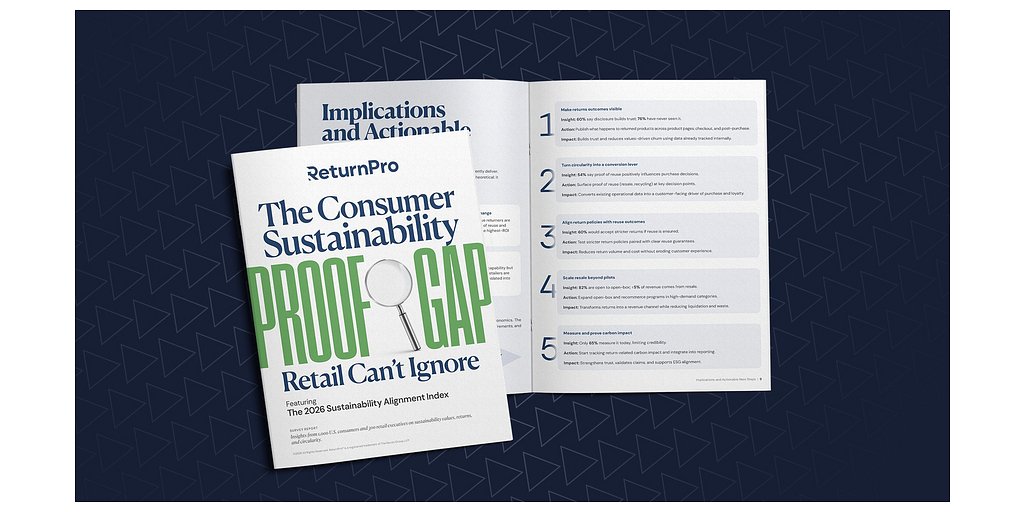
Retailers are facing a quiet crisis, and it has nothing to do with inventory or foot traffic. It’s a crisis of credibility. Despite pouring significant resources into sustainability initiatives, a vast and growing chasm separates their efforts from consumer perception. A new report from returns management firm ReturnPro has given this phenomenon a name: the “Sustainability Proof Gap.”
According to the company's 2026 Sustainability Report, which surveyed 1,000 consumers and 300 retail executives, the breakdown isn’t in intent, but in tangible, verifiable proof. The findings paint a stark picture of distrust: a staggering 56% of consumers are unconvinced or outright skeptical that retailers are being honest about their sustainability efforts. This skepticism persists even as 89% of retailers express confidence that their own sustainability data could withstand a formal audit.
“Sustainability in retail isn’t failing because of lack of intent, it’s breaking down at the point of proof,” said Sender Shamiss, Co-Founder and CEO of ReturnPro, in the report's release. “Retailers have made meaningful investments in sustainability, but without making those outcomes visible to consumers, that effort does not translate into trust. This is not a measurement gap; it’s a credibility gap.”
The Growing Credibility Crisis
The report's data reveals a profound disconnect rooted in a lack of transparency. For instance, a massive 85% of consumers operate under the hopeful assumption that products they return get a second life. Yet, the reality is far murkier in their eyes. Only 17% of those surveyed felt they understood what actually happens to returned goods, and a mere 22% had ever seen a retailer disclose the outcomes for those items.
This lack of visibility directly fuels consumer skepticism. Independent industry analysis echoes these findings, with one recent study indicating that 52% of consumers believe companies frequently distribute misleading or false information about their environmental practices—a practice commonly known as greenwashing. The consequences are real and immediate, as 46% of consumers in ReturnPro's study reported they have stopped shopping with a retailer specifically due to a misalignment on values, including sustainability.
Experts argue that for sustainability claims to resonate, they must evolve from marketing slogans to operational facts. “Brands need to ‘do’ rather than just ‘talk’,” noted one sustainability consultant, who was not involved in the report. “Consumers are looking for concrete data on production methods, recycling rates, and supply chain ethics. Without that evidence, any claim, no matter how well-intentioned, is just noise.”
The Billion-Dollar Problem of Returns
Nowhere is this proof gap more apparent than in the complex and costly world of reverse logistics. Returns represent a critical, yet largely invisible, aspect of the retail lifecycle. For consumers, it’s a simple transaction; for retailers, it’s a massive financial and logistical challenge that directly impacts their environmental footprint.
In 2025, consumers are projected to return an estimated $849.9 billion worth of merchandise, representing nearly 16% of total annual sales. The cost of processing these returns is not trivial, with industry estimates suggesting it costs retailers anywhere from 20% to 65% of an item’s original price to process a single return. This includes shipping, inspection, restocking, and, in many cases, disposal.
The environmental toll is equally staggering. A significant portion of returned items, particularly from online purchases which see higher return rates, never make it back to the shelf. Due to processing costs or minor damages, millions of products end up in landfills each year, contributing to waste and carbon emissions. It is this hidden process that consumers are increasingly demanding to understand. The report found that 81% of shoppers want retailers to be transparent about what happens to returns, and 59% said clear reporting on reuse and recycling rates would directly increase their trust.
Recommerce: The Untapped Opportunity
While the data highlights a significant problem, it also points toward a powerful solution: recommerce. The very process that erodes trust when hidden can become a powerful tool for building it when made transparent. The report reveals a massive, underserved market, with 82% of consumers stating they are open to buying open-box or previously returned items.
Despite this clear demand, recommerce currently accounts for less than 5% of total revenue for the average retailer. This represents a significant missed opportunity to not only generate revenue from returned stock but also to provide the tangible proof of circularity that consumers crave. When a consumer sees a returned item available for resale, it provides a verifiable endpoint that is far more powerful than a vague promise on a corporate website.
This is the strategic intersection where operational efficiency meets sustainability marketing. By managing the reverse supply chain deliberately—inspecting, refurbishing, and reselling items—retailers can transform a cost center into a profit driver. The report shows that 54% of consumers are more likely to purchase from retailers that can prove products are reused or resold. This indicates that a well-executed recommerce strategy can serve as both a revenue stream and a powerful loyalty-building tool.
Consumers Demand Proof, Not Promises
The demand for sustainability is no longer a niche concern. It is a powerful force reshaping consumer behavior, particularly among younger demographics. Studies show that 62% of Gen Z shoppers prefer to buy from sustainable brands, and they are willing to put their money where their values are. A 2024 PwC survey found that 80% of consumers would pay an average premium of 9.7% for goods they know are sustainably produced.
The key, however, remains proof. Consumers are demonstrating a willingness to meet retailers halfway, but only in exchange for verifiable commitments. According to ReturnPro’s findings, 74% would accept slower shipping to reduce environmental impact, and 59% would even accept stricter return policies if the retailer could guarantee the item would be reused. This signals a fundamental shift: consumers are ready to reward tangible action, not just aspirational goals.
Ultimately, the 'proof gap' is a call to action for the retail industry. It highlights the urgent need to move beyond promises and embed transparency into the core of their operations. By transforming hidden processes like returns management into visible demonstrations of their commitment to circularity, retailers have a clear opportunity to rebuild broken trust, meet the demands of a new generation of shoppers, and turn sustainability into a true competitive advantage.