
- 70% of U.S. votes processed by equipment from just two private companies
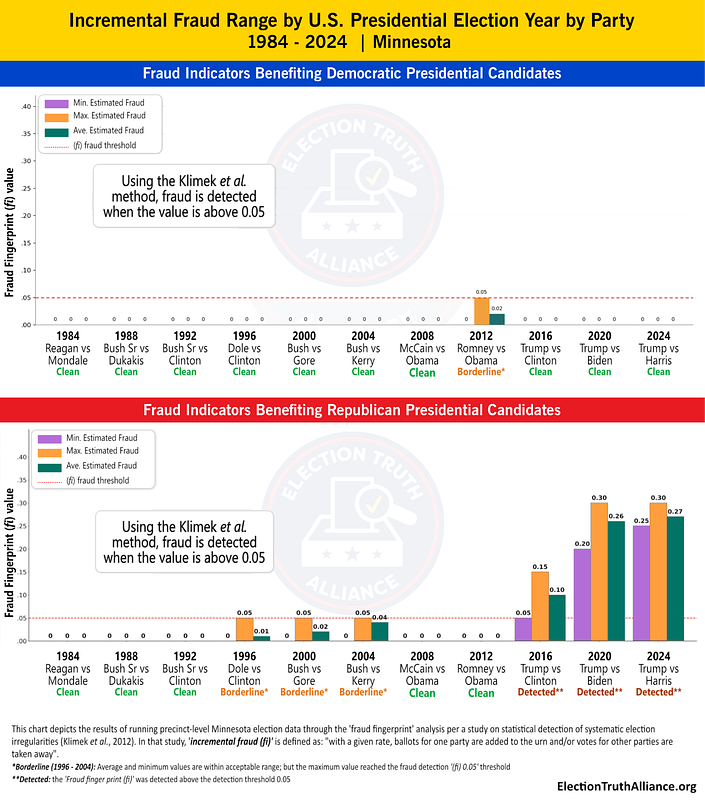
- No fraud indicators detected between 1984 and 2016
- 2016, 2020, and 2024 elections show statistical anomalies benefiting GOP
While statistical anomalies may indicate potential issues, experts caution that such findings alone do not constitute definitive proof of fraud, as legitimate political factors can also produce irregular data patterns.
Report: Minnesota Elections Show Pro-GOP Fraud Indicators
LAS VEGAS, NV – May 21, 2026
A new report from a self-described non-partisan election watchdog group alleges that Minnesota’s presidential elections in 2016, 2020, and 2024 exhibit a sharp increase in statistical indicators of fraud, with a startling conclusion: the irregularities predominantly appear to benefit the Republican Party.
The analysis, released today by the Election Truth Alliance (ETA), applies forensic statistical methods to four decades of the state’s publicly available election data. The findings introduce a contentious new element into the national debate over election security, suggesting potential systemic manipulation in a state long considered a Democratic stronghold.
The Watchdog’s Alarming Findings
According to the ETA, a non-profit founded in late 2024, their analysis of data from the Minnesota Secretary of State reveals patterns in the last three presidential elections that are inconsistent with organic voting behavior. The group utilized the 1984 election as a pre-computerized, 'clean' baseline, which reportedly showed no similar statistical red flags. No election between 1984 and 2016 crossed the group's threshold for 'detected' fraud.
“The analysis indicates that the 2016, 2020, and 2024 Presidential Election data displays patterns inconsistent with organic human voting behavior and shows statistical signs consistent with vote manipulation,” the ETA’s press release stated. The report claims these statistical markers remain even after controlling for various sociodemographic and electoral factors.
The ETA’s report emphasizes the vulnerability of digital voting systems, noting that approximately 70% of American votes are processed by equipment from just two private companies. The group points to a 2019 bipartisan Senate Intelligence Committee conclusion that all 50 states were targeted by Russian cyber actors in 2016 as evidence of systemic risk.
In response to its findings, the organization is calling for a fundamental shift in how election results are verified. The ETA recommends a suite of rigorous post-election processes, including full hand recounts, comprehensive audits of ballot chains of custody, and cyber audits of tabulation software, all administered by non-partisan third parties. The group argues that such measures should be standard practice, not extraordinary interventions.
“Recounts and audits are part of election infrastructure,” said Nathan Taylor, ETA’s Executive Director of Public Engagement, in a statement. “Calling for a recount shouldn't be discouraged because of the perception that doing so is 'questioning the results.' These are levers of democracy that candidates should feel empowered to pull.”
Behind the Numbers: A Controversial Method
The foundation of the ETA's report is a statistical methodology pioneered by researchers like Peter Klimek for detecting election fraud in international contests, particularly in countries like Russia. This forensic technique analyzes vote distributions across thousands of precincts to identify mathematical anomalies that could signal foul play.
Specifically, the method looks for irregularities like unnatural spikes in voter turnout or vote shares for a single candidate that deviate significantly from expected patterns. Such anomalies, referred to as abnormal kurtosis or multimodality, can be tell-tale signs of ballot-box stuffing or the fraudulent reporting of vote totals. The ETA states it used these peer-reviewed techniques to quantify the extent of what it terms “incremental fraud.”
However, independent experts in election forensics urge caution in interpreting such findings. They note that while these statistical tools are valuable for identifying anomalies, an anomaly is not definitive proof of fraud. Legitimate political factors, such as strategic voting patterns in ideologically clustered communities, can sometimes produce data that appears irregular. Distinguishing between authentic voting behavior and deliberate manipulation based on statistics alone remains a significant challenge for researchers.
While academic papers have validated the use of these tools for flagging potential issues, a broad consensus of election officials and many political scientists asserts that claims of widespread fraud in U.S. elections have been consistently unsubstantiated. Previous statistical analyses claiming to prove fraud in the 2020 election were later determined by peer-reviewed studies to be based on flawed interpretations of the data.
Minnesota Officials Emphasize System Security
While the Minnesota Secretary of State’s office has not issued a direct response to the ETA’s newly published report, its long-standing position is that the state’s election system is secure, accurate, and resilient. State election officials have consistently worked to reassure the public by highlighting the multiple layers of security that protect every vote.
Central to Minnesota's system is the use of paper ballots for all voters, which creates a physical, auditable trail for every vote cast. Furthermore, all vote-counting equipment is federally and state-certified and is never connected to the internet or any external network during polling. Before every election, local officials conduct public accuracy tests on the tabulators to ensure they are counting correctly.
Following each general election, counties are required to conduct post-election audits, where bipartisan teams hand-count the ballots from randomly selected precincts and compare the results to the machine totals. This process is designed to verify the accuracy of the tabulation equipment. Officials have repeatedly stated that documented cases of voter fraud are exceedingly rare, and that the state’s verification systems are effective at catching and preventing illegal voting.
A Politically Charged Claim in a Polarized Era
The most explosive element of the ETA’s report is its assertion that the detected anomalies predominantly favor the Republican Party. This finding is particularly striking given that Minnesota has not awarded its electoral votes to a Republican presidential candidate since 1972. The claim directly challenges the post-2020 narrative often associated with Republican figures and injects a new, unpredictable dynamic into the discourse on election integrity.
As a recently formed entity, the Election Truth Alliance and its claims are likely to face intense scrutiny. The organization's assertion of non-partisanship is central to its mission, but in today's highly polarized environment, any group making claims of election malfeasance is subject to questions about its motives and funding. The ETA's collaboration with other watchdog groups that have questioned recent election outcomes may fuel skepticism from its critics.
The release of the report places Minnesota's election officials in a difficult position, forcing them to defend their robust systems against a data-driven challenge that, while not definitive, is designed to sow doubt. The debate now centers on whether these statistical red flags warrant the intensive audits the group recommends, a question that will likely dominate discussions as the 2026 midterm elections approach.