
- $25 billion in investment applications for Thailand's manufacturing sector under Thailand 4.0 initiative.
- THB 200 billion in investment applications for Thailand's PCB industry.
- 90% of goods traded between RCEP members to have tariffs eliminated.
Experts would likely conclude that the China-Thailand machinery matchmaking conference exemplifies how RCEP's trade facilitation measures and Thailand's Industry 4.0 strategy are accelerating regional industrial transformation through targeted B2B collaboration.
RCEP in Action: How China Sourcing Fuels Thailand's Industry 4.0 Push
BANGKOK, TH – June 08, 2026
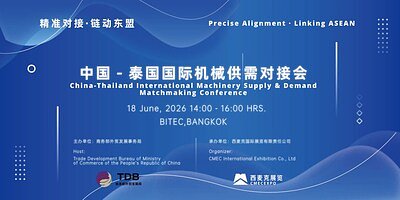
Later this month, a seemingly routine business conference will unfold at the Bangkok International Trade & Exhibition Centre (BITEC). From 14:00 to 16:00 on June 18, the China-Thailand International Machinery Supply & Demand Matchmaking Conference will connect over 70 Chinese machinery manufacturers with Thai industrial buyers. Hosted by China’s Ministry of Commerce and organized by CMEC International Exhibition Co., Ltd, the event runs alongside Manufacturing Expo 2026, Southeast Asia's largest industrial fair. While matchmaking events are common, this one offers a powerful glimpse into the future of regional commerce. It’s a real-world manifestation of how high-level trade policy, national industrial strategy, and curated B2B platforms are converging to reshape Southeast Asia’s manufacturing landscape.
Fueling Thailand's Industrial Renaissance
The conference is not happening in a vacuum. It is tapping directly into what the event's press release calls the "booming procurement demands of Thai enterprises"—a claim strongly substantiated by Thailand's ambitious economic agenda. The nation is in the midst of a massive industrial transformation under its "Thailand 4.0" initiative, a strategic plan to shift the economy from a hub of traditional manufacturing to a center for high-tech, innovation-driven industries.
This ambition is backed by substantial capital. The Thailand Board of Investment (BOI) has been aggressively promoting this shift, recently reporting a historic surge in investment applications, with over $25 billion earmarked for the manufacturing sector alone. This influx of capital is creating urgent demand for the very equipment the Chinese delegation will be showcasing. The conference's five key sectors—Auto & New Energy Parts, Industrial Automation, CNC & Metal Processing, Plastic & Rubber Machinery, and Electronic & PCB Equipment—read like a checklist for Thailand's national priorities.
Consider the electric vehicle (EV) sector. Thailand, already a regional automotive powerhouse, is determined to become a leading EV production base. Government subsidies and tax incentives are fueling a rapid build-out of EV manufacturing capabilities, creating immense demand for vehicle components, semiconductors, and specialized adhesives. Similarly, Thailand is on a trajectory to become one of the world's top five producers of Printed Circuit Boards (PCBs), a critical component in all modern electronics. The BOI has seen over THB 200 billion in investment applications for the PCB industry in recent years, driving a need for advanced electronic and PCB equipment. This aligns perfectly with the offerings at the matchmaking event, providing Thai firms a direct line to source the necessary technology.
Furthermore, an aging workforce and the imperative to boost global competitiveness are accelerating the adoption of automation and robotics across all Thai industries. The government's promotion of Industry 4.0 solutions like IoT and AI-powered production makes the conference's focus on industrial automation and high-precision CNC machining exceptionally timely. This is not just about buying machines; it's about acquiring the technological building blocks for Thailand's next phase of economic growth.
RCEP: From Policy to Practice
The event is being marketed as an "RCEP-powered opportunity," a reference to the Regional Comprehensive Economic Partnership. While such taglines can often be hollow marketing speak, in this case, the impact is tangible and profound. RCEP, which came into effect for Thailand in 2022, is the world's largest free trade agreement, and it fundamentally alters the calculus of regional trade by lowering costs and slashing red tape.
For Thai businesses sourcing machinery from China, the benefits are concrete. The agreement mandates the eventual elimination of tariffs on over 90% of goods traded between members. This directly reduces the sticker price of Chinese machinery, making industrial upgrades more affordable for Thai companies. Beyond tariffs, RCEP introduces streamlined customs procedures, with provisions for expedited clearance that reduce logistical headaches and delivery times—a critical factor when importing large, complex industrial equipment.
Perhaps the most significant innovation is RCEP's common Rules of Origin (ROO). Previously, businesses had to navigate a complex web of rules for each bilateral trade agreement. RCEP creates a single, unified standard. Now, a product qualifies for preferential treatment if just 40% of its value is added within any of the 15 member countries. This flexibility allows Chinese manufacturers to source components from across the region—say, from Vietnam or Malaysia—and still have their final product qualify for tariff benefits when exported to Thailand. As one trade analyst noted, "RCEP is turning the region into a truly integrated market, and this matchmaking event is a perfect example of how the agreement facilitates more resilient and efficient supply chains on the ground."
The Art of the Match: Curating Cross-Border Commerce
Connecting buyers and sellers across borders is fraught with challenges, from language barriers and cultural differences to concerns about supplier reliability and product quality. This is where the specialized B2B matchmaking model demonstrates its strategic value. The event's organizer, CMEC International Exhibition Co., Ltd., is not a newcomer. A subsidiary of the state-owned China National Machinery Industry Corporation (Sinomach), CMEC Exhibition has roots stretching back to the 1950s and holds an ISO9001 certification, lending significant credibility to its operations.
The value proposition for Thai buyers is risk mitigation and efficiency. The press release emphasizes that all 70+ Chinese exhibitors are "carefully selected" and "reliable verified suppliers." This pre-vetting process, likely involving checks on export history, quality certifications, and market reputation, saves Thai procurement managers countless hours of due diligence. The event's core format revolves around pre-matched, one-on-one rotational talks, moving beyond the chaotic and often inefficient environment of a traditional trade show floor.
Moreover, the organizers have anticipated practical trade barriers by providing on-site support, including bilingual interpreters and professional consultants offering free advice on policies and the crucial TISI certification required for many industrial products in Thailand. This comprehensive support system is designed to transform a potentially complex international transaction into a streamlined, accessible process. By offering sustained follow-up services to ensure stable supply chain partnerships post-event, the organizers are aiming to build long-term commercial bridges, not just facilitate one-off deals.
This curated approach, strategically co-located with the massive Manufacturing Expo 2026, creates a powerful nexus of opportunity. Attendees of the broader expo, already primed to invest in new technology, can seamlessly transition into focused, pre-arranged meetings with suppliers whose offerings directly match their needs. This synergy creates a highly efficient marketplace, demonstrating a sophisticated model for international trade that minimizes friction and maximizes results. For the businesses involved, it is a direct and potent way to build the win-win cooperation that regional trade agreements like RCEP were designed to foster.