
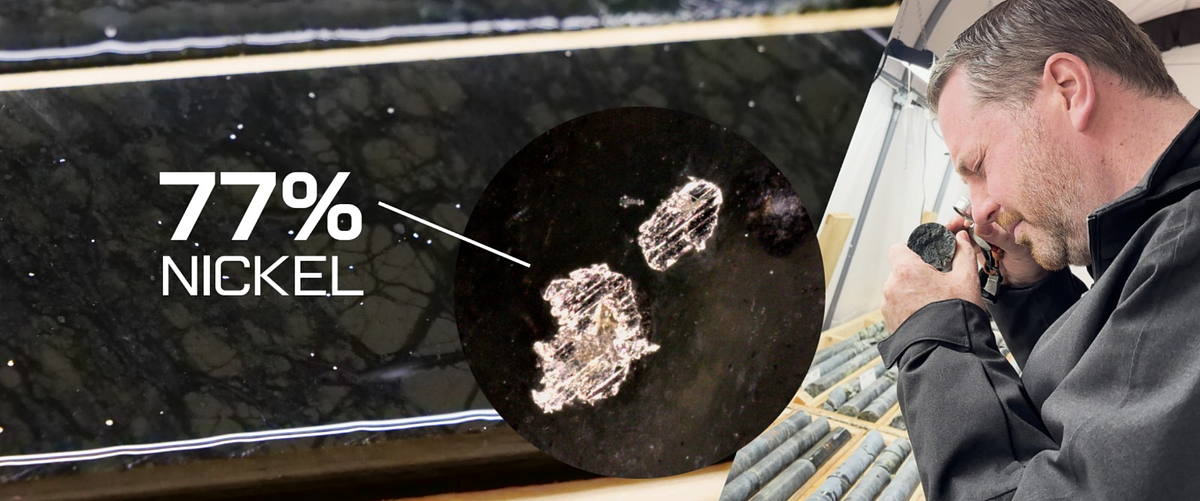
- Nickel content in awaruite: 77.62% average, peaking at 86.68%
- Cobalt content: 1.69% average
- Brucite concentration: 5.49% average, enabling significant CO₂ capture
Experts view this discovery as a game-changer for sustainable nickel production, offering a smelter-free, low-carbon pathway that could redefine North America's critical mineral supply chain.
Rare Alloy Find in Canada Promises Greener, Secure Nickel Source
GRAND FALLS-WINDSOR, Newfoundland and Labrador – May 21, 2026 – A major mineral discovery in central Newfoundland could represent a pivotal shift in how North America sources its critical minerals. First Atlantic Nickel & Cobalt Corp. has announced stunningly high-grade results of a rare, naturally occurring nickel-iron-cobalt alloy called awaruite, a mineral with the unique ability to bypass the costly, carbon-intensive, and increasingly constrained smelting process that has bottlenecked the continent's supply chain for decades.
The findings, detailed in a report released Tuesday, stem from electron microprobe analysis of drill core from the company's Pipestone XL Project. The analysis confirmed that the awaruite mineralization averages 77.62% nickel and 1.69% cobalt, with some samples peaking at an exceptional 86.68% nickel. This discovery is significant not just for its grade, but for its form. Unlike conventional nickel ores that are chemically bonded with sulfur or other elements, awaruite is already a metallic alloy, opening a direct path from mine to market that could fundamentally alter the economics and environmental footprint of nickel production.
A 'Smelter-Free' Revolution for North American Nickel
The core of First Atlantic's announcement lies in awaruite's unique processing advantages. Conventional nickel mining targets two primary ore types: sulfides, which require pyrometallurgical smelting, and laterites, which demand either smelting or High-Pressure Acid Leaching (HPAL). Both pathways are capital-intensive, consume vast amounts of energy, and generate significant environmental byproducts, including sulfur dioxide (SO₂) emissions, a key component of acid rain.
Awaruite sidesteps this entire paradigm. As a highly magnetic, sulfur-free alloy, it can be concentrated using simple and well-established physical separation methods—namely magnetic separation and flotation. This process is more akin to iron ore processing than traditional nickel refining. The result is a high-grade concentrate that can be shipped directly from the mine to stainless steel producers or to specialized refineries for conversion into battery-grade chemicals for the booming electric vehicle (EV) market.
This "smelter-free" pathway directly addresses a critical vulnerability in the Western Hemisphere's industrial base. With the closure of the Riddle, Oregon, smelter in 1998 and Vale's Thompson smelter in Manitoba in 2018, only two primary nickel smelters remain in North America, creating a significant midstream processing bottleneck. The U.S. Geological Survey (USGS) acknowledged awaruite’s strategic potential as far back as 2012, noting it is "much easier to concentrate than pentlandite, the principal sulfide of nickel," and could alleviate prolonged concentrate shortages. First Atlantic's discovery could provide a large-scale, onshore source of nickel and cobalt that is not dependent on this dwindling and foreign-controlled infrastructure.
Beyond Green: A New Standard for Sustainable Mining?
The environmental implications of the Pipestone XL discovery extend far beyond eliminating smelter emissions. The analysis also revealed the presence of two other significant minerals: high-grade chromite and brucite. The near-total absence of sulfur in the system means the project carries virtually no risk of acid mine drainage, a persistent and costly environmental liability for many conventional mines.
Even more compelling is the discovery that the host rock contains an average of 5.49% brucite. This unassuming mineral possesses a remarkable natural ability: it passively captures carbon dioxide from the atmosphere and permanently locks it away in solid, stable carbonate minerals. This process, known as mineral carbonation, is not just theoretical. At BHP’s Mount Keith Nickel mine in Western Australia, tailings containing just 2.5% brucite are reported to capture approximately 40,000 tonnes of CO₂ annually. With more than double that concentration of brucite, the Pipestone XL project has the potential to become a significant carbon sink, potentially offsetting a substantial portion of its own operational emissions and setting a new global benchmark for "green nickel" production.
This combination of a low-energy processing route, zero SO₂ emissions, no acid drainage risk, and inherent carbon capture potential positions the project at the forefront of the industry's push toward Environmental, Social, and Governance (ESG) excellence. As automakers and consumers demand more transparent and sustainable supply chains, a verifiable "green nickel" source from a stable jurisdiction like Canada could command a significant market premium.
Powering a Secure Supply Chain from Newfoundland
The timing of the discovery aligns perfectly with urgent geopolitical efforts to secure domestic supply chains for minerals essential to economic and national security. The U.S. added nickel to its critical minerals list in 2022, and recent reports, including one from the Carnegie Endowment for International Peace, project a staggering U.S. nickel deficit of approximately 742,000 tonnes per year by 2035, driven largely by the EV transition.
First Atlantic's project is ideally positioned to help close this gap. A North American awaruite source could feed directly into U.S. and Canadian refineries, potentially qualifying for lucrative production tax credits under the U.S. Inflation Reduction Act's Section 45X, which incentivizes domestic production of critical minerals. By developing a mine-to-metal pathway within North America, the project helps decouple the continent's advanced manufacturing sector from its reliance on overseas processing, much of which is controlled by geopolitical rivals.
"The microprobe analysis of awaruite (Ni₃Fe) at the RPM Zone, returning metal-in-alloy grades of 77.62% nickel and 1.69% cobalt, confirms what the serpentinization model has been pointing to," commented Mike Piller, the company's Lead Project Geologist. He noted the geological signatures are consistent with what he first studied in the region during his university research over a decade ago. "Finding them now at RPM...speaks to the scale of what we are defining and the potential that remains across the 30-kilometer Pipestone Ophiolite Complex."
This geological scale is now the company's focus. While metallurgical work continues to refine the processing flowsheet for both the nickel-cobalt alloy and the valuable chromite co-product, drills are already turning at two new target areas, the Alloy Max North and Alloy Max South zones, located several kilometers away. The ongoing exploration aims to demonstrate that the high-grade discovery at the RPM Zone is not an isolated occurrence but part of a district-scale mineral system with the potential to anchor a new, secure, and sustainable nickel powerhouse in North America.