
- Global commercial drone market: $30 billion in 2024, projected to exceed $54 billion by 2030
- Public safety drone market: $1.1 billion in 2023, expected to grow to $3.3 billion by 2032
Experts agree that the drone market is experiencing rapid growth, particularly in public safety and critical infrastructure sectors, driven by technological advancements and the need for cost-effective, secure aerial intelligence solutions.
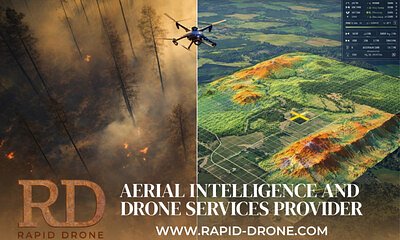
Rapid Drone Launches to Meet Surging Demand for Aerial Intelligence
PHOENIX, AZ – January 05, 2026 – A new player has entered the rapidly expanding aerial intelligence sector, but with a notable distinction: it doesn't build drones. Rapid Drone officially launched today as a specialized services provider, designing and managing mission-ready drone programs for public safety agencies and critical industries. The company's debut comes at a time when the demand for real-time, actionable data from the sky is reaching unprecedented levels.
A Market Primed for Growth
Rapid Drone is positioning itself within one of the tech industry's most dynamic growth sectors. The global commercial drone market, valued at approximately $30 billion in 2024, is on a steep upward trajectory. Projections from multiple market analysis firms, including Grand View Research, indicate the market will exceed $54 billion by 2030. This expansion is fueled by significant technological advancements in autonomous flight, sensor technology, and AI-powered data processing, which are making drones more capable and cost-effective than ever before.
Even more striking is the growth within the company's core focus area: public safety. Industry reports from firms like SNS Insider and Fact.MR project the public safety drone market will more than triple over the next decade, growing from around $1.1 billion in 2023 to over $3.3 billion by 2032. This surge is driven by a clear need among law enforcement and fire departments for faster situational awareness, improved officer safety, and more efficient resource allocation in high-stakes situations. As departments grapple with budget constraints and rising demands, drones offer a powerful force multiplier, providing an aerial perspective that was once the exclusive domain of costly helicopters.
A Service-First Strategy
Rather than competing in the crowded hardware manufacturing space, Rapid Drone is focusing entirely on service delivery. The company's model is to design, operate, and manage end-to-end drone programs, handling everything from flight operations and data capture to analysis and integration into client workflows. This service-centric approach allows the firm to remain agile, selecting the best aircraft for a given mission without being tied to a specific product line.
"Better information changes outcomes. It saves time, avoids costly mistakes, and for first responders, it can save lives," said David Rietz, Chief Drone Officer at Rapid Drone. "We built Rapid Drone to deliver aerial intelligence services that teams can trust in high-stakes environments."
This philosophy is backed by a leadership team with a unique blend of expertise, combining over $2 billion in real estate development experience with more than 15 years of national public-safety foundation leadership and two decades of hands-on UAV engineering. This diverse background provides a deep understanding of both the complex operational needs of their target clients and the technical requirements to meet them.
The 'Blue Certified' Security Advantage
A cornerstone of Rapid Drone's strategy is its exclusive use of 'USA Blue Certified' aircraft. This designation is not a mere marketing label; it refers to drones approved under the Defense Innovation Unit's (DIU) Blue sUAS program. This U.S. Department of Defense initiative was created to provide a roster of secure, vetted, and NDAA-compliant drones for government use. The program addresses widespread concerns about data security and supply chain integrity, particularly regarding components from adversarial nations.
To earn a spot on the Blue sUAS list, a drone platform must undergo rigorous cybersecurity vetting and a thorough supply chain audit to ensure it is free from vulnerabilities and foreign influence. For Rapid Drone's target clients—including law enforcement, federal agencies, and operators of critical infrastructure like power grids and pipelines—this certification is a critical differentiator. It provides assurance that the technology they are deploying is secure and that the sensitive data it collects is protected. By standardizing on these trusted platforms, the company preemptively solves a major procurement and security hurdle for government and high-security private sector organizations.
From Emergency Response to Infrastructure Integrity
The company's initial service offerings are tailored to meet the most pressing needs in its target markets. Headlining its capabilities is DFR (Drones as First Responders), a model where drones are dispatched to provide real-time aerial intelligence during active 911 calls, often arriving before ground units to give commanders a critical early look at the scene.
Beyond emergency services, Rapid Drone is deploying autonomous security patrols for continuous, hands-free monitoring of corporate campuses, industrial facilities, and critical infrastructure sites. Its precision mapping services utilize survey-grade photogrammetry and LiDAR to create highly detailed orthomosaics and 3D models for the architecture, engineering, and construction (AEC) industries. The firm also offers specialized infrastructure inspections using thermal and high-resolution imaging to assess the health of bridges, cell towers, and utility assets, enabling predictive maintenance and reducing risk. Finally, its agricultural intelligence services use multispectral analytics to help farmers optimize irrigation and identify crop stress or disease early.
"First responders and critical industries are being asked to do more with fewer resources, and technology has to rise to meet that moment," said Co-Founder Debbie Steinhauer. "Our focus is on making advanced aerial intelligence operationally realistic, dependable, and accessible for the teams protecting communities and essential infrastructure."
Looking ahead, the company plans to aggressively expand its DFR programs nationwide and scale its remote operations capabilities across its other key sectors. The long-term vision centers on seamlessly integrating drone intelligence into the everyday workflows of its clients, helping them transition from isolated, intermittent drone flights to a model of continuous, data-driven aerial operations.