
- 2 stablecoin pairs launched: USDT-L and USDC-L on the Lightning Network
- 5% of global stablecoin volume: Industry experts predict Lightning Network could capture this by 2028
- 18 months: Speed Wallet's experience operating wrapped stablecoins before RailsX launch
Experts view RailsX as a significant innovation in decentralized finance, enabling secure, self-custodial stablecoin trading on Bitcoin's Lightning Network, though regulatory challenges remain uncertain.
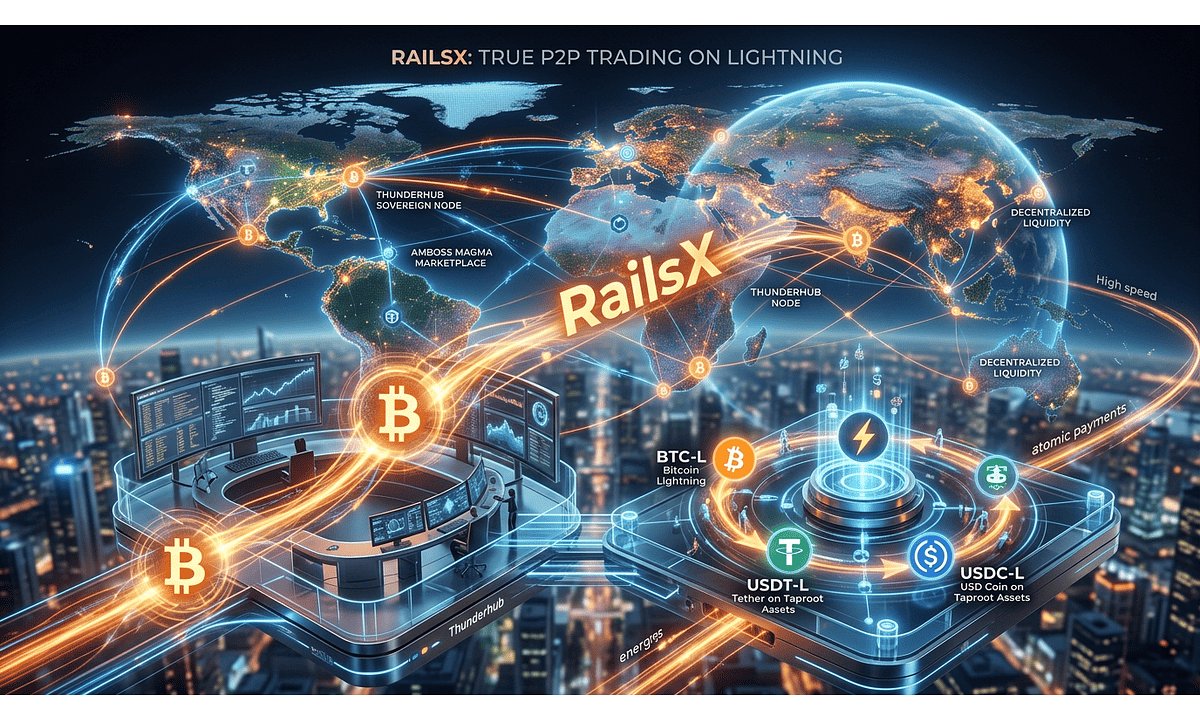
RailsX Launches: Self-Custody Stablecoin Trading on Bitcoin Lightning
LAS VEGAS, NV – April 28, 2026 – Amboss, a key infrastructure provider for the Bitcoin Lightning Network, today launched RailsX, a peer-to-peer exchange that enables users to trade Bitcoin directly against stablecoins without ever surrendering custody of their funds. The platform, built natively on Bitcoin's second-layer payment protocol, promises near-instant settlement and minimal fees, positioning itself as a significant disruptor to the conventional centralized crypto exchange model.
The launch brings two stablecoin pairs to the Lightning Network: USDT-L and USDC-L, both issued and backed by Speed Wallet. By operating on existing payment channels, RailsX facilitates atomic swaps where trades either complete successfully in full or fail without any loss of funds, eliminating counterparty risk and the need for a trusted intermediary. This development marks a pivotal step in evolving the Lightning Network from a simple payment rail into a more comprehensive financial ecosystem.
A New Paradigm for Trading: How RailsX Works
At its core, RailsX represents a fundamental shift in how digital asset trading is conducted. Unlike centralized exchanges that require users to deposit funds into a platform-controlled wallet, RailsX allows users to trade directly from their own Lightning node. This self-custodial approach ensures that users maintain full control of their private keys and, by extension, their money at all times.
The system functions without a centralized order book. Instead, it leverages Amboss's existing liquidity marketplace, Magma, and its automated liquidity service, Rails, to coordinate liquidity across the network. When a user initiates a trade, the system routes the transaction through the network of payment channels, settling in seconds. This process is analogous to how Lightning payments are routed, but applied to the exchange of different assets.
"RailsX lets users trade, hold, and move value on Lightning without ever giving up control of their money," said Jesse Shrader, Co-Founder and CEO of Amboss, in a statement. "We’re unlocking Bitcoin’s potential as a medium of exchange by serving global stablecoin demands without cross-chain DeFi risks."
For early adopters, accessing the platform is streamlined through integration with Thunderhub, a popular open-source node management tool. This allows existing node operators to begin trading with no additional complex setup, lowering the barrier to entry for participating in this new P2P market.
The Stablecoin Catalyst: Powering Lightning's Next Growth Phase
The integration of stablecoins is widely seen as a critical catalyst for the Lightning Network's mainstream adoption. While Bitcoin's price volatility makes it challenging for everyday payments, stablecoins provide a familiar unit of account pegged to fiat currencies like the U.S. dollar. RailsX's debut with USDT-L and USDC-L, issued by Speed Wallet, directly addresses this demand.
Speed Wallet has been operating these "wrapped" stablecoins within its own ecosystem for over 18 months, providing a battle-tested foundation for this public launch. While the trading on RailsX is decentralized, the issuance and backing of the stablecoins remain centralized with Speed Wallet, which ensures all assets are fully collateralized.
"Speed Wallet built this technology with one goal: to make stablecoins on Lightning accessible to everyone," stated Raj Patel, CEO of Speed Wallet. "RailsX is exactly the kind of distribution platform we envisioned, one that opens this up to the entire Lightning Network and takes self-custody stablecoin trading mainstream."
The potential impact is immense. By moving stablecoin transactions onto the Lightning Network, users can bypass the high fees and congestion often found on other blockchains like Ethereum. This makes micropayments and cross-border remittances not just feasible but highly efficient. Some industry experts predict that the Lightning Network could capture at least 5% of the global stablecoin volume, which translates to billions of dollars in daily transactions, by as early as 2028. This influx of activity would not only enhance Bitcoin's utility as a payment network but also increase demand for network liquidity, potentially generating higher routing fees for node operators.
Challenging the Titans: A Decentralized Threat to Centralized Exchanges
The launch of RailsX is a direct challenge to the dominance of centralized crypto exchanges (CEXs), which have long been the primary venue for trading. The history of CEXs is fraught with high-profile hacks, freezes on withdrawals, and catastrophic failures, all stemming from their custodial nature. By eliminating the need for a central custodian, RailsX and similar platforms offer a more secure alternative.
This innovation is part of a broader trend toward decentralized finance (DeFi) on Bitcoin. RailsX enters an emerging competitive landscape that includes other non-custodial swap services like Boltz and Sphinx DEX, as well as upcoming order book-based platforms like LN Exchange and Flashnet. Furthermore, Tether, the issuer of the world's largest stablecoin, is actively working with Lightning Labs to bring native USDT to the network using the Taproot Assets protocol—the same underlying technology that RailsX leverages.
What sets Amboss's offering apart is its integration into a comprehensive liquidity ecosystem. Users can not only trade on RailsX but also use the companion 'Rails' product to provide liquidity to the network and potentially earn a yield. This synergy creates a flywheel effect, where traders provide volume and liquidity providers are incentivized to support that volume, creating a more robust and liquid market over time. This holistic approach could give Amboss a significant advantage in the race to build the financial infrastructure of the future on Bitcoin.
Navigating a Murky Regulatory Landscape
While the technology behind RailsX offers a leap forward in financial sovereignty, it also enters a complex and uncertain regulatory environment. Global regulators, including the Financial Action Task Force (FATF), have expressed concerns about peer-to-peer transactions and so-called "unhosted wallets," citing potential risks for money laundering and terrorist financing.
FATF's guidance suggests that even decentralized platforms may have operators or creators who could be classified as Virtual Asset Service Providers (VASPs), requiring them to comply with Anti-Money Laundering (AML) and Know-Your-Customer (KYC) regulations. In the RailsX model, the most direct regulatory target is likely Speed Wallet, the centralized issuer of the stablecoins, which would almost certainly be considered a VASP.
The regulatory status of the trading platform itself, and even the individual node operators who route the trades, remains a gray area. U.S. regulators like the Financial Crimes Enforcement Network (FinCEN) have previously issued guidance suggesting Lightning node operators could be seen as money transmitters. While RailsX's purely non-custodial design, where Amboss never takes control of user funds, may offer some protection under certain interpretations, it does not exist in a legal vacuum. The platform's reliance on a centralized issuer for its initial assets creates a clear nexus for regulatory oversight, establishing a hybrid model where decentralized trading meets centralized asset issuance. How this structure will be treated by authorities around the world is a question that will ultimately shape the platform's long-term trajectory.