
- High-grade mineral discovery: Up to 31.6% copper, 6.92 g/t gold, and 1.77% rare earth elements (REEs) in 2025 samples.
- Exploration plans: 15-line kilometre Induced Polarization (IP) survey scheduled for August 2026.
- Strategic budget: $1 million allocated for 2026 exploration in the Labrador Trough.
Experts view this discovery as highly promising, with the potential to unlock a major new source of critical metals, though further exploration and drilling are needed to confirm its scale and economic viability.
Quebec's North Heats Up: High-Grade Discovery Sparks Major Survey
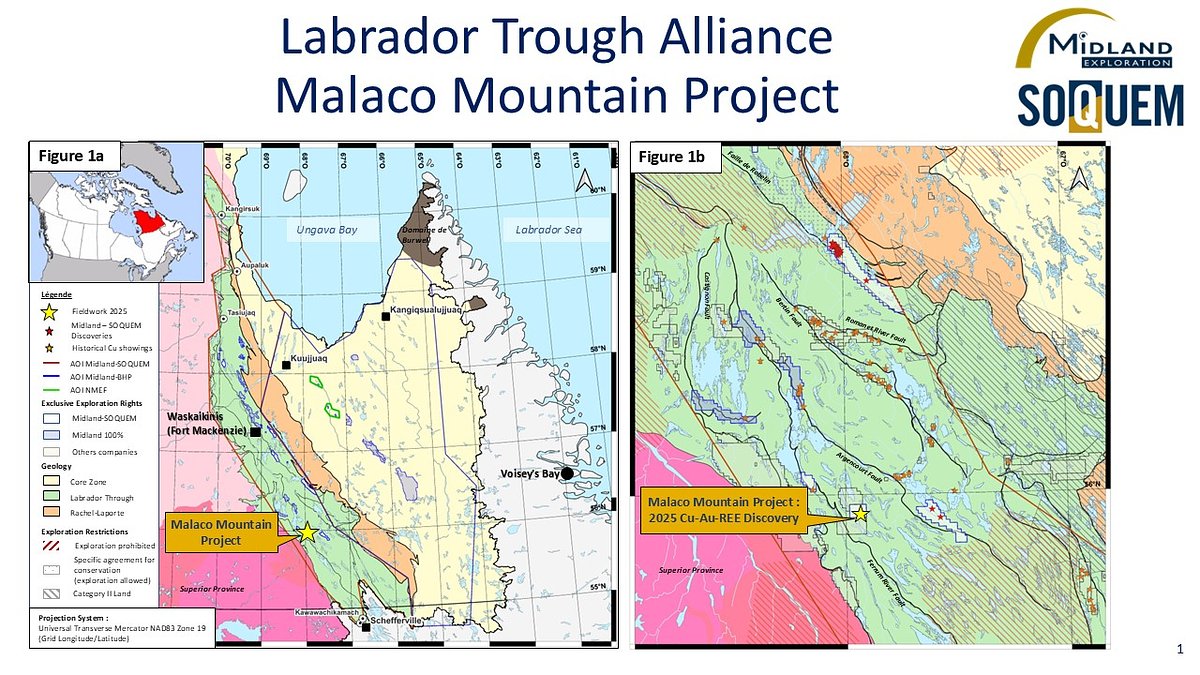
MONTREAL, QC – April 01, 2026 – A spectacular mineral discovery in the remote expanse of Quebec’s Labrador Trough has prompted a significant new exploration campaign, signaling what could be the early stages of unlocking a major new source of critical and precious metals. Midland Exploration Inc., in a strategic partnership with the government-backed SOQUEM Inc., has announced plans for an intensive geophysical survey this summer, following up on 2025 results that included remarkable grades of up to 31.6% copper, 6.92 g/t gold, and 1.77% rare earth elements (REEs).
The partners are now preparing to launch a 15-line kilometre Induced Polarization (IP) survey over the Malaco Mountain project. This advanced exploration technique is designed to peer beneath the earth's surface and map the geological structures that could host a much larger deposit than what has been seen on the surface, potentially turning a tantalizing discovery into a defined, drill-ready target.
Unearthing a Bonanza-Grade Find
The excitement surrounding Malaco Mountain stems from a reconnaissance program in June 2025 that yielded unexpectedly rich results. Initial grab samples from a single mineralized outcrop returned bonanza-grade values for copper and high-grade gold. This discovery prompted a more detailed follow-up, where geologists completed two sampling transects across the mineralized sedimentary unit.
Of the 25 samples collected along these lines, an impressive eighteen returned copper grades above 0.1%, with ten of those exceeding 1% copper. The findings also confirmed the presence of valuable by-products, including silver grades up to 32.4 g/t and significant concentrations of the rare earth elements lanthanum (La) and cerium (Ce), which collectively graded as high as 1.77%.
Geologically, the mineralization is compelling. It appears in two forms: as layers of disseminated chalcopyrite, malachite, and other copper-bearing minerals running parallel to the bedding of a host mudstone, and as massive, discordant veins that cut across the rock layers, often associated with fractures and breccia zones. This dual style of mineralization suggests a robust and dynamic geological system, which is often a key ingredient for large-scale deposits. While the companies prudently caution that selective grab samples may not be representative of the entire mineralized zone, the consistency and high grades across multiple samples have provided a powerful incentive for this aggressive next phase of exploration.
Zeroing In with Advanced Geophysics
To effectively map the potential scale of the discovery, Midland and SOQUEM are turning to an Induced Polarization survey. This geophysical method works by sending an electrical current into the ground and measuring how the subsurface materials “hold” the charge. Metallic sulfide minerals, such as the chalcopyrite that hosts the copper and gold at Malaco Mountain, are highly chargeable. This property allows the IP survey to detect zones of potential mineralization that are hidden beneath soil and rock cover.
Petrophysical testing on samples from the discovery outcrop confirmed a strong electrical contrast between the mineralized rock and the surrounding host rock, validating the choice of IP as the ideal tool for the job. The planned 15-line kilometre survey, slated for August 2026, will cover not only the known mineralized outcrop but also the broader sedimentary mudstone unit and a key regional fold axis—geological features considered highly prospective for concentrating mineralization.
The goal is to create a 3D model of the subsurface chargeability, effectively generating a treasure map that will guide future prospecting and, most importantly, pinpoint the highest-priority targets for a subsequent drilling campaign. While the technique is powerful, geologists will need to carefully interpret the data, as other non-economic minerals like pyrite, which can be common in mudstones, can also produce a strong IP response. By combining the geophysical data with geological and geochemical information, the team aims to build a comprehensive model to vector in on the most promising zones.
The Strategic Imperative: Copper and Rare Earths
The timing and nature of the Malaco Mountain discovery place it directly at the center of powerful global economic and geopolitical trends. Copper, once viewed as a simple industrial metal, is now widely considered a strategic resource critical for the global energy transition. With demand projected to grow by over 40% by 2040, driven by electric vehicles, renewable energy infrastructure, and the massive power requirements of AI data centers, the world is facing a structural supply deficit. Forecasts for 2026 alone suggest a potential shortfall of 500,000 tonnes, putting immense pressure on prices and supply chains.
Even more critical is the discovery’s rare earth element component. REEs are indispensable for high-performance magnets used in EV motors and wind turbines, as well as in advanced defense and electronics applications. The global supply chain for these elements is precariously concentrated, with China controlling over 85% of the world's refining capacity. Recent export controls imposed by China have highlighted the vulnerability of Western nations and sparked an urgent, government-supported push to develop secure, domestic, or allied sources of supply. A significant discovery in a stable jurisdiction like Quebec could therefore have implications that extend far beyond the balance sheet of a single exploration company, contributing to North American mineral security.
A Partnership Forged in the North
Advancing exploration in a remote and challenging region like the Labrador Trough requires significant capital, expertise, and a long-term vision. The Malaco Mountain project is a prime example of how strategic partnerships can de-risk and accelerate this process. The project is being advanced under a strategic alliance formed between Midland Exploration, a nimble project generator with a track record of identifying promising targets, and SOQUEM, a subsidiary of Investissement Québec with a mandate to explore and develop the province's mineral wealth.
This public-private partnership, first established in 2021, allows the two entities to pool their financial resources and technical expertise. For 2026, the partners have committed to a joint $1 million exploration budget for the Labrador Trough, to be shared between the Malaco Mountain and Nachicapau projects. This alliance has already yielded promising results at the nearby Nachicapau project, where sampling has returned high-grade copper, gold, and silver. The collaborative model enables a more sustained and systematic approach to exploration in a vast, underexplored territory that holds immense potential.
The work at Malaco Mountain is not just an isolated effort but part of a broader, multi-year strategy to unlock the mineral wealth of this northern frontier. As the exploration team prepares for the summer survey, the results will be closely watched by the industry and policymakers alike, all keen to see if this high-grade surface showing is the tip of a much larger iceberg.