
- Quantum Key Distribution (QKD) has matured into a viable technology for secure communications, marking the first step toward a global quantum internet. - Purdue University successfully demonstrated a quantum local area network (QLAN), distributing photonic entanglement across multiple labs, a critical milestone for larger systems. - Agentic AI is advancing from simple error correction to autonomous generation of entire RTL designs, automating laborious chip design tasks.
Experts agree that the convergence of quantum networking, agentic AI, and advanced space electronics represents a paradigm shift in computing, communication, and exploration, with significant technological challenges still ahead.
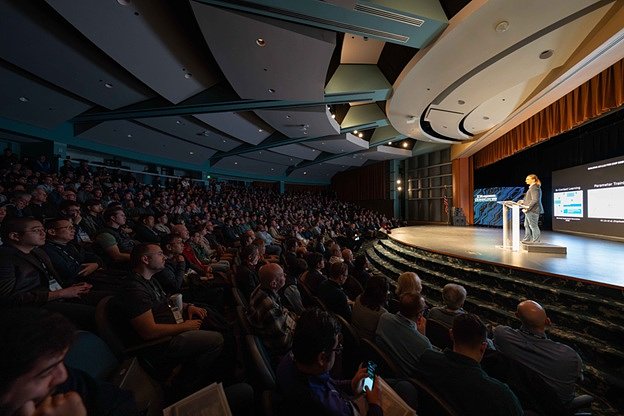
Quantum AI, and Space Tech: DesignCon 2026 Keynotes Chart the Future
SANTA CLARA, CA – February 17, 2026 – The future of high-speed electronics is being forged at the intersection of quantum physics, artificial intelligence, and deep space exploration. DesignCon, Silicon Valley's premier conference for chip, board, and systems engineers, has unveiled a powerful keynote lineup for its 2026 event that underscores this convergence. Featuring top minds from Purdue University, AI innovator Agentrys, and NASA's Goddard Space Flight Center, the program promises a deep dive into the technologies poised to redefine computing, communication, and discovery.
The annual gathering, organized by Manufacturing by Informa, has long been a critical forum for the semiconductor and high-speed communications communities. This year's slate moves beyond incremental advances to spotlight paradigm-shifting innovations, from the architecture of a future quantum internet to AI agents that autonomously design complex microchips.
Weaving the Quantum Information Superhighway
Kicking off the event, Joseph Lukens, an Associate Professor at Purdue University, will address the evolution of quantum networking in his keynote, "From Spooky Action at a Distance to the Quantum Internet." Lukens, who joined Purdue in 2025 after a distinguished tenure at Oak Ridge National Laboratory (ORNL), is a leading figure in photonic quantum systems. His work focuses on building practical quantum networks compatible with existing fiber-optic infrastructure.
The presentation will trace the journey from foundational quantum theory to the first commercial application, Quantum Key Distribution (QKD). While QKD has matured into a viable technology for secure communications, Lukens will argue it is merely the first step. The true revolution lies in the global proliferation of entanglement-based testbeds, which enable far more advanced applications. Purdue itself is a hub for this research, having successfully demonstrated a quantum local area network (QLAN) that distributes photonic entanglement across multiple labs, a critical milestone toward building larger, more capable systems.
The ultimate vision is a "quantum information superhighway"—an interconnected network that leverages the principles of quantum mechanics to measure, process, and transmit information in ways impossible for the classical internet. This network could enable distributed quantum computing, where the power of many smaller quantum processors is linked, and create ultra-precise sensor networks. Lukens is expected to outline both the technological triumphs achieved to date and the significant challenges that remain, including overcoming photon loss in optical fibers and developing the complex hardware needed for seamless quantum routing.
Agentic AI: The New Workforce in Chip Design
On the second day, the focus will shift from quantum bits to intelligent agents. Mark Ren, Founder of Agentrys and head of Design Automation research at NVIDIA, will explore the transformative potential of "Agentic Artificial Intelligence for Chip Design." While AI has been a buzzword in Electronic Design Automation (EDA) for years, with tools like Synopsys's DSO.ai optimizing chip layouts since 2018, Ren's topic signals a major leap forward.
Agentic AI moves beyond optimization to autonomy. Ren will detail the evolution from simple AI agents that can fix syntax errors in Register-Transfer-Level (RTL) code to sophisticated multi-agent systems capable of generating entire RTL designs directly from a set of high-level specifications. This represents a fundamental shift in the role of the human engineer, automating laborious and time-consuming tasks to free up designers for higher-order architectural and system-level thinking. The industry is rapidly moving in this direction, with major players like Cadence recently launching their own "AI Super Agent" platforms.
Ren brings a unique perspective, combining his deep expertise in AI for EDA from his leadership role at NVIDIA with his work at Agentrys, a company building the foundational communication protocols for an "Agentic Internet." His keynote will likely connect the specialized application of AI in chip design to the broader infrastructure needed for intelligent agents to communicate and collaborate securely and reliably, whether they are designing a next-generation GPU or managing a complex supply chain.
Powering the Next Frontier of Exploration
Closing the keynote series, Dr. Bhanu Sood, Chief Technologist at NASA Goddard Space Flight Center, will provide an in-depth look at how advanced electronics are fundamental to the space agency's ambitious science and exploration missions. His presentation, "Technology Innovations Driving NASA's Science and Exploration Goals," will highlight the immense design challenges posed by the harsh environment of space and the cutting-edge solutions being developed to overcome them.
As the manager of NASA Goddard's Internal Research and Development (IRAD) program, Dr. Sood oversees strategic investments in technologies critical for future missions to the Moon, Mars, and beyond. These include high-performance onboard computing for autonomous navigation, miniaturized sensor systems for planetary science aboard compact CubeSats, and radiation-hardened components designed to withstand the brutal solar and cosmic radiation outside Earth's protective magnetosphere. Dr. Sood is expected to discuss emerging trends such as AI-enabled electronics for real-time data analysis, modular architectures for sustainable lunar operations, and advanced photonic systems for high-bandwidth space communication.
These innovations are not confined to space. The extreme requirements for reliability, power efficiency, and performance in NASA's missions often serve as a powerful catalyst for the entire electronics industry, pushing the boundaries of what is possible and ultimately driving advancements that find their way into commercial and consumer technologies.
"DesignCon has always been a hub for innovation, and this year’s keynote lineup is a testament to the incredible advancements shaping the future of engineering and technology," said Suzanne Deffree, VP and Group Portfolio Lead at Manufacturing by Informa. The curated selection of speakers from academia, private industry, and government science reinforces the event's position as a critical nexus for collaboration, ensuring that the engineers in attendance are not just witnessing the future, but are being equipped to build it.
Topics & Related
Generative AI
Machine Learning
Software & SaaS
AI & Machine Learning
ChatGPT
Industry Conference
Related Company Pulse