
- 500+ companies across 20+ countries use Autoware, the leading open-source autonomous driving software.
- Quadric's Chimera™ AI processor delivers up to 840 TOPS (Tera Operations Per Second) for AI workloads.
- The partnership aims to reduce latency and improve power efficiency in autonomous vehicle systems.
Experts view this collaboration as a strategic advancement in autonomous driving technology, combining specialized AI hardware with open-source software to enhance performance, safety, and mainstream adoption.
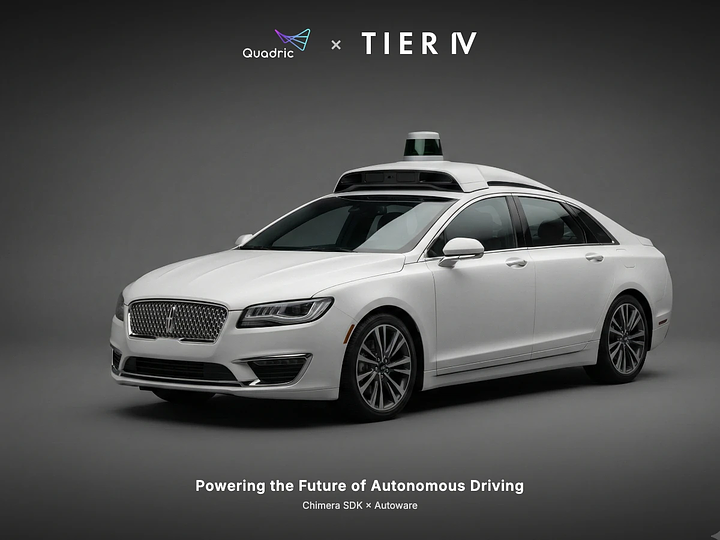
Quadric & TIER IV Partner to Boost Open-Source Self-Driving AI
BURLINGAME, Calif. – January 14, 2026 – In a significant move to accelerate the future of self-driving vehicles, TIER IV, Inc., the Japanese pioneer behind the world's leading open-source autonomous driving software, Autoware, has licensed technology from the AI processor firm Quadric. TIER IV will utilize Quadric's Chimera™ AI processor Software Development Kit (SDK) to evaluate and optimize the AI processing capabilities of its Autoware platform, aiming to enhance performance for next-generation autonomous vehicles.
The partnership brings together TIER IV's open-source software expertise with Quadric's specialized hardware acceleration, a collaboration that could address critical performance bottlenecks and pave the way for safer, more efficient autonomous systems.
"We are thankful that TIER IV has chosen Quadric technology as a development tool for automotive network optimization," noted Veerbhan Kheterpal, CEO of Quadric, in the official announcement.
The Challenge of Open-Source Autonomy
Autoware stands as a cornerstone of the autonomous driving (AD) community. As the first and most widely adopted open-source software for AD, it powers development for over 500 companies across more than 20 countries. It provides a comprehensive stack—from sensor data processing and perception to localization, planning, and vehicle control. However, the very complexity that makes it so powerful also presents significant computational challenges.
Modern autonomous systems are inundated with data from a suite of sensors, including LiDAR, cameras, and radar. Processing this data in real-time, particularly for the AI-driven perception modules that identify objects, predict behavior, and build a model of the world, is immensely resource-intensive. Industry insiders note that even high-end general-purpose CPUs and GPUs can struggle to run the full Autoware stack without encountering performance bottlenecks and latency issues.
Specific pain points within the Autoware ecosystem include the heavy computational load of LiDAR point cloud processing. Filtering environmental noise like rain or fog while accurately identifying distant or sparse objects is a constant challenge. Furthermore, the machine learning models used for object detection are often limited to the data they were trained on, making the real-time identification and safe navigation around unexpected, "unknown" objects a critical hurdle for deployment on public roads. These intensive AI workloads, when competing for resources, can impact the entire system's ability to make split-second, safety-critical decisions.
A Specialized Hardware Solution
This is where Quadric's technology enters the picture. The Burlingame-based company specializes in licensable, fully programmable AI acceleration intellectual property (IP). Its flagship Chimera™ architecture is not a standard processor; it's a General-Purpose Neural Processing Unit (GPNPU) designed from the ground up to tackle the unique demands of on-device AI.
The Chimera GPNPU is engineered to run both complex AI inference models and traditional Digital Signal Processing (DSP) and control algorithms. This dual capability is a key advantage in the automotive world, where AI-based perception must work in seamless harmony with classic vehicle control systems. Capable of delivering up to 840 TOPS (Tera Operations Per Second), the architecture provides the raw processing power needed to handle the massive data throughput of an autonomous vehicle's sensor suite.
By licensing Quadric's SDK, TIER IV gains the tools to evaluate how offloading these demanding AI tasks to a dedicated, highly optimized processor can transform Autoware's performance. The goal is to reduce latency, increase power efficiency, and free up the vehicle's main computer for other critical functions. Crucially, Quadric also offers automotive-grade, safety-enhanced versions of its IP, a non-negotiable requirement for components intended for production vehicles operating under stringent functional safety standards like ISO 26262.
A Strategic Play in a Competitive Market
The collaboration between Quadric and TIER IV is more than just a technical integration; it represents a strategic maneuver in the fiercely competitive autonomous vehicle landscape. The industry is rapidly moving away from siloed development and toward a model of hardware-software co-design, where software capabilities and hardware architecture are developed in tandem for maximum efficiency.
This partnership exemplifies that trend, directly linking a leading open-source software platform with a cutting-edge hardware innovator. For Quadric, it's a powerful validation of its technology in a high-stakes market dominated by giants like NVIDIA and Intel's Mobileye. By offering its GPNPU as licensable IP, Quadric provides automotive manufacturers and Tier 1 suppliers with the flexibility to integrate powerful AI acceleration into their own custom System-on-Chips (SoCs), a compelling alternative to off-the-shelf solutions.
For TIER IV, this move is a continuation of its "Autoware Accelerators" strategy, which involves partnering with hardware specialists to create optimized, high-performance platforms for its software. By strengthening Autoware with specialized hardware support, TIER IV enhances its competitive edge against proprietary, closed-source AD stacks. This makes the open-source platform a more viable and attractive option for commercial deployment, fostering the growth of the entire Autoware ecosystem.
Paving the Road to Mainstream Adoption
Ultimately, the impact of this partnership extends beyond corporate strategy and technical specifications. By enhancing the core processing capabilities of autonomous systems, the collaboration aims to address the fundamental challenges of safety and reliability that are paramount for public trust and mainstream adoption.
More efficient AI processing translates directly into more robust and reliable vehicle behavior. A system that can process sensor data faster and with lower latency can make quicker, more informed decisions, whether it's identifying a pedestrian partially obscured by another vehicle or reacting to an unexpected object on the highway. Optimizing the performance of Autoware's perception and planning modules could lead to smoother, more human-like driving and better handling of complex "corner cases" that have long challenged autonomous systems.
This fusion of specialized hardware and open-source software represents a critical step forward. It works to democratize access to high-performance autonomous driving technology, enabling a wider range of companies to build upon a safer and more capable foundation. As TIER IV begins its evaluation and optimization work with Quadric's Chimera SDK, the automotive world will be watching closely. The success of this partnership could mark a pivotal moment in the journey toward a future where intelligent, autonomous vehicles are not just a technological marvel, but a safe, accessible, and everyday reality.