
- 150MWh: Pylontech's energy storage deployment in Vietnam, a landmark project accelerating the country's energy transition.
- 25-30% annual growth: Vietnam's energy storage market projected to expand at this rate over the next five years.
- 4 GW by 2030: Forecasted installed capacity of energy storage in Vietnam, with a market value exceeding USD 5 billion.
Experts view this deal as a critical step in stabilizing Vietnam's grid and integrating renewable energy, with the new tariff structure and strategic partnership setting a precedent for Southeast Asia's energy storage market.
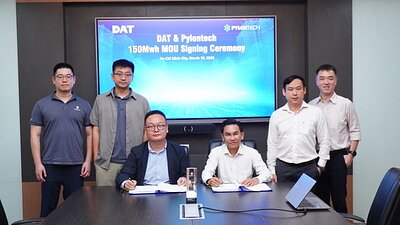
Pylontech's 150MWh Vietnam Deal Ignites SE Asia Energy Storage Market
HO CHI MINH CITY, Vietnam – March 18, 2026 – Global energy storage giant Pylontech has signed a landmark Memorandum of Understanding (MoU) with Vietnamese industrial solutions leader DAT Group Joint Stock Company, committing to a 150MWh energy storage deployment. The agreement signals a significant acceleration of Vietnam's energy transition and solidifies Pylontech's strategic expansion into the burgeoning Southeast Asian market.
This collaboration is more than a simple business deal; it represents a critical step in addressing Vietnam's urgent need for grid stability as it rapidly integrates renewable energy sources. The 150MWh project will leverage Pylontech's world-class battery technology and DAT Group's deep local expertise to build a more resilient and sustainable power infrastructure for the nation.
A Market Poised for Explosive Growth
Vietnam has rapidly emerged as one of the most dynamic and promising energy storage markets in Southeast Asia. Driven by a combination of ambitious green energy goals, soaring electricity demand, and proactive government policy, the sector is on a trajectory for massive expansion. According to market analysis from BloombergNEF, the country's energy storage market is projected to sustain an annual growth rate between 25% and 30% over the next five years.
This explosive growth is forecast to culminate in an installed capacity of approximately 4 GW by 2030, translating to a total market value expected to exceed USD 5 billion. The primary drivers are twofold. First, Vietnam's rapid economic development and industrialization have led to a sharp increase in electricity consumption, placing immense pressure on the existing grid. Second, the nation's aggressive push into solar and wind power, while crucial for its climate goals, has introduced the challenge of intermittency. The country's Power Development Plan VIII (PDP8) explicitly targets between 10,000 MW and 16,300 MW of battery storage capacity by 2030 to manage this variable output.
Without adequate storage, grid operators are often forced to curtail renewable energy generation, wasting clean power and undermining the economic viability of solar and wind farms. Large-scale battery energy storage systems (BESS) are the key to solving this puzzle, allowing the grid to absorb excess power during sunny or windy periods and discharge it during peak demand or when generation lulls.
The Policy Catalyst: A Groundbreaking Tariff Structure
Underpinning the confidence of investors like Pylontech is a pivotal regulatory development. The implementation of Circular No. 62/2025/TT-BCT on January 26, 2026, introduced a formal two-part tariff mechanism for battery energy storage systems, a first for a major ASEAN economy. This policy is widely seen as a game-changer for the bankability of energy storage projects in Vietnam.
Historically, a key barrier to BESS investment in the region was the lack of a clear revenue model that properly valued the multiple services batteries provide. The new Vietnamese framework addresses this directly by creating a dual-revenue stream. BESS operators will now be compensated not only for the actual energy they deliver to the grid (an energy charge) but also for their availability to provide grid support (a capacity charge).
This capacity charge provides a predictable, stable income that helps project developers recover high upfront capital costs, significantly de-risking investments and attracting private capital. The policy applies to BESS installations connected at 110 kV or higher with an installed capacity of 10 MW or more, directly targeting utility-scale projects like the one planned by Pylontech and DAT Group. This forward-thinking regulation is expected to not only accelerate BESS adoption across Vietnam but also serve as an influential blueprint for neighboring countries grappling with similar energy transition challenges.
The Power of a Strategic Partnership
The success of deploying sophisticated energy infrastructure hinges on the powerful synergy between global technological leadership and deep local market understanding. The Pylontech-DAT Group alliance is a prime example of this model in action. Pylontech, founded in 2009, brings a wealth of experience as a vertically integrated provider, controlling everything from battery cell research and development to complete system integration. With solutions deployed in over 90 countries, its technology has been proven across residential, commercial, and utility-scale applications.
Complementing this global expertise is DAT Group, a respected Vietnamese company with nearly two decades of experience in industrial automation and sustainable energy. DAT Group is not a newcomer to Pylontech's ecosystem; it is already an authorized dealer for the company's lithium battery products in Vietnam. This existing relationship ensures technical familiarity and a shared vision for quality and performance. DAT Group's extensive network and understanding of the local regulatory landscape, customer needs, and logistical challenges are invaluable assets that will facilitate a smoother and more effective deployment.
This partnership allows Pylontech to execute its regional strategy of adapting its products for Southeast Asia's unique conditions, translating its global track record into competitive, scenario-ready solutions. The company has already established regional service centers in Vietnam and the Philippines to ensure timely and efficient local support, further demonstrating its long-term commitment to the market.
Stabilizing the Grid for a Sustainable Future
The deployment of a 150MWh BESS will have tangible and far-reaching benefits for Vietnam's energy system and environmental goals. On a technical level, the system will play a crucial role in enhancing grid stability by providing ancillary services like frequency regulation and voltage support. It can absorb sudden spikes in generation or dips in demand, acting as a shock absorber for the national power system and reducing the risk of blackouts.
Environmentally, the project is a direct contribution to Vietnam's ambitious Net Zero 2050 target. By enabling the grid to integrate a higher percentage of renewable energy, the BESS directly displaces the need for fossil fuel-fired peaker plants, which are traditionally used to meet high demand. This leads to a significant reduction in greenhouse gas emissions and a cleaner energy mix for the country.
"We are pleased to deepen our collaboration with DAT Group and further expand our presence in Vietnam," said a spokesperson from Pylontech. "Moving forward, we will continue to leverage our global experience and localized capabilities to support the development of a more resilient and sustainable energy system across the Southeast Asia region."