
- 611,000 petajoules of stored thermal energy in the Millungera Basin, equivalent to 170 million gigawatt-hours
- Potential to power Australia 600 times over
- 90% probability of the basin's massive geothermal resource
Experts view the Millungera Basin as a transformative geothermal resource with the potential to become a cornerstone of Australia's clean energy future, provided the pulsed power drilling technology proves commercially viable.
Pulsed Power Tech Aims to Unlock Australia's Geothermal Giant
NEW YORK, NY – March 23, 2026 – A strategic partnership is set to deploy a novel drilling technology in the Australian outback, aiming to unlock a geothermal energy resource so vast it could theoretically power the continent 600 times over. I-Pulse, an American technology firm, has announced it will lead a joint venture to develop the Millungera Basin in northwest Queensland, using a proprietary “pulsed power” system designed to slash the cost of reaching the Earth’s deep heat.
The collaboration brings together I-Pulse with Sunrise Energy Metals and Greenvale Mining to tackle one of the biggest obstacles holding back geothermal energy: the immense expense and difficulty of drilling through kilometers of hard, crystalline rock. By succeeding where previous efforts have stalled, the venture hopes to establish a new frontier for clean, continuous, baseload power, providing a critical complement to Australia's abundant but intermittent solar and wind resources.
“The Millungera Basin represents an extraordinary endowment of geothermal energy,” said I-Pulse Co-Founder, Chairman, and CEO Robert Friedland. “At I-Pulse, we believe geothermal has the potential to become one of the most important sources of clean, perpetual baseload energy on Earth.”
The Millungera Prize
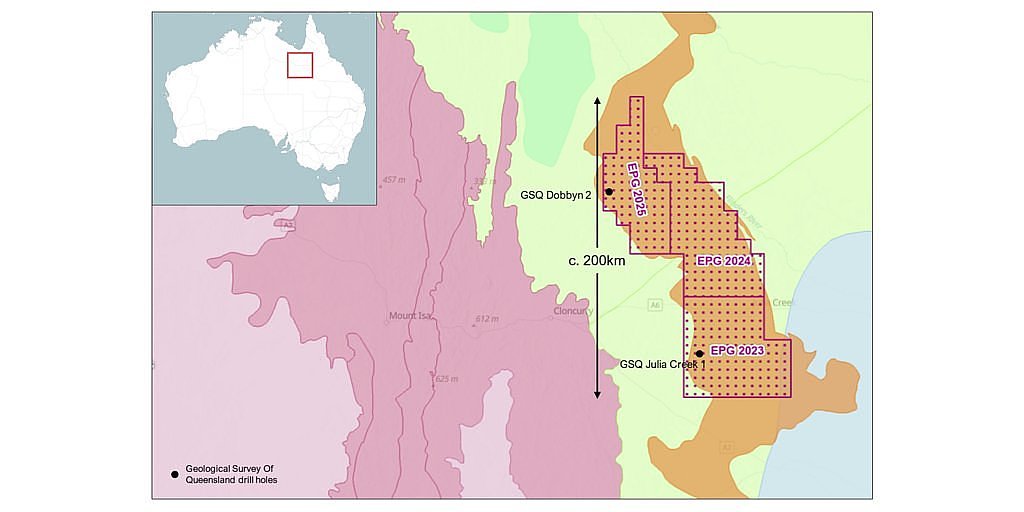
Stretching over 300 kilometers long and up to 50 kilometers wide, the Millungera Basin is a geological giant. Located about 200 kilometers east of Mount Isa, it lies within the Central Australia Heat-Flow Province, a region known for its elevated geothermal activity. While the basin itself has been known to geologists, its true potential has only recently been quantified.
An independent analysis by Ascendience Geoscience, commissioned by project partner Greenvale Mining, confirmed the basin’s staggering scale. The report identified a 90% probability of more than 611,000 petajoules of stored thermal energy. This colossal figure is equivalent to approximately 170 million gigawatt-hours, dwarfing Australia’s current annual electrical consumption.
The source of this immense heat is believed to be large granitic bodies buried deep beneath the basin. These formations, similar to the uranium- and thorium-rich Williams Supersuite, are thought to act as natural radiogenic heat engines, consistently warming the overlying rock to temperatures suitable for power generation. “Early-stage mapping and drilling on two areas of the Millungera Basin by the Geological Survey of Queensland has identified it as one the largest and most prospective geothermal basins on the Australian continent,” noted Sunrise Managing Director Sam Riggall.
A Technological Breakthrough
Accessing this deep heat has always been the primary challenge. Conventional drilling technologies struggle in the extremely hard granitic rock, leading to slow progress, rapid equipment wear, and prohibitively high costs. This is the problem I-Pulse’s subsidiary, G-Pulse, was created to solve.
The company’s core technology harnesses high pulsed power—the ability to compress electrical energy and release it in incredibly short, powerful bursts. In practical terms, the system can draw a small amount of energy, even from a source as modest as a mobile phone battery, and convert it into a discharge with power comparable to a nuclear power plant, delivered in a fraction of a second. When applied to drilling, this electrical pulse generates intense shockwaves that fracture and soften the hard rock just ahead of the mechanical drill bit. This pre-weakening of the rock is designed to dramatically accelerate drilling speeds while extending the life of the equipment, potentially reducing overall drilling costs by a factor of three or more.
“Through our G-Pulse technology, we are developing a fundamentally new way to drill into deep hot rock formations, dramatically lowering the cost and time required to access geothermal energy,” explained I-Pulse Co-Founder and Head of Technology Laurent Frescaline. “Our vision is to unlock vast geothermal resources around the world and deliver clean, perpetual energy for the planet.”
A High-Stakes Venture
The partnership is structured to leverage each company's strengths. Under an earn-in agreement, I-Pulse will assume operational control and provide the funding to advance the project. This capital-light structure allows Sunrise Energy Metals to remain a free-carried minority holder, maintaining its stake without further financial outlay during the initial phases. Greenvale Mining, an early permit holder in the region, also continues as a key partner.
Upon completion of the earn-in period, a formal joint venture will be established, with I-Pulse holding a controlling 65% interest, Greenvale 20%, and Sunrise 15%. This arrangement positions I-Pulse, a private company co-founded by mining magnate Robert Friedland, to become a major player in Australia’s next generation of large-scale, low-emissions power development.
The Global Race for Deep Heat
The Millungera project does not exist in a vacuum. It is part of a global technological race to solve the deep-drilling puzzle and unlock geothermal energy on a massive scale. Several innovative companies are pursuing different paths to the same goal.
US-based Quaise Energy is developing a hybrid system that uses conventional drilling to reach basement rock before switching to high-power millimeter waves to vaporize its way to unprecedented depths. Fervo Energy, another American firm, is adapting horizontal drilling and hydraulic fracturing techniques from the oil and gas industry to create more efficient underground reservoirs. Meanwhile, Canadian company Eavor is pioneering a closed-loop system that circulates fluid through a network of underground tunnels, acting like a giant subsurface radiator without the need for fracking or fluid injection into open rock formations.
Other concepts being explored in research labs and startups globally include plasma torches and high-powered lasers to melt or weaken rock. This competitive landscape underscores the critical importance of cost-effective drilling. The first technology to prove itself commercially viable and scalable could transform the world's energy map.
Australia's Geothermal Crossroads
For Australia, the success of projects like Millungera could be transformative. Despite possessing world-class geothermal resources, the country’s geothermal sector remains nascent, generating a tiny fraction of its clean energy. A key barrier has been the remote location of many top-tier resources, far from existing grid infrastructure and population centers. However, the pressing need for firm, 24/7 renewable power to balance the grid is renewing interest in solutions that can overcome these hurdles.
Geothermal energy offers precisely the kind of reliable, baseload power that can support intermittent sources like solar and wind, ensuring grid stability as coal-fired plants are phased out. While government bodies like the Australian Renewable Energy Agency (ARENA) have funded early-stage research, the path to commercialization for large-scale geothermal has been fraught with regulatory and financial challenges. The I-Pulse venture, backed by significant private capital and a potentially disruptive technology, represents one of the most ambitious attempts yet to prove that Australia's deep heat is not just a geological curiosity, but a viable cornerstone of its clean energy future.