
- 23% market share: Pudu holds a 23% share of the global commercial service robot market, with over 130,000 units shipped across 80+ countries. - 40% task failure rate: Robots face a 40% failure rate on long-duration tasks (>30 minutes) due to lack of contextual understanding. - $1.5B valuation: Pudu's latest funding round values the company at $1.5 billion.
Experts would likely conclude that Pudu's 'One Brain, Multiple Embodiments' strategy represents a bold and potentially transformative shift in robotics, leveraging its vast operational data to create a unified software platform that could redefine industry standards.
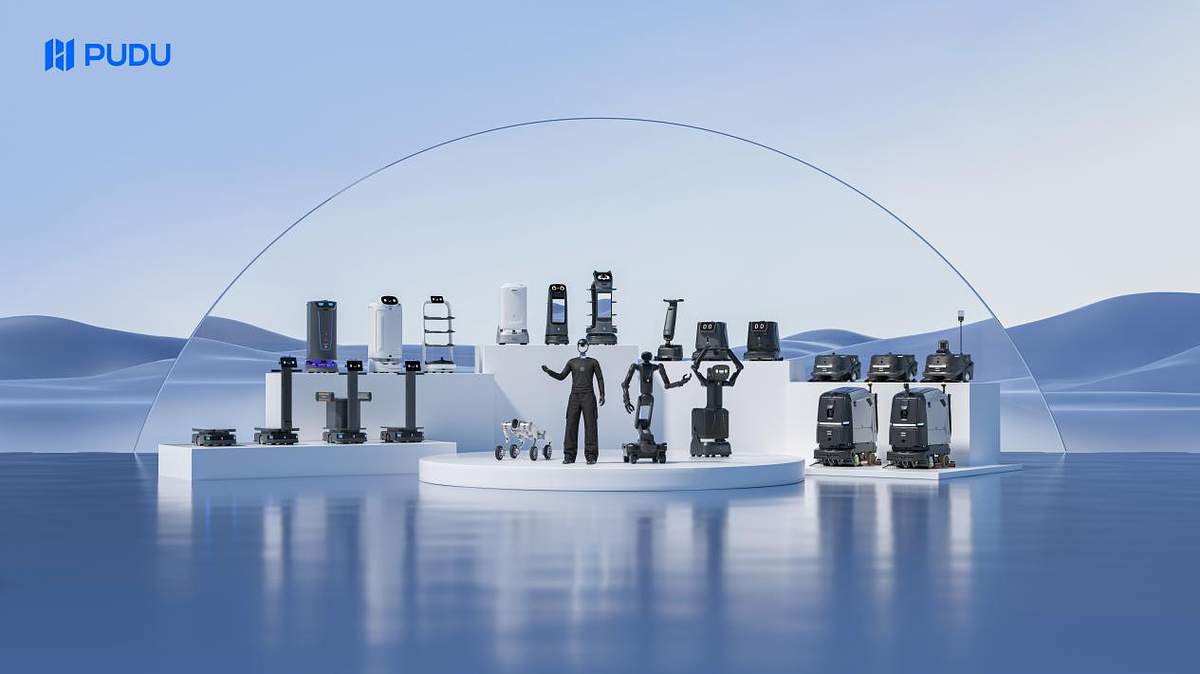
Pudu's 'Unified Brain' Gambit: A Bet on Software to Scale the Robot Workforce
SHENZHEN, China – June 05, 2026 – For years, the robotics industry has been a parade of captivating hardware demos—humanoids that walk, quadrupeds that climb, and arms that manipulate with uncanny grace. Yet for business leaders, the spectacle has often been followed by a nagging question: how do these impressive machines transition from a controlled lab environment to creating scalable, reliable value in the messy reality of a factory floor, hospital corridor, or bustling restaurant?
This week, Pudu Robotics, a company that has quietly become the world's largest commercial service robot provider, offered a decisive answer. With the launch of PuduFM 1.0, a foundational model for robots, and PuduAgent, a general-purpose software platform, the company is making a strategic declaration: the future of robotics isn't about the perfect body, but the perfect brain. This isn't just another product launch; it's a calculated move to transform a decade of hard-won operational data into a unified software and ecosystem advantage that competitors will find difficult to replicate.
The 'One Brain' Solution to a Fragmented Industry
Pudu's strategy, dubbed 'One Brain, Multiple Embodiments,' is a direct response to the structural problems that have plagued the industry and hobbled large-scale deployment. The dominant paradigm has been 'one machine, one model,' a fragmented approach where every new robot form requires its own bespoke brain. This dilutes R&D, creates data silos, and makes it nearly impossible for lessons learned by a delivery robot in a hotel to benefit a cleaning robot in a mall.
The consequences are tangible. In complex commercial settings, robots struggle with 'goal drift' on long-duration tasks. A robot tasked with a hotel room delivery must navigate elevators, yield to pedestrians, and find the right door. Small errors compound, and as Pudu's own data reveals, task failure rates can reach 40% on jobs lasting over 30 minutes. The core issue is a lack of long-term memory and contextual understanding.
Furthermore, the industry has a collective blind spot around what the company calls 'physical intuition.' A language model can generate a perfect text-based plan for 'picking up a tilted cup,' but it cannot inherently grasp the physics of grip strength, balance, and friction required to execute it without spilling. Robots can see an obstacle, but they often fail to understand its physical properties or predict the consequences of interaction.
Pudu Robotics encountered these barriers firsthand. Its first-generation PuduBot, launched in 2017, had to navigate crowded restaurants with greasy floors and unpredictable children—environments far removed from clean training datasets. This experience forged the company’s core insight: intelligence must be earned in the field, not just programmed in the lab. The new PuduFM 1.0 and PuduAgent are the architectural culmination of that insight, designed to create a single, end-to-end cognitive system that can be shared across its entire product family, from the BellaBot delivery robot to the new PUDU D7 industrial semi-humanoid.
From Data Dominance to Physical Intuition
What gives Pudu the credibility to attempt such an ambitious architectural shift is its market position. Validated by reports from Frost & Sullivan, the company holds a 23% share of the global commercial service robot market, having shipped over 130,000 units across more than 80 countries. This massive, active fleet is not just a sales figure; it is a data-gathering engine of unprecedented scale, creating a 'data flywheel' that forms the foundation of its new strategy.
At the heart of that strategy is PuduFM 1.0, which aims to give robots physical common sense. It moves beyond simple pattern matching to genuine understanding. The system's novelty lies in its two-part structure. A Vision-Language-Action (VLA) model aligns what a robot sees, is told, and does, a concept also being explored by tech giants like Google with its RT-2 model. However, Pudu pairs this with a Physical Intuition Model (PIM), a module explicitly designed to model and predict physical dynamics.
Instead of just reacting to a tipped coffee cup after it spills, a robot powered by PIM anticipates the instability the moment the cup begins to tilt and adjusts its posture to compensate. It's the difference between seeing a reflection on a glass wall as an obstacle and understanding it as a harmless optical illusion—a real-world problem Pudu engineers faced at Shenzhen Bao'an Airport. By focusing on sparse state prediction rather than processing every pixel, the PIM achieves the computational efficiency needed for real-time control, a critical hurdle for deploying complex models on physical hardware.
This focus on real-world physics, trained on data from a vast and varied fleet, is Pudu's core differentiator. While competitors like Boston Dynamics showcase incredible hardware agility and others like Agility Robotics focus on specific logistics applications, Pudu is leveraging its operational scale to build a generalized intelligence layer that can be deployed across a diverse, multi-form product matrix.
Building the 'Android for Robots': An Ecosystem Play
If PuduFM is the intelligent engine, PuduAgent is the operating system designed to deploy that intelligence at scale. Here, the company's ambition becomes even clearer: it is trying to build the Android or iOS for the physical world. PuduAgent provides a standardized three-layer architecture (System, Capability, Safety) that abstracts away the complexity of the underlying hardware and models.
Its 'Agent Core' allows a robot to break down complex, hour-long tasks like a hospital medication delivery run into a strategic sequence of steps, while its 'Agent Memory' allows it to learn from past errors, turning it into a 'veteran employee' that doesn't make the same mistake twice. The platform also includes a 'Capability Layer,' where atomic skills like 'navigate corridor' or 'call elevator' are stored in a library, reusable by any robot in the fleet, regardless of its physical form. A new cleaning bot entering a hotel for the first time can instantly access the navigation maps and elevator protocols learned by the delivery bots already operating there.
Crucially, Pudu is opening this platform to the world. By offering a full Software Development Kit (SDK), a simulation environment, and a 'SkillHub' marketplace, it is inviting third-party developers to build and sell their own applications. A developer could, for instance, combine a pre-built navigation skill with their own custom inspection module to create a 'pharmacy inventory check' app and deploy it on Pudu hardware without ever needing to write a SLAM algorithm. This strategy, previously outlined in a white paper with Deloitte, aims to spark a flywheel effect where more developers create more skills, making the platform more valuable and attracting even wider adoption.
Navigating a Competitive Landscape
Pudu's strategic pivot comes at a time of intense activity in the embodied AI space. While the press release mentioned a new funding round lifting its valuation into the 'tens of billions,' financial reporting clarifies the figure at a still-formidable $1.5 billion. This places it among well-funded peers but underscores the importance of strategic execution over hype.
The company leads the overall commercial service robot market but faces fierce competition in specific segments. Qinglang Intelligent, for instance, holds a dominant share in the food delivery robot niche. Meanwhile, a new class of competitors like D-Robotics is emerging with a similar vision of creating integrated embodied intelligence platforms.
However, Pudu's bet is that its unique combination of a massive, deployed hardware base, a torrent of real-world operational data, and a unified software platform designed for an open ecosystem will create a durable competitive advantage. While others debate which robot form factor will ultimately win, Pudu Robotics has changed the terms of the discussion. The question is no longer which body is best, but whether a single, learning mind can effectively command them all.