
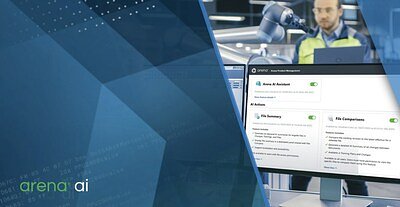
- AI File Summary: Automates review of dense documentation, reducing manual review time from days to minutes.
- AI File Comparison: Automatically highlights modifications in complex files, reducing human error in version control.
- Supply Chain Intelligence (SCI): Performs weekly checks for electronic components against global regulatory updates.
Experts view PTC's Arena AI Engine as a transformative tool for defense manufacturing, enhancing compliance, supply chain resilience, and operational efficiency through AI-driven automation and risk reduction.
PTC's Arena AI Engine: A New Digital Shield for Defense Manufacturing
BOSTON, MA – December 09, 2025 – In an industry where a single misplaced decimal in a technical specification can have catastrophic consequences, the management of product data is paramount. For defense and aerospace contractors, this challenge is magnified by labyrinthine regulatory frameworks and globe-spanning supply chains. Today, global software company PTC introduced a new tool aimed directly at this complexity: the Arena® AI Engine, designed to automate critical review processes within its Product Lifecycle Management (PLM) and Quality Management System (QMS) platforms.
The launch signifies a major step in applying artificial intelligence not just as an analytical tool, but as an integrated operational partner within the digital thread of manufacturing. Powered by Amazon Bedrock, the Arena AI Engine promises to streamline the overwhelming task of managing and comparing complex product documentation, a move that could have profound strategic implications for national security, supply chain resilience, and the pace of innovation in the defense sector.
"Our customers manage complex documentation and ongoing revisions that can slow work and increase risk," said David Katzman, Executive Vice President and General Manager of Onshape and Arena by PTC, in the company's official announcement. "The launch of Arena AI Engine marks the next step in our long-term investment to make those processes more intuitive and give teams greater clarity and control over their product information."
Deconstructing the AI's Role in the Digital Thread
Beyond the buzzwords, the Arena AI Engine introduces highly practical functionalities aimed at tangible pain points. The system is built on two primary actions: AI File Summary and AI File Comparison. These features are designed to function as an intelligent assistant, poring over dense documentation to extract what matters most.
AI File Summary allows teams to condense lengthy reports—such as quality audits, material specifications, or test results—into concise, actionable insights. For a prime defense contractor managing thousands of components from hundreds of suppliers, this can dramatically accelerate approval cycles. Instead of a compliance officer spending days manually reviewing a supplier's quality report, the AI can generate a summary of key findings and deviations in minutes, flagging areas that require human expert attention.
Perhaps more critically, the AI File Comparison action automates version control for the complex files that define modern defense systems. When an engineering change order is issued for a satellite component or an aircraft subsystem, the system can automatically highlight the specific modifications between the old and new versions of schematics, design files, or multi-thousand-page specification documents. This capability directly reduces the risk of human error in manual checks, a crucial factor in maintaining the integrity and safety of mission-critical hardware. By providing faster visibility into revisions, it allows senior management to more rapidly assess risks and opportunities associated with design changes.
PTC has also emphasized its responsible AI policy, noting that the features are opt-in and that no customer data is used to train the underlying large language models, addressing deep-seated industry concerns around data security and intellectual property protection.
A Shield for Compliance and Supply Chain Resilience
The strategic heart of this announcement lies in its potential to fortify two of the defense industry's most significant vulnerabilities: regulatory compliance and supply chain fragility. Defense contractors operate under a heavy burden of standards like ITAR, DFARS, and numerous ISO certifications. Maintaining compliance is a constant, resource-intensive effort where failure can lead to severe penalties and loss of contracts.
The Arena AI Engine, coupled with enhancements to PTC's Arena Supply Chain Intelligence (SCI) offering, acts as a digital shield. The SCI module now performs weekly checks for electronic components against global regulatory updates, providing AI-driven monitoring directly within the product development workflow. When a component is suddenly flagged under a new environmental regulation or trade restriction, that information is surfaced immediately, not weeks later during a manual audit. This allows for proactive mitigation, such as sourcing an alternative component before production is impacted.
This shift from reactive to predictive compliance management is transformative. In an era of geopolitical instability and rapidly shifting trade policies, an automated system that monitors and flags changes across both internal design documents and external regulatory databases provides a powerful layer of resilience. It helps turn compliance from a costly, defensive necessity into a source of competitive advantage, enabling companies to navigate global complexity with greater confidence and speed.
An Emerging AI Arms Race in Industrial Software
PTC's move is not happening in a vacuum. It is a key development in a broader industry trend that sees major industrial software vendors engaged in an AI arms race to create the most intelligent digital platforms. The goal is to build a seamless, data-rich environment—the 'digital thread'—that connects every stage of a product's life from initial concept to in-field service.
Competitors are making similar strategic pushes. Siemens has integrated a 'Teamcenter Copilot' into its PLM platform, using generative AI to enable conversational searches of product data and document analysis. Similarly, Dassault Systèmes is embedding its 'AURA' virtual companion within its 3DEXPERIENCE platform to synthesize information and assist with design. Other players like Aras are leveraging Microsoft Azure's AI services to offer intelligent search and chatbot assistants for their PLM users.
While the overarching goal is similar, PTC's specific focus with the Arena AI Engine on automating the comparison of complex documents and specifications addresses a particularly tedious and high-risk task in engineering and quality management. This practical, workflow-centric approach may prove to be a key differentiator in a market where the tangible ROI of AI is under intense scrutiny. It reflects a maturing market that is moving from general AI capabilities to highly specific, value-driven applications.
Augmenting the Modern Engineer
Fears of AI replacing human jobs often overlook a more immediate and powerful reality: augmentation. The Arena AI Engine is positioned not to replace skilled aerospace engineers or quality assurance professionals, but to free them from low-value, repetitive tasks. The human brain is an unparalleled engine for innovation, critical thinking, and complex problem-solving—not for manually cross-referencing line items in two 800-page documents.
By delegating this digital drudgery to an AI copilot, engineers and designers can dedicate more of their time to the high-value work that drives a company forward. This includes developing next-generation technologies, optimizing system performance, and creatively solving unforeseen challenges. In an industry facing a persistent skills gap, maximizing the productivity and impact of its existing expert workforce is a strategic imperative.
This human-AI partnership represents the future of work in advanced manufacturing. The enhancements to the Arena AI Assistant, which now includes multilingual support and a broader help database, further underscore this vision. The aim is to lower the barrier to entry for powerful software tools and empower every user, from a new hire on the factory floor to a senior design engineer, to interact with complex product data more intuitively. As these AI tools become more deeply embedded in daily workflows, they will not only boost efficiency but also foster a more data-driven and agile culture, which is essential for any organization competing in the fast-paced defense and space technology landscape.