
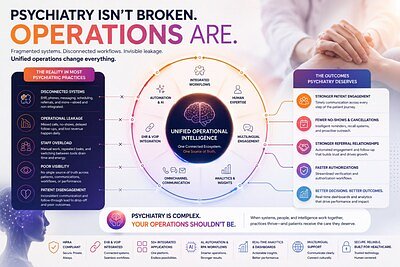
- Operational fragmentation in psychiatry leads to 'invisible operational leakage', impacting patient care, finances, and clinician burnout.
- Clinicians spend excessive time navigating complex software, contributing to workforce shortages.
- The Saffron Solution proposes an integrated platform combining over 50 applications to streamline workflows.
Experts agree that operational fragmentation in psychiatry is a critical systems-coordination crisis that undermines care delivery, and a unified technology ecosystem is essential to address this issue.
Psychiatry's Silent Crisis: How Operational Chaos Undermines Care
WILMINGTON, Del. – May 12, 2026 – While the psychiatric community grapples with high-profile challenges like physician shortages, burnout, and the integration of artificial intelligence, a more insidious problem is eroding the foundation of mental healthcare delivery: operational fragmentation. According to a new warning from healthcare technology firm The Saffron Solution, a patchwork of disconnected software, siloed workflows, and fractured communication channels is creating "invisible operational leakage," a systemic issue that quietly compromises patient care, strains finances, and exhausts clinicians.
Ahead of the American Psychiatric Association's (APA) 2026 Annual Meeting in San Francisco, the company argues that the specialty is facing not just a workforce crisis, but a critical systems-coordination crisis. This operational disarray, born from years of adopting disparate technologies without a unifying strategy, has left many practices struggling to manage a complex web of non-integrated tools for everything from patient scheduling and electronic health records (EHRs) to billing and communications.
The Hidden Burden of Fragmentation
The problem extends far beyond simple inconvenience. Independent research confirms that operational fragmentation is a significant and pervasive issue in behavioral health. Unlike general medicine, psychiatric care relies heavily on longitudinal relationships, detailed narrative documentation, and sensitive communication—all of which are strained by disjointed systems.
Many practices find their EHR systems, often designed for physical health, are ill-suited for the nuances of mental healthcare. These systems can lack templates for common behavioral conditions or struggle to support the narrative-heavy nature of therapy notes, forcing clinicians into inefficient workarounds. This is compounded by the use of separate platforms for telehealth, patient messaging, scheduling, and billing, requiring staff to constantly switch between applications and manually re-enter data. This duplication of effort not only wastes valuable time but also increases the risk of errors that can impact patient safety and care continuity.
This administrative overload is a primary driver of clinician burnout. Mental health professionals report spending an inordinate amount of time navigating complex software, chasing prior authorizations, and managing paperwork, pulling them away from their core mission of patient care. The constant friction created by these inefficient systems contributes to a sense of exhaustion and disillusionment that is fueling workforce shortages across the specialty.
Financially, the impact is just as severe. "Invisible operational leakage" manifests as missed appointments, poor patient follow-up, claim denials due to coding errors, and inefficient revenue cycle management. For practices operating on already thin margins, these accumulated small failures can threaten long-term sustainability.
A Call for Operational Unification
In response to this crisis, The Saffron Solution is advocating for a fundamental shift in how psychiatric practices approach technology: a move away from isolated applications and toward a unified operational ecosystem. The company's position is that adding more technology, even advanced AI tools, into an already fragmented environment will only exacerbate the chaos.
"Healthcare does not fail because people stop caring," said Varun Khanna, founder and CEO of The Saffron Solution, in a recent press release. "It fails because fragmentation quietly destroys visibility, continuity, accountability, communication, and operational trust."
Their proposed solution is an integrated, HIPAA-compliant platform that combines more than 50 applications—spanning patient engagement, analytics, automation, and administrative infrastructure—into a single operational layer. By connecting to a practice's existing EHR and VoIP systems, the platform aims to create seamless workflows. This includes leveraging robotic process automation (RPA) and agentic AI to handle repetitive tasks, multilingual human support for patient engagement, and centralized analytics dashboards to give practice leaders a clear view of their operations.
The goal, the company stresses, is not to replace human interaction but to eliminate the administrative chaos surrounding it, allowing clinicians and staff to focus on what they do best: caring for patients.
Beyond Standalone Apps and AI Hype
The current healthcare technology market is a crowded field. Behavioral health practices are inundated with pitches for specialized EHRs like SimplePractice and TherapyNotes, telehealth platforms such as Talkspace, and emerging AI-powered documentation tools. While many of these products offer value, they often operate as standalone solutions, contributing to the very fragmentation they seek to solve.
The Saffron Solution's argument is that the next phase of innovation will not come from another isolated app but from the intelligence that connects them. By creating an operational ecosystem that unifies patient data, communication logs, scheduling information, and financial reporting, practices can move from reactive problem-solving to proactive, data-driven management.
This approach stands in contrast to the hype surrounding many standalone AI tools. While AI holds promise for tasks like automating clinical notes or flagging at-risk patients, its effectiveness is limited if it isn't deeply integrated into the practice's core workflows. An AI tool that generates a patient summary is of little use if that summary cannot be easily accessed within the EHR or shared with the patient's primary care physician. The push for operational unification is a call to build the foundational infrastructure first, ensuring that any new technology, including AI, can be implemented effectively and cohesively.
Aligning with a Profession at a Crossroads
The timing of this conversation is critical, as it directly aligns with the central theme of the upcoming APA 2026 Annual Meeting: "Empowering The Psychiatric Workforce: Taking Control of Our Practices One Step at a Time." The conference aims to provide psychiatrists with practical strategies to navigate increasing administrative demands and build more resilient, patient-centered practices.
The discussion around operational fragmentation provides a crucial context for these goals. Empowering the workforce is difficult when clinicians are bogged down by inefficient, frustrating technology. Taking control of a practice is nearly impossible without clear visibility into its operational health. By bringing the issue of systemic fragmentation to the forefront, the industry can begin to address a root cause of many of the challenges—from burnout to access to care—that currently define the psychiatric landscape.
As thousands of mental health professionals gather in San Francisco, the debate will likely shift from simply adopting new technologies to strategically implementing unified systems. The focus is moving toward creating an environment where technology serves clinicians and patients, rather than the other way around, marking a potentially significant turning point for the future of mental healthcare delivery.