
- 28 conservation assets across nine states, encompassing thousands of acres of wetlands and miles of streams.
- 5,734 acres of wetland habitat and over 11 miles of stream corridors added through recent acquisition.
- $37 billion projected global market value for mitigation banking by 2035.
Experts view mitigation banking as a market-driven solution that balances economic development with ecological restoration, though some question its long-term effectiveness in fully replicating natural ecosystems.
Private Equity Bets Big on Restoring America's Wetlands
DALLAS and NACOGDOCHES, Texas – April 23, 2026 – By Nancy Torres
In a move that signals the growing convergence of high finance and environmentalism, Conservation Equity Management (CEM), a private equity firm co-founded by famed investor Kyle Bass, has announced a major expansion of its environmental portfolio. The firm has acquired a diversified national collection of mitigation banks, significantly scaling its operations and planting a flag at the intersection of private capital and large-scale ecosystem restoration.
The acquisition adds nine new mitigation banks to CEM’s holdings, extending its footprint into the high-growth states of Florida, Illinois, and Alabama. This brings the firm’s total to 28 conservation assets across nine states, encompassing thousands of acres of wetlands and miles of streams now dedicated to ecological recovery. This strategic purchase underscores a burgeoning industry where restoring nature is not just a conservationist’s goal, but a calculated financial play.
The Mechanics of a Green Market
At the heart of CEM's strategy is the concept of mitigation banking, a market-based system designed to offset the unavoidable environmental damage caused by development. Under the U.S. Clean Water Act, developers who impact protected ecosystems like wetlands or streams are often required to compensate for that loss. Instead of attempting complex restoration projects themselves, they can purchase “credits” from a mitigation bank.
These banks are large tracts of land where a sponsor, like CEM, has undertaken significant, scientifically-backed efforts to restore, enhance, or preserve ecological functions. Federal and state agencies, led by the U.S. Army Corps of Engineers, oversee the creation of these banks and quantify the ecological uplift into a set of tradable credits. Once a developer buys credits, the legal liability for ensuring the ecosystem’s long-term success transfers to the bank owner, who is bound by a perpetual conservation easement to maintain the land as a natural habitat forever.
This system creates a streamlined, market-driven solution. Developers can meet their regulatory obligations efficiently, while private capital is incentivized to fund large-scale, consolidated restoration projects that are often more ecologically successful than smaller, piecemeal efforts. The recent CEM acquisition alone brings 5,734 acres of wetland habitat and over 11 miles of stream corridors under this model.
A New Asset Class for Wall Street
The involvement of figures like Kyle Bass, founder of Hayman Capital Management who famously profited from the 2008 subprime mortgage crisis, lends significant weight to the idea of conservation as a formal asset class. For investors, mitigation banking offers a “double bottom line”: the potential for financial returns alongside measurable environmental benefits. The market is substantial and growing, with some analysts projecting it to exceed $37 billion globally by 2035, driven by infrastructure projects, commercial and residential construction, and the energy sector.
“The most compelling investment opportunities and the most pressing conservation needs often exist together,” said Kyle Bass, Co-Founder of Conservation Equity Management, in a statement accompanying the announcement. “This acquisition expands CEM’s reach across five new states and dozens of high-growth markets.”
The firm's portfolio is a mix of mature, revenue-generating banks with established credit sales and newly permitted projects with large inventories ready to meet future demand. This diversification, spread across multiple U.S. Army Corps of Engineers districts, creates a resilient platform insulated from regional economic downturns and positioned to capitalize on development across the American South, Midwest, and Mid-Atlantic.
Balancing Bulldozers and Biodiversity
Nowhere is the tension between development and conservation more apparent than in states like Texas and Florida. Rapid population growth and economic expansion fuel a constant demand for new roads, housing, and energy infrastructure, all of which can impact natural landscapes. CEM’s recent acquisitions are strategically located to service these booming markets.
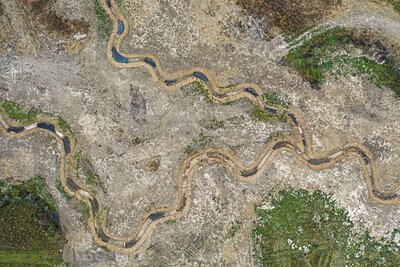
In March, prior to this larger portfolio deal, the firm acquired the Straus Medina Mitigation Bank in Bexar County, Texas. Located in the fast-growing corridor west of San Antonio, the bank consists of nearly seven miles of restored streams, now permanently protected. This asset provides a ready source of compensatory mitigation credits for public and private projects in the region, allowing economic development to proceed while addressing its ecological footprint.
The newly acquired portfolio follows the same logic on a national scale. By providing a predictable, regulated mechanism for environmental offsets, mitigation banks act as a critical lubricant for economic engines. Without them, project timelines could be delayed for years as developers struggle to navigate complex environmental permitting and restoration requirements on their own.
“Streams and wetlands are the connective tissue of healthy landscapes,” noted Terry Anderson, CEM Co-Founder and a veteran with over 30 years in natural resource management. “When they are degraded, everything suffers: water quality, wildlife, and communities. Every bank in this portfolio is a commitment to reversing that damage permanently, and that is something worth building.”
The Promise and Peril of Perpetual Restoration
Proponents argue that private mitigation banking is the most effective way to channel significant capital into conservation. Bank sponsors have the expertise and financial incentive to ensure projects are successful, and regulatory oversight from agencies like the Army Corps of Engineers provides a layer of accountability. The use of perpetual conservation easements, often held by trusted third-party organizations like the Texas Land Conservancy, is designed to guarantee that these restored landscapes are protected from future development forever.
However, the model is not without its critics. Some environmental scientists and conservation groups express skepticism about the ability to truly “recreate” a complex ecosystem that took centuries to evolve. Studies have shown that some mitigation projects fail to meet their ecological performance standards, falling short of the biodiversity and functional value of the natural habitats they are meant to replace.
There are also philosophical concerns about a system that effectively commodifies nature and permits the destruction of one habitat in exchange for the restoration of another. The fear is that while the ledger of “credits” and “debits” may balance on paper, the net result could be a loss of unique, irreplaceable ecosystems. Despite these challenges, the 2008 federal rule on compensatory mitigation established a clear preference for mitigation banks over other forms of offsets, citing their generally higher rates of success and long-term viability, a conclusion supported by a National Research Council report. As private equity firms like Conservation Equity Management continue to pour capital into this space, they are betting that they can deliver on the promise of durable, large-scale restoration that benefits both their investors and the environment.