
- 34 microwatts: POLYN's NeuroVoice chip operates on an ultra-low power consumption of 34 microwatts, significantly lower than competitors.
- Microsecond-scale latency: The chip promises near-instantaneous responsiveness for always-on devices.
- 140 microwatts: Competitor Syntiant's NDP100 consumes around 140 microwatts for similar tasks.
Experts view POLYN's analog AI chip as a groundbreaking solution for battery efficiency in always-on devices, with its neuromorphic architecture offering a significant leap in power savings and responsiveness compared to traditional digital processors.
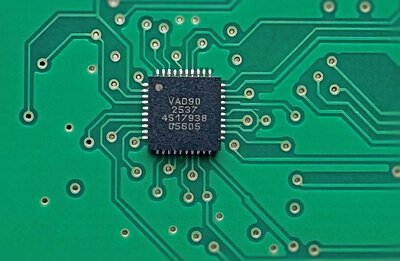
POLYN's Analog AI Chip Aims to End Battery Drain in Always-On Devices
LAS VEGAS, NV – December 17, 2025 – In the relentless pursuit of smarter, more intuitive technology, the biggest obstacle has often been the smallest: the battery. The dream of truly "always-on" devices that listen and react intelligently has been consistently hampered by the immense power drain of continuous AI processing. Now, POLYN Technology is set to demonstrate a solution at CES 2026 that could fundamentally change the equation for battery-powered electronics.
The fabless semiconductor company will showcase its NeuroVoice Voice Activity Detection (VAD) chip, a novel piece of hardware that operates on a minuscule 34 microwatts of power. This live demonstration represents the first practical application of POLYN's Neuromorphic Analog Signal Processing (NASP™) technology, a brain-inspired architecture that performs AI calculations directly in the analog domain, sidestepping the power-hungry digital conversion that hobbles conventional chips.
This approach promises not only a revolution in energy efficiency but also near-instantaneous responsiveness, with the company claiming microsecond-scale latency. For the next generation of wearables, smart home devices, and industrial sensors, this breakthrough could finally unlock the door to continuous, on-device intelligence without the daily scramble for a charging cable.
The Microwatt Revolution: Analog AI Tackles Battery Drain
The core challenge for voice-activated technology is that listening requires constant power. Traditional digital signal processors (DSPs) must digitize incoming sound, run complex algorithms to filter out noise, and identify speech patterns. This process, while effective, consumes precious milliwatts of energy, making it impractical for continuous operation in small, battery-reliant devices like earbuds or smartwatches.
POLYN's NASP™ technology confronts this problem by eliminating the digital middleman. By mimicking the structure of biological neurons, the chip processes raw, analog audio signals directly. This brain-inspired method is inherently more efficient for pattern-recognition tasks like voice detection, resulting in power consumption measured in microwatts—a tiny fraction of that used by its digital counterparts. The result is a chip that can remain perpetually alert, listening for a human voice while having a negligible impact on battery life.
"This CES demo shows how the NASP technology platform moves from validation to practical functionality," said Aleksandr Timofeev, CEO of POLYN Technology, in a recent announcement. "Voice detection is a highly sought-after feature, but only if it can run continuously without draining power. That's exactly what analog neuromorphic processing enables."
This move from theoretical validation to a silicon-proven product is a critical step. While the concept of neuromorphic computing has been lauded for years as a future pathway to hyper-efficient AI, POLYN's demonstration aims to prove it is ready for the market today.
A Crowded Field: The Battle for the AI Edge
POLYN is entering a fiercely competitive market for edge AI hardware, where established players and agile startups are all vying to deliver intelligence at the point of data capture. The demand for low-latency, energy-efficient processing is surging across consumer and industrial sectors.
Prominent competitors like Syntiant have already made significant inroads with their Neural Decision Processors (NDPs). Syntiant's chips, which have earned CES Innovation Awards, offer impressive performance, with some models like the NDP100 consuming around 140 microwatts for keyword spotting. Other specialists, such as AONDevices, also target the sub-150 microwatt range for their voice solutions. In this context, POLYN's claim of 34 microwatts positions its NeuroVoice chip as a potentially disruptive force, offering an order-of-magnitude improvement in power efficiency.
While semiconductor giants like Qualcomm and NXP integrate AI capabilities into their powerful processors, their solutions are often designed for more complex tasks and operate on a power budget measured in watts, not microwatts. POLYN's hyper-specialization on ultra-low-power sensor-level processing carves out a distinct and valuable niche. The company is betting that for the vast ecosystem of simple, battery-powered IoT devices, extreme energy efficiency is the single most important feature.
Beyond Wake Words: Enabling a Smarter, More Private World
The implications of microwatt-level, always-on voice detection extend far beyond simply waking up a smart assistant. This level of efficiency enables a more pervasive and natural form of human-computer interaction while simultaneously strengthening user privacy.
Because all processing occurs directly on the NeuroVoice chip, no audio data needs to be sent to the cloud for analysis. This on-device approach directly addresses growing consumer anxiety over data privacy, ensuring that personal conversations remain within the user's physical control. This is a critical selling point for devices intended for the home, office, or to be worn on one's person.
Furthermore, the technology promises to unlock new applications. In consumer electronics, earbuds could offer seamless, hands-free control and health monitoring without compromising a full day of listening. In the automotive sector, in-cabin voice systems could become more responsive and reliable, even amidst road noise. For industrial settings and critical-communications equipment, robust, always-on voice commands can improve safety and operational efficiency where hands and eyes are otherwise occupied.
POLYN's roadmap suggests this is just the beginning. The VAD core is the first step, with plans for more sophisticated functions like speaker recognition and voice extraction. This transforms voice from a simple trigger into a rich source of intent, paving the way for what the company calls "Physical AI"—intelligent machines that can understand and react to human speech in a more nuanced way, all while operating at the edge.
As the industry gathers in Las Vegas for CES 2026, many will be watching to see if POLYN's demonstration lives up to its transformative potential. The company will be offering evaluation kits and early access to its technology, signaling a clear intent to move quickly from a showcase demo to widespread commercial integration. For a market hungry for the next leap in device intelligence, this analog approach may provide a powerfully efficient answer.