
- 74% of tariff lines now qualify for zero tariffs under the new customs regime.
- 9,600 foreign-invested enterprises established in Hainan since 2020, with $14 billion in foreign capital utilized.
- 15% corporate income tax rate for prioritized sectors, down from the standard 25% in mainland China.
Experts view Hainan's free trade port as a bold but complex experiment, offering significant trade liberalization and incentives, though its long-term success will depend on overcoming institutional and geopolitical challenges.
Hainan's Big Bang: China's Blueprint for Global Trade Goes Live
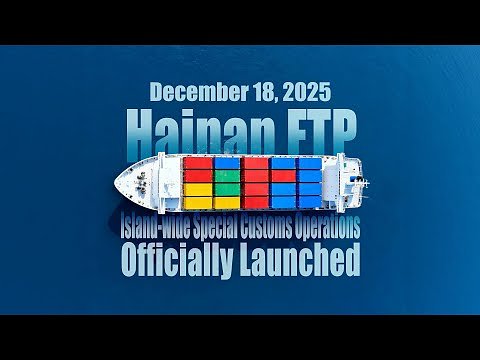
HAIKOU, China – December 18, 2025 – In a move signaling a major escalation of its economic opening-up strategy, China's southern island province of Hainan today officially launched island-wide special customs operations. The initiative transforms the entire 35,100-square-kilometer island into a unique customs zone, a critical step toward realizing Beijing's ambition of creating a globally influential free trade port (FTP) by the middle of the century.
The new system, effective immediately, implements a novel regulatory framework defined as "freer access at the first line, regulated access at the second line, free flow within the island." This launch marks the culmination of years of planning and testing since the master plan for the Hainan FTP was unveiled in 2020, positioning the tropical island as China's premier testbed for high-level economic liberalization in an era of growing global protectionism.
A New Model for Trade: Deconstructing the 'Two Lines'
At the heart of Hainan's transformation is a customs model fundamentally different from any other in mainland China. It effectively creates a customs border around the island, treating it as a distinct territory for trade purposes.
The "first line" refers to the border between Hainan and all overseas countries and regions. Under the new rules, goods crossing this line into Hainan will be largely exempt from customs procedures. An expansive list covering approximately 74% of all tariff lines now qualifies for zero tariffs, a significant increase from previous pilot programs. This liberalization is governed by a "negative list," meaning all goods are permitted to enter freely unless specifically prohibited or restricted, providing greater clarity for international businesses.
In contrast, the "second line" regulates the movement of goods from Hainan into the Chinese mainland. Goods crossing this line are treated as imports and are subject to standard duties and taxes. However, a powerful incentive has been built into the system to encourage high-value manufacturing and processing on the island. Goods that undergo substantial processing in Hainan, defined as achieving at least 30% value-added, can enter the mainland market tariff-free. While import VAT and consumption taxes will still apply, this rule is designed to attract sophisticated manufacturing and prevent the FTP from becoming a simple transshipment or smuggling hub.
Within the island itself, goods are intended to circulate freely among eligible enterprises, further reducing administrative friction and fostering an integrated market environment. This framework aims to slash compliance costs, streamline clearance, and create an unprecedented level of market access for international firms looking to tap into both regional and Chinese consumer markets.
Luring Global Business: An Oasis of Incentives
The ambitious customs regime is bolstered by a suite of preferential policies designed to make Hainan an irresistible destination for capital, talent, and innovation. Beyond the zero-tariff policies, qualified enterprises in prioritized sectors—such as tourism, modern services, high-tech, and tropical agriculture—can enjoy a corporate income tax rate of just 15%, a significant discount from the standard 25% rate elsewhere in China. A similar 15% rate applies to the individual income tax for high-end and urgently needed talent.
These financial incentives are coupled with efforts to remove non-tariff barriers. Hainan has already implemented China's first-ever negative list for cross-border trade in services, liberalizing access for foreign providers in key sectors. Furthermore, visa-free entry for tourism and business is available for citizens from 59 countries, with policies being progressively relaxed to allow independent travel and longer stays, aiming to attract not just tourists but a global workforce.
Early indicators suggest the strategy is bearing fruit. Since the FTP master plan was announced in mid-2020, over 9,600 foreign-invested enterprises have been established on the island. The actual utilization of foreign capital has surpassed $14 billion in the past five years, with an investor base that has expanded from 43 countries to over 170. Tourism is also booming, with Hainan receiving over 97 million visitors in 2024, and inbound international travel showing strong recovery in 2025.
The Competitive Landscape: A Rival to Hong Kong and Singapore?
With its sheer scale—roughly 30 times the size of Hong Kong—and forceful policy backing, Hainan is being positioned as a potential competitor to established Asian free trade hubs like Singapore and Hong Kong. Proponents argue its unique model, which combines a free port's openness with direct, preferential access to the massive Chinese mainland market, gives it a distinct advantage.
However, significant challenges remain. Analysts note that Hainan currently offers "managed liberalization" and still lacks the robust, independent legal frameworks and deep financial markets that underpin the success of Hong Kong and Singapore. "It's an attractive proposition, but global firms rely on legal predictability and institutional maturity, which takes decades to build," commented one trade consultant based in the region.
The FTP also faces growing competition from within China. As other pilot free trade zones across the country adopt similarly liberal policies, some of Hainan's unique advantages risk being diluted. For instance, the 30% value-added tariff exemption rule has already been extended to parts of the Guangdong-Hong Kong-Macao Greater Bay Area, intensifying the race to attract investment. Attracting and retaining a highly skilled international workforce also remains a critical hurdle for the developing island province.
A Strategic Play in a Shifting World
The Hainan FTP is more than just an economic project; it is a key component of China's broader geopolitical and strategic vision. It serves as a cornerstone of the "dual circulation" strategy, designed to bolster the domestic economy while strengthening linkages with international markets, thereby increasing China's resilience to external shocks.
Geographically, Hainan is a pivotal node for deepening economic ties with Southeast Asian nations, China's largest trading partners, and a central platform for advancing the Regional Comprehensive Economic Partnership (RCEP). By becoming a hub for trade, services, and technology, Beijing hopes to cement its economic leadership in the Asia-Pacific.
The launch of the island-wide operations sends a powerful message of China's commitment to free trade at a time of global fragmentation. Yet, its strategic location in the South China Sea introduces a layer of complexity, potentially complicating economic integration with regional neighbors who have competing territorial claims. The ultimate success of this grand experiment will depend not only on flawless policy execution but also on navigating these intricate geopolitical currents. The world is watching to see if this tropical island can truly become the globally influential free trade port Beijing envisions, or if it will remain a grand experiment caught between ambition and reality.