
- $8M Annual Investment: 407 ETR funds a dedicated OPP detachment with over $8 million annually.
- 60% Lower Collision Rate: The highway reports a collision rate 60% lower than other 400-series highways in the GTA.
- 10,000 Charges Laid: Over 10,000 charges were issued last year targeting major driving offenses.
Experts would likely conclude that 407 ETR's privately funded policing model demonstrates a highly effective approach to enhancing road safety and efficiency, though its scalability may face legal and policy challenges.
Policing the Toll Road: 407 ETR's Unique $8M Safety Partnership
TORONTO, ON – January 09, 2026 – On a day dedicated to appreciating law enforcement across the country, a unique public-safety model operating on one of North America's busiest commuting corridors is drawing attention. Highway 407 ETR, the privately operated toll road stretching across the Greater Toronto Area, is highlighting its long-standing partnership with the Ontario Provincial Police (OPP)—a collaboration it fully funds to the tune of over $8 million annually. This substantial investment supports a dedicated OPP detachment tasked solely with patrolling the 108-kilometre highway, a structure that distinguishes it from every other roadway in the province.
Unlike provincially managed highways funded by taxpayers, 407 ETR covers 100% of its own operational costs, from snow removal and maintenance to the entire expense of its dedicated police service. This arrangement was celebrated today, underscoring a different approach to ensuring driver safety on a critical piece of infrastructure.
A Distinctive Model for Public Safety
The partnership between 407 ETR and the OPP is more than a simple contract; it represents a deeply integrated operational system. The company's annual investment funds a detachment of over 30 officers who work out of a full-service facility on Bathurst Street, which was also built by 407 ETR. These officers collaborate closely with the highway's own control centre and field operations patrollers, creating what the company describes as a comprehensive safety network.
"By working together with the OPP, we've created a safety network that helps make this highway one of the safest in Ontario," said Jose Espinosa, President & CEO of 407 ETR, in a statement. "We appreciate this partnership that helps to ensure peace of mind for everyone who travels on Highway 407 ETR."
While public-private partnerships (P3s) are common in Canadian infrastructure for building projects like hospitals and police stations, the 407 ETR model is notably different. Research into P3s reveals that while a private entity might build and maintain a facility, the operational costs of public services like policing, including officer salaries and equipment, are almost always borne by the government. The 407 ETR arrangement, where the private concession company directly funds the law enforcement contingent for its corridor, appears to be a rare, if not singular, model in Canada.
The OPP detachment's mandate is clear and focused. "The 407 Detachment is unwavering in our commitment to ensuring traffic safety," stated Staff Sergeant and Detachment Commander Nathan Majer. He emphasized a priority on the 'Big Four' driving offenses: impaired driving, speeding, distracted driving, and improper occupant restraint. This targeted enforcement, he noted, aims to "significantly mitigate the risk of injury and fatalities for all who travel on our roadways."
The Payoff in Safety and Efficiency
The results of this focused, privately funded policing model are tangible, according to data released by the company. 407 ETR reports a collision rate that is 60% lower than that of other 400-series highways in the Greater Toronto Area. This statistic, consistently cited by the company based on internal analysis and reports from global infrastructure consultancies, points to a significant safety advantage.
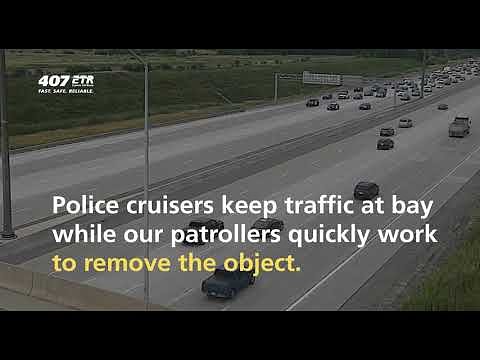
This improved safety record is attributed not only to the visible police presence but also to the seamless coordination between the OPP and highway staff. A recent video showcased this teamwork, with OPP officers holding back traffic while 407 ETR patrollers swiftly removed hazardous debris from the live lanes. The dedicated detachment's efforts are also reflected in its enforcement numbers, with over 10,000 charges laid last year targeting the 'Big Four' offenses. These actions, the company states, represent "lives protected, accidents prevented and safety upheld."
While dedicated enforcement plays a key role, other factors inherent to a toll highway contribute to its safety profile. The managed traffic volumes and more consistent travel speeds, free from the gridlock that often plagues parallel public highways like Highway 401, naturally reduce the conditions that lead to collisions. This combination of superior road design, active maintenance, and robust policing creates an environment where safety and efficiency are intertwined.
Beyond the Asphalt: An Economic Engine
The benefits of the 407 ETR extend far beyond driver safety, according to a recent economic impact report by the global consultancy Steer. The study quantifies the value of time saved by drivers using the highway at a staggering $990 million annually. For a typical commuter, this translates to saving up to one hour during a rush-hour trip, a significant boost to productivity and quality of life.
The highway's contribution to the broader economy is also substantial. The report, based on 2024 data, found that 407 ETR's operations contributed $490 million to Canada's annual Gross Domestic Product (GDP). This economic activity supports an estimated 1,800 jobs and generates $140 million in wages across the province and the country. According to the analysis, for every dollar spent by a customer on the highway, nearly two dollars in economic value are generated across the GTA's economy.
Further burnishing its role as a regional partner, the company has also invested over $10 million in community programs between 2020 and 2024, supporting everything from youth initiatives to environmental partnerships, with plans to expand these investments in 2026.
A Blueprint for the Future or a One-Off?
The success and uniqueness of the 407 ETR policing model inevitably raise a critical question: could it be a blueprint for future infrastructure projects? While the model provides a compelling case study in shifting a significant public safety cost from taxpayers to a private operator, its scalability faces considerable hurdles.
Replicating this arrangement would require navigating complex legal and policy frameworks. Policing is fundamentally considered a core public good, and the idea of private entities directly funding law enforcement operations could face public and political resistance over concerns about accountability, equity, and the potential for conflicts of interest. Furthermore, not every private infrastructure project has the financial capacity of 407 ETR to absorb an multi-million-dollar annual policing budget.
Nonetheless, the partnership serves as a powerful example of how private infrastructure can be leveraged to deliver enhanced public services. It challenges policymakers to think creatively about risk allocation and value creation in public-private partnerships. As urban regions like the GTA continue to grapple with crippling congestion and the associated safety risks, the debate over innovative solutions will only intensify, with the private patrol of Highway 407 ETR standing as a prominent, if complex, example of what is possible.