
- 3.2 GW: The massive capacity of the Baltic Data Center Campus, making it one of the largest in Europe.
- $8-10 billion: Estimated investment for the first phase of the project.
- 2028–2029: Expected operational date for the first data center.
Experts view this project as a strategic move to position Poland as a key hub for Europe's AI-driven digital transformation, though they emphasize the need for sustainable energy and environmental management to balance its ambitious scale.
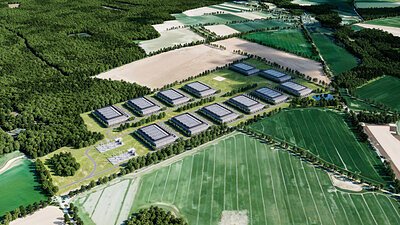
Poland Plans Massive 3.2 GW Data Center to Power Europe's AI Boom
TOMASZÓW MAZOWIECKI, Poland – March 24, 2026 – In a move set to reshape Europe's digital landscape, Polish energy infrastructure firm WBS Power S.A. has announced plans for a colossal 3.2-gigawatt (GW) hyperscale data center campus in northern Poland. The project, dubbed the Baltic Data Center Campus, is designed to meet the voracious energy demands of the artificial intelligence boom and positions Poland as a central hub in the continent's technological future.
The campus will be located in Lublewo, within the Choczewo municipality in the Pomerania region, an area already becoming a strategic energy nexus for the country. WBS Power confirmed it has already secured the critical grid connection conditions for the full 3.2 GW capacity, a significant hurdle for projects of this magnitude.
"This will be the largest project of its kind in Poland and one of the largest in Europe," said Maciej Marcjanik, CEO of WBS Power, in a statement. The development underscores a major strategic pivot for the company, which is leveraging its 15 years of experience in the energy sector to become a key infrastructure provider for the digital age.
Poland's Bid for Digital Supremacy
The Baltic Data Center Campus is the latest and most ambitious project in Poland's rapid emergence as a key destination for digital infrastructure. The country's data center market, valued at over $1.15 billion in 2024, is projected to more than double to $2.78 billion by 2030. This growth has been fueled by a wave of investment from global hyperscalers, with Google Cloud, Microsoft Azure, and Amazon Web Services (AWS) all establishing or expanding their presence, particularly around the capital, Warsaw.
This new 3.2 GW campus, however, signals a geographical diversification and a massive scaling-up of ambition. The project will be constructed in four distinct phases, each with an 800 MW capacity—a power load that dwarfs many existing national data center markets. The initial investment for the first phase alone is estimated to be between $8-10 billion.
The campus is explicitly designed for the next generation of computing. Each phase will include dedicated infrastructure for power-intensive AI and High-Performance Computing (HPC) workloads, which require rack densities exceeding 100kW and often necessitate advanced liquid cooling solutions. This focus aligns with explosive market forecasts, which see the European AI data center market growing from approximately $17.5 billion in 2025 to over $126 billion by 2034.
"We are building the infrastructure that will underpin the next phase of the global digital transformation," stated Hubert Bojdo, CFO of WBS Power. The company's strategy reflects a broader trend of building a new European AI infrastructure landscape, aiming to enhance the continent's "economic competitiveness and technological sovereignty," as Marcjanik noted.
The Energy Conundrum: A Diversified Power Strategy
The single greatest challenge facing the data center industry is access to power. The International Energy Agency expects global data center electricity demand to double by 2030, and WBS Power's project directly confronts this reality. The company’s background as an energy developer is its core strategic advantage.
The choice of location in Choczewo is no accident. The campus will be situated near one of Poland's largest power substations, which is currently being upgraded to receive and transmit electricity from new offshore wind farms in the Baltic Sea. The first power from the nearby 1.2 GW "Baltic Power" offshore wind project is expected to connect to the grid starting in 2026, with the substation itself slated for completion in 2027.
WBS Power plans a diversified energy mix to ensure a stable supply for the campus. Initially, it will draw from conventional sources, but these will be heavily supplemented by the region's growing renewable energy capacity. Critically, the plan has a long-term nuclear component. Poland's first large-scale nuclear power plant, a 3.7 GW facility, is planned for the same municipality, with a target operational date of 2033.
"The digital revolution requires infrastructure on an entirely new scale," Bojdo explained. "We selected the location for the Baltic Data Center Campus very carefully, ensuring access to large power capacities, a diversified energy mix already in place today, and the long-term prospect of stable supply supported by future nuclear generation."
Each phase of the project will also integrate its own battery energy storage systems (BESS) to enhance grid stability and maximize the use of intermittent renewable sources.
A New Model: From Energy Provider to AI Enabler
WBS Power is positioning itself not as a direct competitor to cloud providers like AWS or Google, but as a crucial enabler for them. The company's model is to develop "powered-land"—sites with secured power, permits, and foundational infrastructure—that hyperscalers can then build upon. This approach addresses the industry's primary bottleneck, allowing tech giants to deploy their data centers faster.
This strategy is not confined to Poland. WBS Power is simultaneously advancing the 500 MW Finsterwalde Data Center project in Germany, where it recently sold a large solar and battery project while establishing a joint venture for the hyperscale development. This two-pronged approach in Europe's largest economies demonstrates a clear corporate strategy to become the go-to energy infrastructure partner for the AI industry.
"The rapid development of AI is driving demand for hyperscale data centers supported by advanced infrastructure and reliable access to large volumes of power," Marcjanik said. The company's focus on integrating energy and digital infrastructure is designed to be a key competitive advantage.
Balancing Ambition with Environmental Responsibility
A project of this scale inevitably brings significant environmental and community considerations. Hyperscale data centers are immense consumers of not only electricity but also water, primarily for cooling. A facility of this size could have a water footprint equivalent to a small city, a growing concern as the EU moves to regulate water usage effectiveness in data centers.
While WBS Power's press release highlights a commitment to "the highest ESG, energy efficiency and energy security standards," specific details on water sourcing, cooling technology, or waste heat reuse have not yet been released. The potential to integrate the campus's waste heat into a local district heating system, for example, could offer significant environmental benefits.
The development is expected to bring substantial economic activity to the Choczewo region, creating hundreds of construction jobs and an estimated 200-300 permanent operational roles. However, the influx of such a massive industrial project will require careful management and transparent engagement with the local community to address potential impacts on infrastructure, land use, and the environment. The project will need to navigate Poland's formal planning and environmental approval processes, which will require detailed impact assessments before construction can begin. Preparatory work for all four phases is expected to be completed by the end of 2027, with the first data center planned to become operational around 2028–2029.
This ambitious undertaking in Pomerania is more than just a construction project; it is a high-stakes bet on the future of AI and a test of whether Europe can build the massive infrastructure required to power it sustainably.