
- 800% increase in Turkish Lira-to-crypto trading volume since 2021
- 35% growth in Kazakhstan's AIFC-licensed platform users in the last year
- 2nd globally in per-capita crypto adoption: Moldova (2025 Chainalysis report)
Experts would likely conclude that Platov.co's expansion into Eurasia is a strategic move to capitalize on high-demand crypto markets, but its success will hinge on navigating complex and evolving regulatory landscapes in Turkey, Moldova, and Kazakhstan.
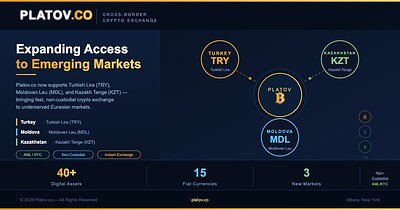
Platov.co Targets Eurasia in Crypto Expansion Amid Regulatory Shifts
ALBANY, NY – March 05, 2026 – Cross-border cryptocurrency exchange Platov.co announced a significant expansion today, adding support for the Turkish Lira (TRY), Moldovan Leu (MDL), and Kazakh Tenge (KZT). The move aims to deepen the platform's footprint in the Commonwealth of Independent States (CIS) and broader Eurasian markets, targeting regions characterized by soaring crypto adoption and rapidly evolving financial regulations.
In a statement from its Albany headquarters, the company detailed that the expansion includes integration with major international payment providers to facilitate smoother crypto-to-fiat conversions for users in Turkey, Moldova, and Kazakhstan. This strategic pivot addresses a growing demand for accessible digital asset services in markets where economic pressures and gaps in traditional banking have fueled a surge of interest in cryptocurrencies.
"Expanding access to emerging markets in the CIS region and Eurasia is central to our mission," said Sam Greenfield, Founder & CEO of Platov.co, in the official press release. "By supporting local fiat currencies and trusted payment methods, we're removing barriers that prevent millions from participating in the digital economy."
Tapping into High-Demand, High-Stakes Markets
The selection of these three nations is far from arbitrary. Each represents a unique and powerful trend in global crypto adoption. Turkey has solidified its position as a crypto powerhouse, ranking as the fourth-largest crypto market globally by transaction volume in 2025. Driven by persistent high inflation and the depreciation of the Lira, Turkish citizens have turned to digital assets like Bitcoin and Tether as a hedge, with trading volume for Lira-to-crypto pairs exploding by over 800% since 2021. For many, crypto is less a speculative investment and more a necessary tool for wealth preservation.
Meanwhile, Moldova has quietly emerged as a leader in per-capita crypto acceptance. A 2025 Chainalysis report ranked the country second globally in crypto adoption by population, a trend fueled by economic instability and a deep-seated distrust in traditional financial institutions. With a technically literate population seeking alternatives for capital preservation and cross-border transactions, Moldova presents a fertile ground for platforms that can offer reliable access to the digital economy.
Kazakhstan offers a different but equally compelling narrative. The government is actively cultivating the nation as a regional crypto hub, centered around the Astana International Financial Centre (AIFC). The number of users on AIFC-licensed platforms has grown by over 35% in the last year alone, and the country is piloting initiatives like crypto-backed payment cards. This state-driven push for regulated adoption signals a structured and growing demand for compliant and accessible exchange services.
Navigating a Complex Regulatory Maze
While demand is high, Platov.co is entering a trio of complex and shifting regulatory environments. The company's stated focus on "advanced AML/KYC verification protocols" will be critical to its survival and success. In Turkey, while crypto trading is legal, the central bank banned the use of digital assets for domestic payments in 2021. More recent legislation from 2024 and 2025 established a strict licensing regime for Crypto Asset Service Providers (CASPs), requiring adherence to stringent compliance and identity verification rules. Platov.co's ability to operate as a compliant exchange for converting crypto to Lira, rather than a payment processor, will be key.
Moldova is at a crucial inflection point. The country is on track to adopt a comprehensive legal framework for crypto by the end of 2026, aligning its rules with the European Union's landmark Markets in Crypto-Assets (MiCA) regulation. This will transform the market from one previously described as having "prohibitive legislation" to one with a clear, albeit strict, set of rules. Platov.co's entry is timed to capitalize on this move towards regulatory clarity, positioning it as an early, compliant player in a newly structured market.
In Kazakhstan, the path to operation is through regulation. The AIFC acts as a gatekeeper, licensing a select number of exchanges and maintaining a "Green List" of approved digital assets. To operate legally, Platov.co would need to secure a license and integrate into this highly structured ecosystem. The government's plan to roll out a state-run crypto custody service by mid-2026 further underscores its hands-on approach to managing the sector's growth.
A Strategic Play in a Crowded and Emerging Field
Platov.co's success will depend on its ability to differentiate itself within each country's unique competitive landscape. In Turkey, it faces a market of established giants. Local exchanges like BtcTurk and Paribu boast millions of users and deep integration with Turkish banks, while international behemoth Binance TR dominates trading volumes. Platov.co's non-custodial model—where the platform does not hold user funds, mitigating risks of a centralized hack—and its focus on streamlining cross-border transactions could be its core competitive advantages.
In Moldova, the company has more of an early-mover advantage. With the market still nascent and formal competition limited ahead of the 2026 regulations, establishing a trusted presence now could secure significant market share. By supporting the Moldovan Leu and integrating with international payment systems, the platform provides a crucial on-ramp that has been largely absent.
The challenge in Kazakhstan is to become part of the establishment. The market is not a free-for-all but a curated garden of licensed providers. Here, Platov.co's competitive edge will be its ability to meet the AIFC's rigorous compliance standards while offering a superior user experience, a wider array of supported assets, or more efficient fiat conversions than the dozen or so exchanges already licensed to operate. By supporting over 40 cryptocurrencies, it offers a broader selection than many regionally-focused platforms, which could appeal to more sophisticated traders within the country's burgeoning crypto scene.