
- 70+ patents held by PhotonIC Technologies
- 40 million integrated circuits shipped worldwide
- 100 million units in design wins through 2027
Experts would likely conclude that PhotonIC's ROCS platform represents a strategic advancement in mitigating semiconductor supply chain risks, offering customers unprecedented flexibility and resilience through multi-region manufacturing and dual-technology optimization.
PhotonIC Unveils ROCS Platform to De-Risk Chip Supply Chains
By Sharon Kelly
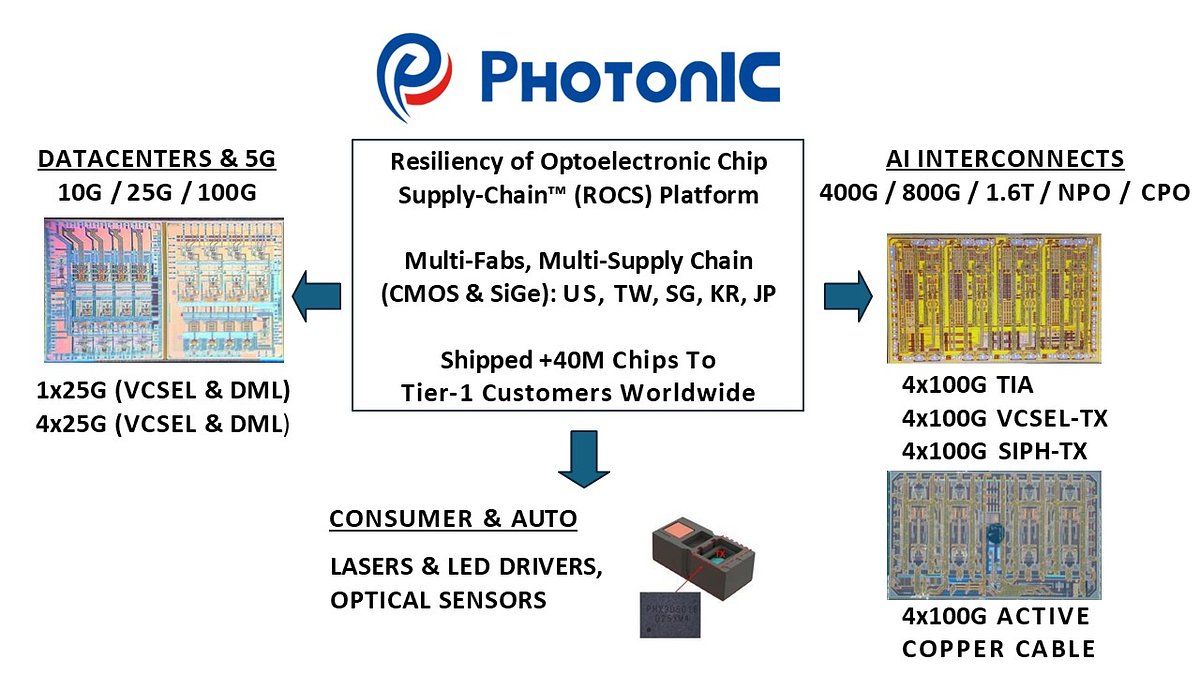
LOS ANGELES, CA – February 27, 2026 – In a direct response to the escalating volatility in the global semiconductor market, fabless optoelectronic chip designer PhotonIC Technologies today launched a comprehensive product portfolio built on its new Resiliency of Optoelectronic Chip Supply-Chain™ (ROCS) platform. The initiative is engineered to give customers a new level of control over manufacturing strategy, performance, and geopolitical risk by leveraging a network of geographically diverse fabrication plants.
As the world grapples with the dual pressures of soaring demand from the AI revolution and the fragility of a highly concentrated manufacturing base, PhotonIC’s strategy marks a significant move toward building a more stable foundation for the world’s digital infrastructure. The company plans to showcase a range of production-ready chips, from 10G to 1.6T, at the upcoming OFC 2026 conference in Los Angeles, signaling that its resilience-focused approach is ready for commercial deployment.
A Platform Built for a Volatile World
The past several years have served as a harsh lesson in supply chain vulnerability. The COVID-19 pandemic exposed deep-seated weaknesses, with factory shutdowns and logistical nightmares creating a global chip shortage that hobbled industries from automotive to consumer electronics. More recently, geopolitical tensions have added another layer of uncertainty. The heavy concentration of advanced semiconductor manufacturing in East Asia, particularly Taiwan, has become a focal point of concern for governments and corporations worldwide, prompting a frantic push to diversify.
It is this landscape of risk that PhotonIC's ROCS platform is designed to navigate. By creating chip designs that are portable across multiple CMOS and Silicon-Germanium (SiGe) processes in fabs located in the United States, Korea, Japan, Singapore, and Taiwan, the company offers its customers an unprecedented level of flexibility. This multi-fab, multi-region approach means that a disruption in one country or a capacity constraint at one foundry does not have to bring a customer’s production to a halt. Instead, manufacturing can be shifted to an alternative, pre-qualified site, mitigating delays and ensuring supply continuity.
This strategy moves beyond mere disaster recovery; it offers a strategic advantage. Customers are no longer locked into a single process or supplier, giving them the power to optimize for cost, performance, and regional stability based on their specific needs and the evolving global climate. This built-in redundancy is a powerful selling point in an industry where a single point of failure can have billion-dollar consequences.
Balancing Speed and Scale with a Dual-Tech Strategy
PhotonIC’s platform is not just about resilience; it is also a masterclass in technological optimization. The insatiable data appetite of AI and cloud computing has created a bifurcated demand: the need for cost-effective, high-volume components for general cloud infrastructure, and the simultaneous need for ultra-high-performance, bleeding-edge interconnects to power AI clusters. The ROCS platform addresses both through its strategic use of two distinct semiconductor technologies.
For high-volume cloud applications, such as 25G and 100G connectivity, the platform leverages mature, cost-efficient CMOS processes. CMOS is the workhorse of the semiconductor industry, known for its scalability and low power consumption, making it ideal for the massive, price-sensitive deployments typical of large-scale data centers. This allows PhotonIC to offer solutions that balance performance with manufacturability and cost, a critical combination for the cloud market.
However, when it comes to the extreme speeds required by modern AI interconnects, the company shifts to advanced Silicon-Germanium (SiGe). SiGe offers superior high-frequency performance, enabling the development of chips for 400G, 800G, and the emerging 1.6T standards. These speeds are essential for the massive parallel processing that underpins large language models and other AI workloads, where minimizing latency is paramount. By using SiGe for these high-performance linear-drive applications, PhotonIC positions itself at the forefront of the AI infrastructure boom.
This dual-tech approach allows the company to serve a broad market without compromise, using the right tool for every job—from cost-effective scale to record-breaking speed.
From Design Wins to Mass Production
While the ROCS platform is a new announcement, PhotonIC is not a new player. The company brings significant market experience and credibility to its latest initiative, holding over 70 patents and having already shipped over 40 million integrated circuits worldwide. This track record is bolstered by a claim of design wins for a cumulative 100 million units through 2027, with a client roster that includes Tier-1 customers like Nokia, ST-Micro, Accelink, and Hisense across the 5G, sensing, automotive, and datacenter markets.
This existing market traction provides a strong foundation for the ROCS launch. The company's upcoming demonstrations at OFC 2026, the premier global event for optical communications, are poised to turn its strategic vision into tangible reality. PhotonIC will be showcasing several mass-production-ready products, including 4x100Gb VCSEL transmitter and receiver chipsets for linear pluggable optics and 4x100G redriver ICs for active copper cables. The availability of these products underscores that this is not a long-term roadmap but a near-term solution to today's problems.
Furthermore, the company will be sampling chips for Co-Packaged Optics (CPO), a next-generation technology that promises to further reduce power consumption in data centers by integrating optics and electronics more tightly. By demonstrating capabilities across current and future technologies, PhotonIC is making a clear statement about its ambitions.
"Process, manufacturing, and supply-chain strategy can no longer be treated separately," said Dr. Frank Shi, CEO of PhotonIC Technologies, in the company's announcement. "Our ROCS platform integrates scalable, low-power CMOS with high-performance SiGe across multi-region manufacturing partnerships, strengthening supply resilience and giving customers confidence in on-time, on-budget delivery, and long-term scalability." This integrated approach, combining technological innovation with a robust, de-risked manufacturing network, may well set a new standard for the optoelectronic semiconductor industry as it builds the backbone for the next era of computing.