
- $29.7 million contract awarded to Beehive Industries for 3D-printed jet engines
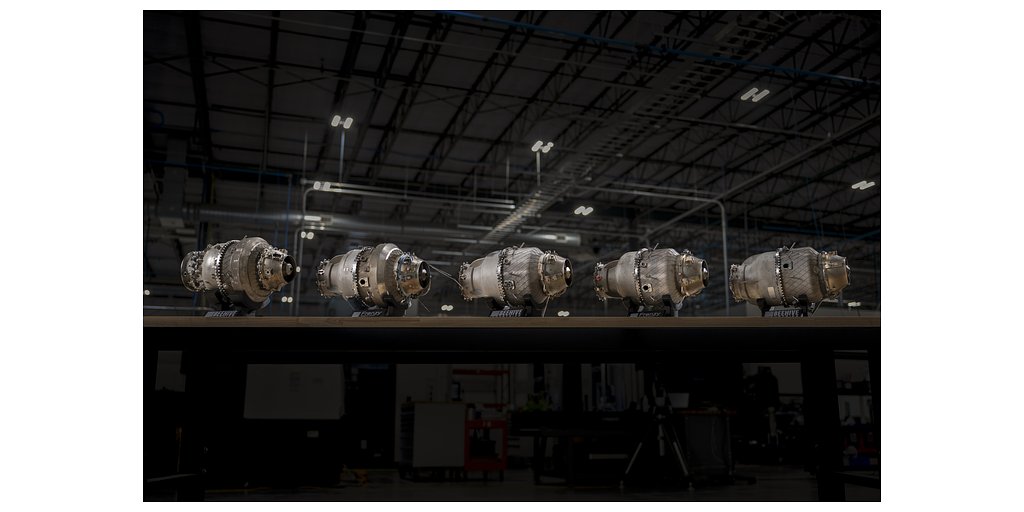
- Frenzy™ 8 engine (200 lbf thrust) and Frenzy™ 6 engine (100 lbf thrust) to power future drone swarms
- Beehive's expansion from 40,000 to 170,000 sq. ft. to support mass production
Experts view this as a strategic shift towards 'affordable mass' deterrence, leveraging 3D printing to produce cost-effective, expendable drones at scale.
Pentagon Bets on 3D-Printed Engines for Future Drone Swarms
DENVER, CO – April 09, 2026 – The U.S. Air Force has awarded Beehive Industries, a Denver-based advanced propulsion manufacturer, a $29.7 million contract to finalize and scale production of its 3D-printed jet engines. The deal is a significant step in the Pentagon's radical strategic shift towards a new generation of low-cost, mass-produced weapons designed for an era of great power competition.
The contract focuses on Beehive's Frenzy™ engine family, specifically funding the final testing and qualification of the 200 lbf thrust Frenzy™ 8 engine. It also provides funds to advance the smaller 100 lbf Frenzy™ 6, which will power a new class of expendable drones and munitions. This award moves Beehive's innovative engines out of the lab and onto a clear path for large-scale production, directly supporting a sweeping Pentagon initiative to build a larger, more affordable arsenal.
The Pentagon's Pivot to 'Affordable Mass'
This contract is not a routine procurement; it is a cornerstone of the Air Force's "Family of Affordable Mass Munitions" (FAMM) program. Managed through the Air Force Life Cycle Management Center, FAMM is a multi-billion-dollar, Pentagon-wide effort to counter the rising cost and shrinking inventories of high-end weaponry. The strategic goal is to move away from relying solely on small numbers of expensive, "exquisite" systems and instead build the capacity to deploy thousands of cheaper, attritable, or expendable uncrewed systems.
The underlying doctrine, known as affordable mass, aims to create a new form of deterrence by overwhelming potential adversaries with sheer numbers. In a future conflict, the U.S. military envisions deploying swarms of networked drones and smart munitions that are effective yet inexpensive enough to be lost in combat without catastrophic strategic or financial consequences. This requires a fundamental rethinking of the defense industrial base, starting with the most critical components—like jet engines.
Beehive is one of several companies benefiting from this strategic pivot. The Air Force has also awarded contracts to firms like PBS Aerospace for similar small turbine engines, and to Anduril and Zone 5 Technologies for related munition development, signaling a broad effort to cultivate a new ecosystem of suppliers capable of delivering on the FAMM vision.
"Beehive is honored to partner with the U.S. Air Force in redefining the speed of defense," said Gordie Follin, Chief Product Officer at Beehive Industries, in a statement. "By harnessing additive manufacturing to collapse complex supply chains into scalable, 3D-printed propulsion, we are providing the ‘affordable mass’ essential to modern deterrence."
A Manufacturing Revolution in Metal
At the heart of Beehive's capability—and the FAMM initiative's feasibility—is additive manufacturing (AM), more commonly known as 3D printing. While AM has been used in aerospace for prototyping for years, companies like Beehive are pioneering its use for the serial production of flight-critical hardware.
By using laser-powder bed fusion machines, Beehive can print complex engine components, consolidating what would traditionally be dozens or even hundreds of individual parts into a single, optimized unit. This "additive-first" approach provides several revolutionary advantages:
* Speed: Design cycles that once took years can be compressed into months. Beehive validated its Frenzy 8 engine through ground and high-altitude testing in record time.
* Cost: AM drastically reduces material waste and eliminates the need for expensive tooling, molds, and complex assembly lines, driving down the per-unit cost of each engine.
* Performance: 3D printing allows for the creation of intricate internal cooling channels and complex geometries that are impossible to produce with traditional casting or machining, leading to lighter, more efficient, and higher-performance engines.
This technological leap is not happening in a vacuum. It mirrors a broader trend across the defense sector, where industry leaders like GE Aviation and Lockheed Martin are increasingly integrating AM to build everything from next-generation fighter jet components to satellite structures. The technology is seen as a critical tool for enhancing supply chain resilience, enabling on-demand production of spare parts, and giving the U.S. a decisive manufacturing edge.
From Startup to Scale-Up
Founded just six years ago in 2020, Beehive Industries' rapid ascent illustrates the changing dynamics of the defense industry. The $29.7 million award is a powerful validation of its technology and a signal that the Pentagon is increasingly turning to agile, innovative startups to solve its most pressing challenges.
The company has been on an aggressive growth trajectory to position itself for this moment. In the past year alone, Beehive has expanded its footprint from 40,000 to nearly 170,000 square feet. This includes a new 60,000-square-foot headquarters and production facility in Centennial, Colorado, and a similarly sized facility in Knoxville, Tennessee, strategically located near the advanced manufacturing expertise of Oak Ridge National Laboratory.
This expansion is backed by a demonstrated ability to deliver. The company's internal "Pathfinder" program successfully validated its ability to scale production, proving it could transition from a development-focused R&D shop to a production-ready propulsion provider. With a workforce that has grown to over 200 employees and plans for further hiring, Beehive is gearing up to begin mass engine production this year, moving from building dozens of engines to potentially thousands.
Reshaping the Defense Industrial Base
The rise of companies like Beehive and the embrace of additive manufacturing signal a profound disruption for the traditional defense supply chain. For decades, the model has relied on a tiered system of established prime contractors and specialized suppliers, often characterized by long lead times, high costs, and supply chain vulnerabilities.
The new paradigm of "point-of-need sustainment" enabled by AM promises to create a more resilient and responsive industrial base. Instead of shipping a replacement part from a depot halfway around the world, a digital file could be sent to a forward-deployed 3D printing hub to manufacture the component on-site, drastically reducing downtime and logistical burdens.
This shift creates immense opportunities for tech-forward companies but poses a significant challenge to established players who are slow to adapt. The defense landscape is evolving into one where mastery of digital design, advanced materials, and scalable manufacturing processes is as critical as traditional engineering prowess. The successful qualification of the Frenzy engine family will serve as a powerful proof case for this new model, paving the way for a future where America's defense superiority is measured not just by the quality of its weapons, but by its ability to produce them at speed and scale.