
- $80 million: Total philanthropic donations by Peach Bowl, Inc. since inception, with $5.4 million distributed in the last season alone.
- $29.1 million in revenue and $23.1 million in expenses for the fiscal year ending May 2024, maintaining over $76 million in assets.
- $1.6 billion cumulative economic impact on Atlanta since 2002, with the 2025-26 season alone contributing an estimated $111 million.
Experts would likely conclude that Peach Bowl's new CEO, David Epps, is strategically positioning the organization to thrive in the NIL era by leveraging its deep institutional knowledge and innovative partnerships to redefine neutral-site games and enhance athlete value.
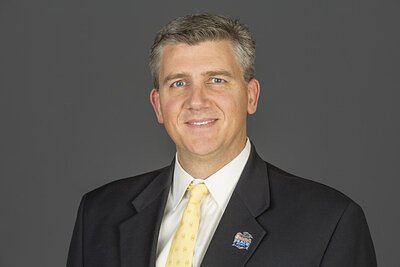
Peach Bowl's New CEO Unveils a New Playbook for the NIL Era
ATLANTA, GA – June 02, 2026 – In the turbulent world of college football, where legacy institutions are scrambling to adapt, Peach Bowl, Inc. just made a telling move. By promoting David Epps to Chief Executive Officer, the organization didn't just fill a leadership vacancy; it signaled a strategic commitment to navigating—and profiting from—the sport's unprecedented disruption. Epps, a 30-year veteran who started as an intern, takes command at what he calls an "inflection point within an inflection point," a moment where the very business model of collegiate athletics is being rewritten in real-time.
While the press release marks a formal transition of power from the successful tenure of retiring CEO Gary Stokan, the real story lies in the playbook Epps is already executing. With conference realignment shredding tradition, the transfer portal creating free agency, and Name, Image, and Likeness (NIL) deals transforming amateurism into a sophisticated market, survival requires more than just hosting a good football game. It demands innovation. For the Peach Bowl, that innovation is a calculated, multi-million-dollar bet on a new way to do business.
Redefining the Neutral-Site Game
The most significant tell of Epps's strategic direction is not in his title but in a groundbreaking deal he recently architected. Under his leadership as COO, the organization pioneered a "first-of-its-kind" NIL model for its Aflac Kickoff Game, starting with a partnership with Auburn University. This isn't just about adding a new revenue stream; it's a fundamental re-engineering of the value proposition for neutral-site games.
Traditionally, universities weigh the loss of a home game against a guaranteed payout and national exposure. The Peach Bowl's new model adds a powerful new variable to the equation: a structured, multi-million-dollar NIL package for the school's student-athletes. The organization is leveraging its own corporate partnerships to create marketing assets and promotional appearances for players, turning the game into a direct financial opportunity for the athletes themselves. In essence, the Peach Bowl is no longer just a platform for teams, but a facilitator for the burgeoning athlete economy.
This is a masterstroke in the current environment. It addresses the most pressing needs of its partners—the universities—who are locked in an arms race for talent where NIL opportunities are a primary weapon. By helping schools like Auburn secure lucrative, compliant NIL deals for their players, the Peach Bowl makes its kickoff event exponentially more attractive than a standard neutral-site matchup. It transforms the game from a one-off exhibition into a strategic component of a university's recruitment and retention strategy. This forward-thinking approach positions the Atlanta-based entity not as a passive stage, but as an active, indispensable partner in the new era of college sports.
The 30-Year Game Plan
Epps's ascent is the kind of story that seems almost anachronistic in today's job-hopping corporate culture. Beginning as an intern in 1994, he has spent his entire professional life inside the organization, a journey that provides him with unparalleled institutional knowledge. This is a classic case of a board choosing deep-seated expertise and a proven track record over the potential disruption of an outside hire.
"David's leadership, experience and deep understanding of both the Chick-fil-A Peach Bowl and the changing college football landscape make him the ideal leader to guide this organization forward," said Percy Vaughn, the organization's board chair. This sentiment underscores the board's confidence that Epps is uniquely equipped to protect the bowl's legacy while aggressively pursuing growth.
His long tenure has seen him instrumental in every major milestone, from elevating the bowl to its current status as a College Football Playoff host to the creation of the season-opening kickoff games. This isn't a leader who needs to get up to speed; he's the one who helped build the engine. His deep Atlanta roots—growing up attending games and later earning a master's from the University of Georgia—further entwine his personal story with the organization's civic identity. This long-term, inside perspective allows for a disciplined approach to innovation, ensuring that new ventures like the NIL model are built on a stable, successful foundation rather than being Hail Mary passes born of desperation.
The Bottom Line: More Than a Game
Beyond the gridiron, Peach Bowl, Inc. operates as a significant economic and philanthropic engine for its home city. As a 501(c)3 non-profit, its mission explicitly ties its sporting events to charitable impact, and the numbers are staggering. The organization stands as college football's most charitable bowl, having donated over $80 million to philanthropic causes, with $5.4 million distributed in the last season alone. Beneficiaries range from the Aflac Cancer and Blood Disorders Center at Children's Healthcare of Atlanta to the Boys & Girls Club of Metro Atlanta.
This charitable work is funded by a highly efficient business operation. In the fiscal year ending May 2024, the entity reported $29.1 million in revenue against $23.1 million in expenses, maintaining over $76 million in assets. The cumulative economic impact on Atlanta has surpassed a projected $1.6 billion since 2002, with events from the 2025-26 season alone contributing an estimated $111 million. The CFP Semifinal at the Chick-fil-A Peach Bowl consistently sells out, drawing massive television audiences and tourism dollars into the city.
Under Epps, the strategy is clear: continue executing these core events at the highest level while using that operational and financial strength as a platform for growth. His challenge is to maintain this momentum in a market defined by constant change. By tackling the NIL chaos head-on and turning it into a competitive advantage, David Epps is not just preparing the Peach Bowl for the future of college football; he is actively working to define it.