
- 20 kilometers: The FiberPlex™ TKIT-12G SDI Fiber Converter/Extender Kits can extend 12G-SDI signals up to 20 kilometers over single-mode optical fiber, doubling the typical range of competing products. - Two configurations: Available in single-channel (TKIT-12G/1CH) and dual-channel (TKIT-12G/2CH) versions for flexible deployment. - US-manufactured: The kits are built domestically, enhancing supply chain security and resilience for critical infrastructure.
Experts would likely conclude that Patton's new FiberPlex™ TKIT-12G SDI Fiber Converter/Extender Kits represent a significant advancement in long-haul 4K video transport, offering extended range, robust construction, and strategic domestic manufacturing advantages that address critical needs in broadcast and production workflows.
Patton Fortifies SDI with Rugged, US-Made 4K Fiber Kits
GAITHERSBURG, Md. – April 23, 2026 – Patton Electronics Co. today announced the pre-order availability of its new FiberPlex™ TKIT-12G SDI Fiber Converter/Extender Kits, a US-manufactured solution designed to transport broadcast-quality 4K video over remarkable distances. The kits promise to extend 12G-SDI signals up to 20 kilometers over single-mode optical fiber, directly addressing the growing demand for high-bandwidth, long-haul video transport in modern production workflows.
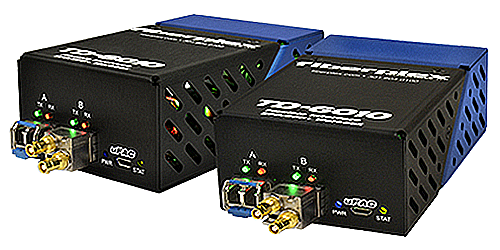
The launch introduces two configurations: the TKIT-12G/1CH for single-channel bidirectional transport and the TKIT-12G/2CH for dual-channel applications. Housed in a compact, ruggedized casing described as "throw-down tough," the converters are built for demanding field environments, from live event production to remote camera setups. "The TKIT-12G proves our commitment to providing broadcast professionals with reliable, problem-solving connectivity solutions," said Tim Godby, Director of Media Transport Systems at Patton. This release enters a competitive market, but Patton aims to differentiate itself through extended range, robust construction, and a strategic emphasis on domestic manufacturing.
The 'Made in USA' Advantage in Critical Infrastructure
In an industry where supply chain disruptions can halt multi-million dollar productions, Patton's decision to manufacture the FiberPlex TKIT-12G series in the United States is a significant strategic move. This domestic production model offers enhanced supply chain security and resilience, insulating customers from the geopolitical risks and logistical delays that can plague overseas manufacturing. For broadcasters and production houses that depend on equipment uptime, this reliability is a critical purchasing consideration.
This commitment to US manufacturing was recently solidified by Patton's acquisition of Practical Technologies Inc. (PTI) in early 2026, which expanded its domestic production footprint. This move not only enhances quality control oversight but also positions the company to better serve clients with stringent sourcing requirements, such as government agencies and defense contractors. For these sectors, a secure, verifiable supply chain is often a non-negotiable requirement for critical communications and surveillance infrastructure. The "Made in USA" label, therefore, transitions from a marketing point to a key feature, promising a higher degree of quality assurance and logistical stability for mission-critical applications.
Bridging the Distance in 4K Remote Production
The technical specifications of the TKIT-12G kits are squarely aimed at solving one of the biggest challenges in modern broadcasting: moving uncompressed 4K video over long distances without signal degradation. The kits' ability to transport a 12G-SDI signal—capable of carrying 4K video at 60 frames per second—up to 20 kilometers is a notable achievement. This doubles the typical 10-kilometer range offered by many competing products from industry mainstays like Blackmagic Design and AJA Video Systems.
This extended reach is particularly valuable for the burgeoning field of remote production. It allows production crews to place cameras at greater distances from mobile units or central control rooms, covering expansive venues like golf courses, racing circuits, or large-scale music festivals with fewer points of failure. The use of a single fiber optic cable simplifies rigging and reduces weight compared to multi-link copper-based solutions, which become impractical over such distances. Furthermore, the kits' "throw-down tough" design ensures they can withstand the rigors of field deployment, where equipment is often subjected to harsh handling and environmental exposure. By delivering a reliable, long-haul signal path in a durable package, Patton is providing a practical tool for engineers and technical directors pushing the boundaries of live and remote content creation.
Navigating the SDI to IP Transition
The introduction of a high-performance 12G-SDI product occurs against the backdrop of the broadcast industry's ongoing, and often complex, migration toward all-IP workflows. While IP-based systems like SMPTE ST 2110 offer unprecedented flexibility and scalability, Serial Digital Interface (SDI) remains a deeply entrenched and trusted standard, prized for its reliability, low latency, and plug-and-play simplicity.
Patton's investment in an advanced SDI solution signals a belief in the standard's enduring relevance. Rather than being a legacy holdout, 12G-SDI represents a powerful evolution, enabling single-cable 4K transport that simplifies infrastructure and avoids the complex timing and synchronization challenges of earlier quad-link SDI setups. For many broadcasters, a robust SDI backbone remains the most reliable choice for uncompressed video transport within a studio or for critical live feeds. Patton's strategy appears to be a pragmatic one, supporting both sides of the technological divide. Through its Artel Video Systems brand, the company is also developing ST 2110 gateways and other IP-based solutions, positioning itself as a key partner for facilities operating in hybrid SDI-IP environments. The FiberPlex TKIT-12G, therefore, serves not only to fortify existing SDI workflows but also to provide a high-quality, reliable bridge for content moving into or out of an IP core.
Under the Hood: Engineered for Broadcast Excellence
Beyond the headline features, the FiberPlex TKIT-12G series incorporates several key technologies essential for maintaining broadcast-quality signals. The units feature "auto-sensing intelligence," which automatically detects and adapts to various SDI formats, including 12G, 6G, 3G, HD, and SD-SDI. This plug-and-play capability simplifies integration into diverse production environments where multiple video standards are in use.
Crucially, the kits ensure "lossless transmission" through an integrated re-clocker and cable driver. In digital video, jitter—or timing variations in the signal—can accumulate over long cable runs, leading to data errors and visible artifacts, a phenomenon known as the "sparkle effect." The re-clocker regenerates the signal at each end, stripping out jitter and restoring it to its original, clean state. This is vital for maintaining the integrity of high-bandwidth 12G-SDI signals over the full 20-kilometer distance.
Full compliance with a suite of SMPTE standards, including ST 2082 (12G-SDI) and ST 424M (3G-SDI), guarantees interoperability with a wide range of professional cameras, switchers, routers, and monitors. The added support for DVB-ASI, a common format for compressed video transport streams, further enhances the kits' versatility, allowing them to be used for contribution and distribution links in addition to raw camera feeds. These technical underpinnings demonstrate a focus on the uncompromising performance and reliability that broadcast professionals demand.
Topics & Related
Software & SaaS
Digital Transformation
Related Company Pulse