
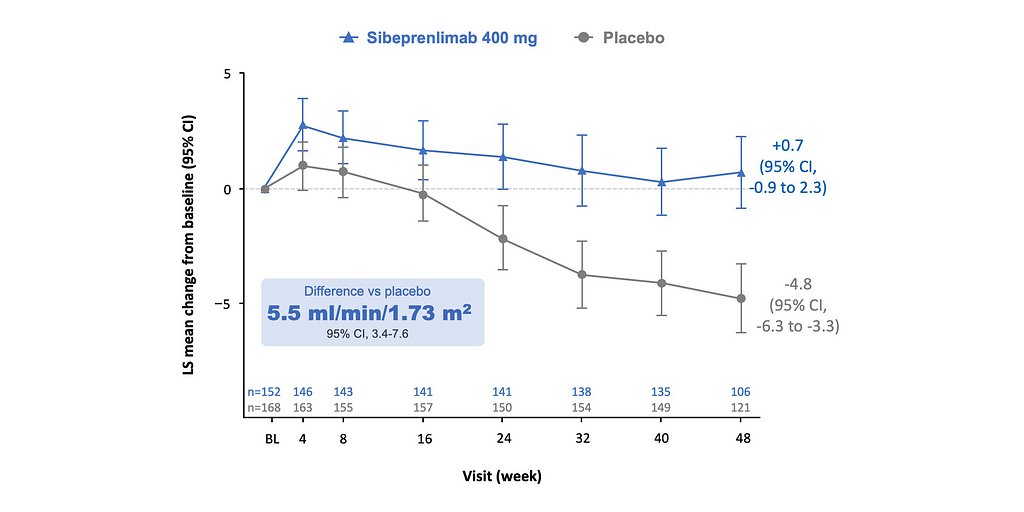
- eGFR Improvement: VOYXACT demonstrated a mean increase of +0.7 mL/min/1.73 m² in kidney function, while the placebo group saw a decline of -4.8 mL/min/1.73 m², resulting in a 5.5 mL/min/1.73 m² treatment effect.
- Annualized eGFR Decline: VOYXACT reduced the annualized eGFR decline to -3.0 mL/min/1.73 m²/year compared to -7.6 mL/min/1.73 m²/year with placebo.
- Safety Profile: VOYXACT was generally well-tolerated, with adverse events occurring at rates comparable to placebo.
Experts would likely conclude that Otsuka's VOYXACT represents a significant advancement in IgA nephropathy treatment, offering robust kidney function preservation and setting a new benchmark for efficacy in the nephrology market.
Otsuka's VOYXACT Data Signals a New Era in Kidney Disease Treatment
PRINCETON, NJ – June 04, 2026 – In the high-stakes world of biopharmaceutical development, a company’s most powerful signal is not a marketing campaign, but a data readout that reshapes a treatment landscape. Otsuka Pharmaceutical just sent such a signal. The presentation of interim Phase 3 data for its IgA nephropathy (IgAN) drug, VOYXACT® (sibeprenlimab-szsi), at the European Renal Association (ERA) Congress 2026 was more than a clinical update; it was a strategic declaration of intent to dominate the future of nephrology.
The data is compelling: VOYXACT didn't just meet its endpoints, it demonstrated the ability to preserve actual kidney function over 12 months, a feat that moves beyond symptom management to fundamentally alter the course of a progressive disease. For Otsuka, this result is the culmination of a shrewd strategy, leveraging an accelerated FDA approval into a commanding position backed by the very evidence the market, physicians, and patients have been waiting for.
A Landmark Shift in Treating IgAN
For decades, treating IgA nephropathy—a chronic autoimmune disease that often strikes young adults and is a leading cause of kidney failure—has been a frustrating exercise in managing decline. The primary goal was to slow the inevitable loss of kidney function using supportive care like blood pressure medications. More recently, novel therapies have gained approval based on their ability to reduce proteinuria (excess protein in the urine), a key surrogate marker for disease progression.
Otsuka’s new data, however, represents a paradigm shift. The pre-specified interim analysis of the VISIONARY Phase 3 trial showed that patients treated with VOYXACT experienced a mean increase in estimated glomerular filtration rate (eGFR)—a direct measure of kidney function—of +0.7 mL/min/1.73 m². In stark contrast, the placebo group saw a decline of -4.8 mL/min/1.73 m². This staggering 5.5 mL/min/1.73 m² treatment effect suggests VOYXACT can effectively halt the disease's destructive march.
“For patients with IgA nephropathy, slowing the loss of kidney function is essential to improve long-term outcomes, including the likelihood of kidney failure and the need for dialysis or transplant,” said Vlado Perkovic, MBBS, Ph.D., a lead investigator, in a statement. “These data are very encouraging and suggest that selective inhibition of APRIL may slow eGFR decline.”
This outcome aligns perfectly with the latest Kidney Disease: Improving Global Outcomes (KDIGO) guidelines, which have raised the bar for treatment success, emphasizing the stabilization of eGFR with an annual loss of no more than 1 mL/min/1.73 m². VOYXACT’s performance at 12 months meets this ambitious goal, positioning it not just as another option, but as a potential new standard of care that directly addresses the ultimate objective of treatment: preserving the organ itself.
Otsuka's Strategic Play for Nephrology Dominance
This clinical victory is the payoff for a meticulously executed corporate strategy. Otsuka secured accelerated FDA approval for VOYXACT on November 25, 2025, based on its ability to reduce proteinuria. This was a critical first step, establishing a market foothold and a first-mover advantage as the only approved therapy that selectively inhibits A-PRoliferation-Inducing Ligand (APRIL), a key driver of the pathogenic IgA production that causes the disease.
But accelerated approval is a calculated risk, contingent on future data confirming clinical benefit. This new eGFR data is precisely that confirmation. It provides powerful evidence that the drug’s mechanism translates into tangible, long-term organ preservation. As John Kraus, M.D., Ph.D., Otsuka's chief medical officer, noted, these findings “strengthen the rationale for selective APRIL inhibition as a targeted approach that modulates B-cell activity to reduce pathogenic IgA production, without B-cell depletion.”
This targeted approach, combined with a favorable safety profile comparable to placebo, gives Otsuka a formidable competitive edge. The IgAN market is rapidly heating up, with recent approvals for therapies like Calliditas Therapeutics' Tarpeyo (targeted-release budesonide), Travere Therapeutics' Filspari (a dual receptor antagonist), and Novartis' Fabhalta (a complement inhibitor). Furthermore, a decision on another APRIL-targeting agent, atacicept, is expected from the FDA in July 2026. Yet, by presenting robust eGFR preservation data, Otsuka has set a new benchmark for efficacy that competitors will be hard-pressed to meet. The company has already initiated a rolling submission for traditional FDA approval, signaling its confidence that the full 24-month data from the VISIONARY trial will cement VOYXACT’s market-leading status.
Beyond the Numbers: A New Horizon for Patients
Behind the market analysis and statistical significance lies the profound human impact of this development. For the millions living with IgAN, the typical prognosis involves a slow but steady decline toward dialysis or the need for a kidney transplant. This new data offers a different future—one where their own kidneys might be preserved for years, or even decades, longer.
Translating the clinical results, an annualized eGFR decline of -3.0 mL/min/1.73 m²/year with VOYXACT versus -7.6 mL/min/1.73 m²/year with placebo is a life-altering difference. It represents a significant slowing of the disease, buying precious time and improving quality of life. The treatment, a self-administered subcutaneous injection once every four weeks, also offers a manageable regimen for long-term therapy.
Critically, this benefit does not appear to come at the cost of significant safety issues. The press release confirms VOYXACT was generally well-tolerated, with the most common adverse events, such as infections and injection site reactions, occurring at rates comparable to placebo. This balance of potent efficacy and manageable safety is the holy grail for any chronic disease therapy, boosting the likelihood of both physician adoption and patient adherence.
With these results, Otsuka has successfully moved VOYXACT from a promising drug to a potential franchise cornerstone. The data presented at the ERA Congress was not just an update; it was a clear signal to competitors, investors, and the medical community that the standard for treating IgA nephropathy is rising, and Otsuka is leading the way.