
- 1,000,000 drones/year: Orqa's target production capacity under its Global Manufacturing Partnership Program.
- 280,000 drones/year: Current annual production capacity at Orqa's headquarters in Osijek, Croatia.
- $160 billion: Projected global drone manufacturing market size by 2033, up from $65 billion in 2025.
Experts view Orqa's decentralized production model as a strategic shift that enhances supply chain resilience and technological sovereignty for Western defense sectors, aligning with growing global demand for high-performance drones.
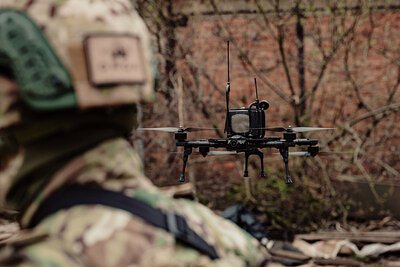
Orqa's Million-Drone Plan Aims to Reshape Global Defense Production
OSIJEK, Croatia – December 23, 2025 – In a move poised to significantly alter the landscape of global defense technology, Croatian drone manufacturer Orqa has announced an ambitious plan to scale its production capacity to over one million unmanned aerial systems (UAS) per year. The initiative, named the Global Manufacturing Partnership Program, seeks to create a decentralized network of production facilities across allied nations, directly addressing the soaring demand for secure, high-performance drones and challenging the market dominance of Chinese manufacturers.
The announcement positions Orqa, Europe's leading developer of first-person view (FPV) systems, as a central player in the strategic push for technological sovereignty and supply chain resilience among Western nations. Building from a formidable base, the company already operates a fully vertically integrated headquarters in Osijek, Croatia, capable of producing 280,000 NDAA-compliant, Chinese-component-free drones annually.
A New Blueprint for Defense Manufacturing
Orqa's strategy marks a departure from traditional centralized manufacturing. Instead of scaling up a single mega-factory, the company is exporting its production model. Through strategic partnerships already established in North America, Europe, the Middle East, and the Indo-Pacific, Orqa will provide its standardized, proprietary components and engineering oversight to local manufacturers. This allows partner nations to build the same advanced drone systems in-country, creating a distributed and resilient production network.
"We are a rapidly growing business with the capacity to produce 280,000 drones at our headquarters alone," said Srdjan Kovacevic, CEO of Orqa. "Our Global Manufacturing Partnership Program extends this capability by enabling allied markets to produce the same high-performance systems using Orqa's standardized components. The agreements we've already secured put us on track to achieve our target capacity of one million drones per year, a significant milestone at a time when global security challenges are evolving rapidly."
This federated approach is designed to yield multiple strategic advantages. It dramatically reduces logistical complexity and shipping times, allowing for faster delivery to military and enterprise clients. Furthermore, it helps navigate the intricate web of local regulatory barriers and procurement requirements, smoothing the path for government contracts. By embedding production within key markets, Orqa aims to build a more agile and responsive supply chain, one that is less vulnerable to the geopolitical disruptions that have plagued global trade in recent years.
Meeting Unprecedented Global Demand
The target of one million drones per year, while ambitious, reflects a new reality in modern defense. The conflict in Ukraine has served as a powerful catalyst, demonstrating the critical role of vast quantities of low-cost, high-performance FPV drones. These systems, once a niche for hobbyists, have become indispensable tools for reconnaissance, targeting, and direct attack, often treated as expendable munitions rather than precious assets. Reports indicate that drone usage in the conflict has reached staggering numbers, fundamentally changing battlefield calculus.
Western military planners have taken note. The U.S. Army, for example, has launched its own "SkyFoundry" initiative, a public-private strategy with the explicit goal of building a domestic industrial base capable of producing millions of drones annually. This reflects a strategic pivot towards mass-produced UAS to counter potential adversaries. Orqa's program aligns perfectly with this demand, offering a ready-made, scalable solution for allied nations seeking to rapidly build their drone arsenals without relying on Chinese technology.
The market forecasts underscore this trend. The global drone manufacturing market is projected to swell from an estimated $65 billion in 2025 to $160 billion by 2033. Orqa's focus on secure, NDAA-compliant systems places it in a prime position to capture a significant share of the defense and enterprise segments of this booming market.
Drone Diplomacy and Economic Ripples
Beyond the hardware, Orqa's initiative carries significant geopolitical and economic weight. By enabling allied nations to produce their own defense-grade drones, the program fosters what could be termed 'drone diplomacy.' It strengthens defense partnerships, enhances interoperability between allied forces using standardized equipment, and collectively reduces dependence on DJI and other Chinese firms that dominate the commercial drone market but are viewed with suspicion in Western defense circles.
The program also delivers on promises of economic development. Orqa touts the initiative as a vehicle for "re-industrialization" and the creation of "high-value manufacturing jobs" in its partner countries. By localizing the final assembly and potentially some component manufacturing, the model injects investment and technical expertise into local economies. This resonates with a broader political desire in North America and Europe to onshore critical manufacturing capabilities, particularly those related to national security, strengthening the domestic industrial base for future challenges.
From Osijek to Global Contender
Based in the eastern Croatian city of Osijek, Orqa has quietly built itself into a European technology powerhouse. The company's core strength lies in its complete vertical integration—designing and manufacturing everything from the core electronics and software to the airframes themselves. This gives it unparalleled control over performance, security, and its supply chain, a key differentiator in the security-conscious defense sector.
Having delivered over 100,000 products to customers in more than 50 countries in 2024, the company has proven its ability to execute. This track record has attracted significant financial backing, including a recent seed round of over $6 million led by a major venture capital firm. Investors see Orqa as uniquely positioned to become the definitive Western alternative for scalable drone solutions, built on a foundation of European engineering and a deep understanding of modern defense needs.
As its global partnership program rolls out, Orqa is not just scaling production; it is scaling a new model for collaborative defense manufacturing. The company is betting that the future of security lies not in siloed, nationalistic production, but in a resilient network of trusted allies working together to build the tools needed to ensure their collective safety. With this ambitious one-million-drone gambit, the Croatian firm is making a bold bid to become an indispensable architect of that future.