
- 80% reduction in design time: OPPEIN's AI tool cuts initial custom interior design from weeks to as little as 30 minutes.
- $550 billion market impact: The innovation targets the global furniture industry, potentially redrawing competitive dynamics.
- 98% automated workflows: OPPEIN's factories achieve machining accuracy of 0.1 mm, reducing rework costs and material waste.
Experts would likely conclude that OPPEIN’s AI-driven design-to-manufacturing integration sets a new industry standard for speed, precision, and operational efficiency in custom furnishing.
OPPEIN's AI Gambit: Reshaping the Global Furnishings Market in Minutes
NEW YORK, NY – June 26, 2026
OPPEIN Home Group, Asia’s largest home furnishing enterprise, today unveiled a proprietary AI design tool that promises to compress the initial phase of custom interior design from weeks into minutes. While many companies are dabbling in AI for visual mockups, OPPEIN has engineered a system that directly integrates its client-facing design software with one of the world’s largest automated manufacturing operations. This move isn't just about creating faster renderings; it's a calculated strategy to weaponize speed and precision, potentially redrawing the competitive blueprint for the $550 billion global furniture market.
The 30-Minute Design Revolution
For decades, the custom cabinetry and whole-home furnishing process has been notoriously slow at the outset. It involves multiple consultations, manual measurements, drafting, and revisions before a client even sees a preliminary plan and quote. OPPEIN’s new AI-driven software, developed in-house since 2017, aims to obliterate this bottleneck. The company claims its platform can take a customer’s floor plan and basic requirements and generate a complete, decorated, and rendered furnishing solution in as little as 30 minutes—an 80% reduction in time. Promotional materials even suggest that a full CAD-to-custom-layout process can take as little as five minutes.
This dramatic acceleration is a critical competitive advantage. “Customers will not always wait for your plans,” said the overseas sales manager of OPPEIN Home in the company’s announcement. “We all know first impressions are crucial, and whoever can provide the design and quotation faster wins the game from the very start.”
The software goes beyond simple object placement. It handles complex tasks like automated ornament and lighting arrangement, intelligent product replacement, and the instant generation of photorealistic 3D renderings, immersive VR walkthroughs, and client-ready PowerPoint presentations. For B2B clients and homeowners alike, this means near-instant visualization and faster decision-making, transforming a lengthy, abstract process into an immediate, tangible experience. Positive feedback on OPPEIN's existing 3D tools, with customers noting previews look “exactly like the real thing,” suggests a strong foundation for this new AI-powered evolution.
From Pixel to Production: The Integrated Factory
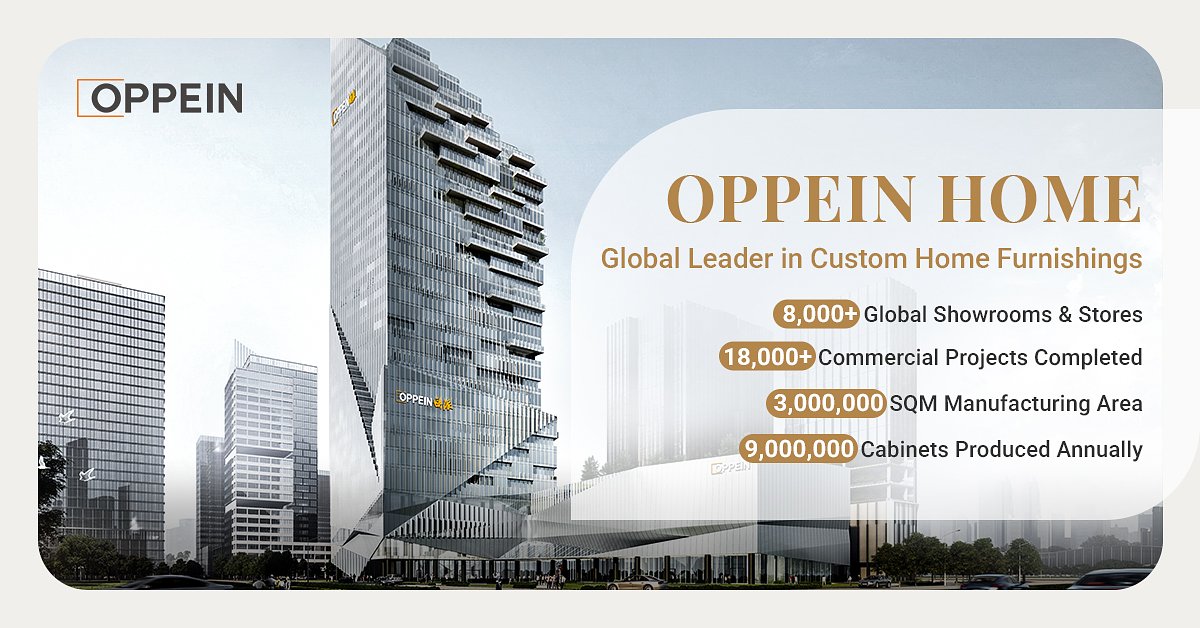
The true red flag for competitors, however, isn't the design tool itself, but its seamless integration into OPPEIN’s colossal manufacturing backend. The AI platform is the sleek frontend for a highly automated industrial empire. With five production bases spanning over 3 million square meters, the company has a daily capacity exceeding 25,000 cabinets, alongside thousands of other furnishing components. The new software acts as a direct conduit, converting a finalized design into a precise factory order list and customer quotation instantaneously.
This is where OPPEIN’s long-term investment in intelligent manufacturing pays dividends. The company boasts a “globally leading AI digital factory” where design data is transmitted to production lines in minutes. This digitalized order-to-production system, refined since 2015, leverages advanced German HOMAG machinery to achieve a machining accuracy of 0.1 mm, a tenfold improvement over the industry standard of 1 mm. This precision, driven by AI and 98% automated workflows, drastically reduces rework costs and material waste, contributing to what the company claims are 50% higher margins than its European counterparts.
Once an order is placed, it is assigned a unique QR code for end-to-end traceability. Automated Guided Vehicles (AGVs) transport components through the factory, minimizing logistical errors and delays. This intricate system of software, robotics, and logistics ensures that the promise made in a 30-minute design session can be reliably executed and delivered to an overseas project in approximately 45 days. The stated goal is “0 mistakes in actual production,” a bold ambition made plausible only through this deep, vertical integration of technology.
A New Competitive Landscape Forged by AI
OPPEIN’s launch arrives as the entire interior design and furniture industry pivots toward AI. The global market for AI in interior design is projected to surge from $1.76 billion in 2026 to $4.55 billion by 2030. A host of competitors, from consumer-facing apps like RoomGPT and Planner 5D to retail giant IKEA’s Kreativ platform, are already using AI to help users visualize new spaces. These tools have democratized design, making it more accessible to the mass market.
However, most of these platforms decouple the design phase from the complexities of manufacturing and fulfillment. Their primary function is inspiration and visualization. OPPEIN’s strategic masterstroke is connecting the two. While a user can design a kitchen with IKEA’s tool, OPPEIN’s platform designs a kitchen and simultaneously instructs a robot in one of its factories on how to cut the specific panels required, generating an exact price in the process. This end-to-end control is a powerful differentiator that few global competitors can match at scale.
This integration allows OPPEIN to effectively capitalize on the trend of hyper-personalization without succumbing to the logistical chaos it often creates. By standardizing the data flow from client to machine, the company can offer mass customization with the efficiency of mass production, setting a new benchmark for operational excellence in the industry.
Global Ambitions Powered by Code
This AI-powered ecosystem is the engine for OPPEIN's aggressive global expansion. With over 18,000 commercial projects completed in more than 100 countries and a network of 8,000 showrooms, maintaining consistency and efficiency is paramount. The new software provides a unified platform that empowers franchisees and sales partners worldwide to deliver the same rapid, high-quality service whether they are in Southeast Asia, Europe, or North America.
For large-scale residential and hospitality projects, the efficiency gains are even more pronounced. The ability to quickly iterate designs, generate accurate quotes, and ensure reliable production timelines provides a significant advantage when bidding on and executing major contracts. By systemizing the most complex and time-consuming aspects of the business, OPPEIN is not just selling furniture; it is selling a streamlined, predictable, and highly scalable procurement experience. This technological backbone makes the company a formidable partner for B2B clients and a compelling option for prospective franchisees looking to tap into a proven, tech-forward business model.