
- OpenTug's platform manages over 40% of U.S. barge capacity and tracked 3,500+ active barges monthly in 2023.
- The company has secured $5.3 million in total funding and handled 3 million tons of cargo in 2023.
- Signal Optimization integrates demand planning with live operational data to reduce manual workload and improve efficiency.
Experts view OpenTug's AI-driven Signal Optimization as a transformative tool for marine logistics, replacing fragmented manual processes with intelligent, automated planning to enhance efficiency and profitability in the industry.
OpenTug's AI Charts a New Course for Marine Logistics Planning
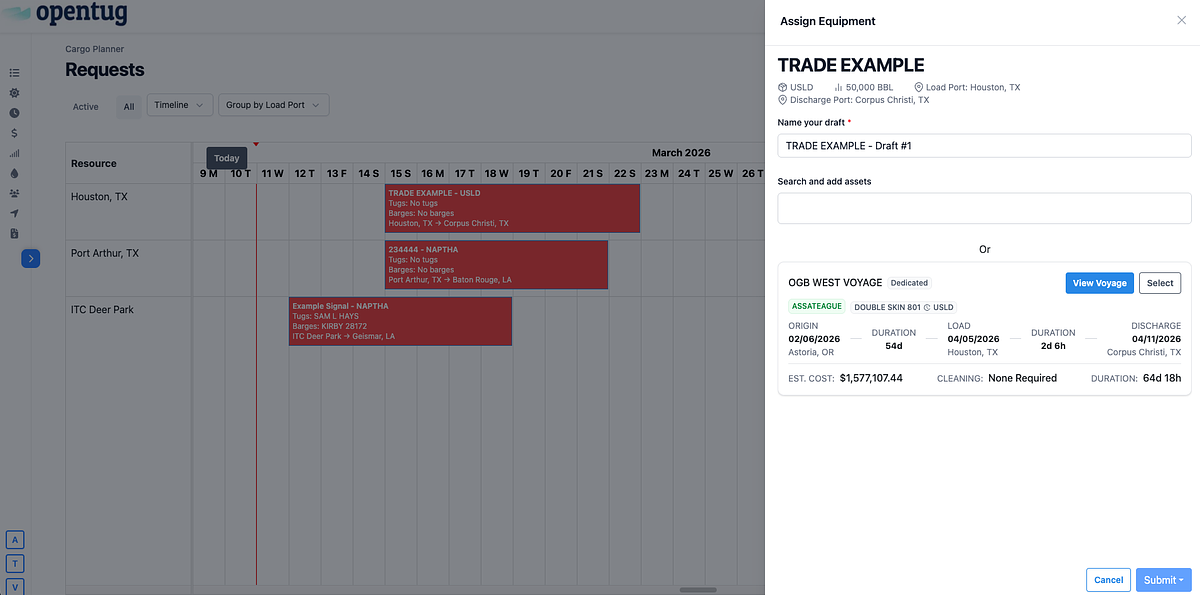
SEATTLE, WA – March 19, 2026 – In a move poised to disrupt the traditionally manual processes of marine logistics, technology firm OpenTug today announced the launch of Signal Optimization. This new capability, integrated into its AI-native BargeOS platform, is designed to bring a new level of intelligence and efficiency to how charterers, shippers, and commercial marine teams plan their complex inland and coastal operations.
The new feature aims to solve a core industry challenge: matching the right assets to the right movements at the right time. By creating a unified digital workflow, Signal Optimization promises to replace the fragmented patchwork of spreadsheets, emails, and disconnected systems that have long dominated high-stakes planning in the maritime sector.
Beyond the Spreadsheet: A Digital Overhaul for Waterways
The marine logistics industry, particularly the inland barge sector, has historically operated on a foundation of fragmented information and manual processes. Planners and dispatchers often find themselves navigating a sea of data spread across multiple platforms and communication channels. This lack of a single source of truth leads to significant inefficiencies, including suboptimal asset utilization, costly idle time, and an inability to react swiftly to market volatility.
"Marine planning teams are often making high-stakes decisions across disconnected systems, spreadsheets, and inboxes," said Jason Aristides, Co-Founder and CEO of OpenTug, in the company's announcement. "Signal Optimization brings those inputs together so teams can evaluate options faster, improve asset selection, and move with greater confidence."
Signal Optimization is engineered to directly address these pain points. It allows users to ingest and organize all inbound demand requirements—such as refinery and plant schedules, trade signals, and specific delivery windows—into a single dashboard. From there, the system enables a comprehensive comparison of available equipment. This evaluation goes far beyond simple availability, factoring in complex operational and commercial constraints including contract terms, repositioning time and cost, cargo compatibility, and specific cleaning requirements needed between voyages. This digital approach empowers planners, shifting their focus from tedious administrative tasks to higher-value strategic decision-making.
The AI-Native Advantage in a Niche Market
Founded in 2019, OpenTug has quickly established itself as a formidable innovator in the marine logistics space. The company has secured $5.3 million in total funding and has already made a significant impact, with its platform reportedly providing access to over 40% of U.S. barge capacity. In 2023 alone, OpenTug's systems serviced over 3 million tons of cargo and managed over $500 million in freight costs, tracking more than 3,500 active barges monthly.
While the broader maritime software market includes established players like Veson Nautical, OpenTug has carved out a distinct niche by focusing on the unique challenges of U.S. inland and coastal waterways and building its platform with an "AI-native" architecture. This means artificial intelligence is not an add-on but a core component of the system's design. This approach allows BargeOS to perform sophisticated predictive analytics for dynamic cost estimation, route optimization, and now, advanced demand planning.
This technical differentiation is central to Signal Optimization's power. Instead of relying on static rules, its AI algorithms can process a multitude of constantly changing variables to recommend the most efficient and cost-effective asset matches. This is a significant leap from legacy systems and addresses the industry's deep-seated reliance on manual judgment.
"Every shipment is planned before it is placed, but too much of that process still depends on fragmented information and manual judgment," noted Mike Baldwin, Co-Founder and COO of OpenTug. "Signal Optimization helps teams make those decisions with better data, better speed, and better operational context."
From Signal to Settlement: An Integrated Operating Model
A key differentiator for OpenTug's new feature is its seamless integration into the end-to-end BargeOS platform. Signal Optimization is not a standalone planning tool; it is the starting point of a connected operational lifecycle. Once an asset is assigned to a demand signal, that decision flows directly into downstream workflows without manual re-entry.
This integration connects commercial planning with voyage management, invoice intelligence, and long-term performance management. A plan created in Signal Optimization can be used to generate quotes, execute the voyage with real-time tracking, and ultimately reconcile invoices with greater accuracy. This closed-loop system provides unprecedented visibility and control, helping companies mitigate the financial risks associated with volatile schedules, asset constraints, and unexpected operational delays.
By linking demand planning more closely with live operational data, the platform helps commercial teams improve responsiveness while building a more resilient foundation for execution. This capability is crucial for improving margins in an industry where unpredictable factors like river conditions, water levels, and lock delays can quietly accumulate significant costs.
Charting the Course Ahead
With Signal Optimization now entering its beta phase, OpenTug is positioned to further solidify its reputation as a key modernizer in marine logistics. The company's innovative approach has already garnered significant industry recognition, including a 2024 Software & Tech Award from Supply & Demand Chain Executive and a place for its founders on the Forbes 30 Under 30 list for Transportation and Mobility.
The introduction of this new capability represents a critical step in the ongoing digital transformation of the supply chain's vital, yet often overlooked, waterways. As early adopters in the beta program begin to leverage this integrated intelligence, the platform's ability to enhance efficiency, improve profitability, and empower planners with better data will be put to the test. For an industry navigating increasing pressure to improve margins without adding manual workload, the shift from fragmented spreadsheets to intelligent, automated planning systems marks a pivotal change in direction.