
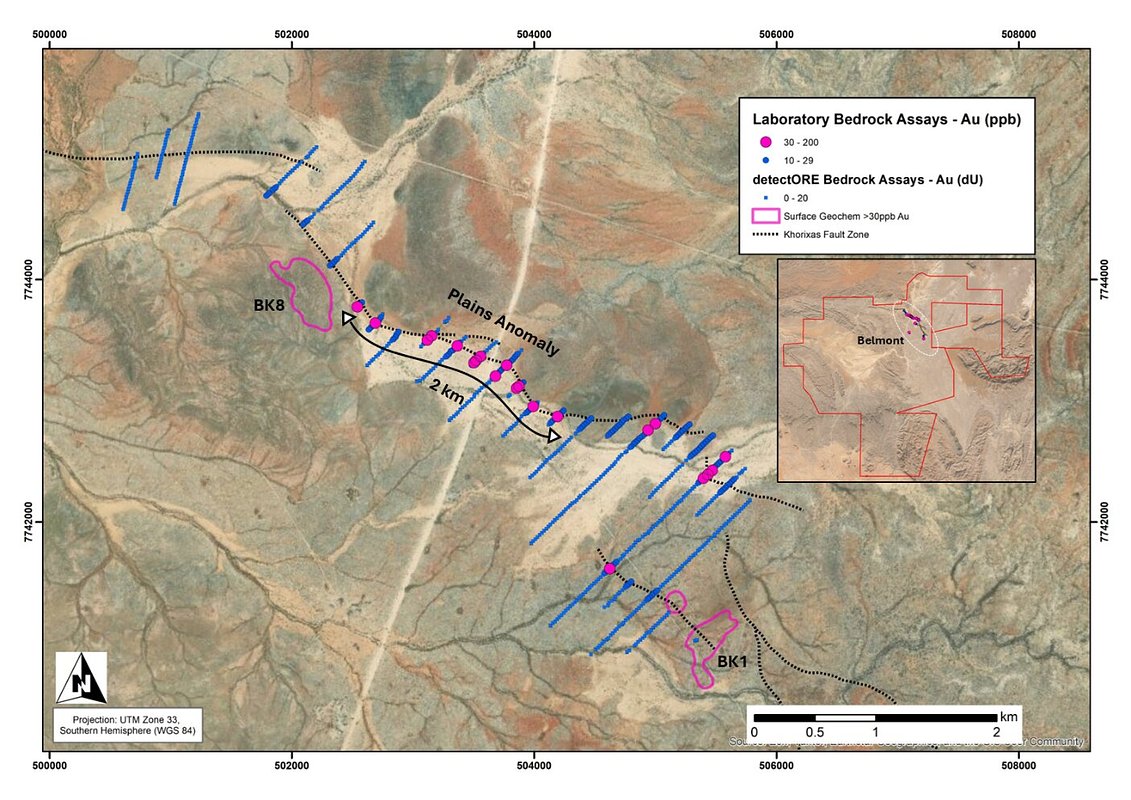
- 2 km-long gold anomaly discovered at Ongwe Minerals' Belmont Prospect in Namibia's Damara Belt
- 639 shallow drill holes (3,970 meters total) revealed gold values up to 0.2 g/t in bedrock samples
- 125-meter-wide mineralized zone traced along the Khorixas Fault Zone
Experts view Ongwe Minerals' discovery as a significant validation of the Damara Belt's gold potential, reinforcing the region as a world-class gold district with strong exploration upside.
Ongwe Minerals Unearths Major Gold Anomaly in Namibia's Damara Belt
VANCOUVER, BC – April 13, 2026 – Canadian exploration firm Ongwe Minerals Inc. has announced a significant discovery in the arid plains of Namibia, potentially adding a new chapter to the nation's burgeoning gold rush. The company has identified a 2-kilometer-long bedrock gold anomaly at its Belmont Prospect, part of the larger Khorixas Gold Project, confirming the high potential of a region increasingly seen as one of Africa’s most exciting gold frontiers.
The discovery, dubbed the “Plains” anomaly, lies hidden beneath a thick blanket of alluvial sand and hard calcrete, rendering it invisible to traditional surface prospecting. Its delineation marks a major technical and strategic victory for Ongwe, validating an exploration methodology designed to peer beneath this challenging cover and unlock the wealth of the Northwest Damara Gold Belt.
Peering Beneath the Surface
The Plains anomaly is not just a line on a map; it represents a substantial zone of altered and mineralized rock up to 125 meters wide, traced consistently over two kilometers along the regional Khorixas Fault Zone. To find it, Ongwe deployed a systematic bedrock sampling program, drilling 639 shallow holes for a total of 3,970 meters. Each hole punched through an average of six meters of cover to retrieve a bedrock sample from a previously inaccessible geological contact.
Initial analysis of these bedrock samples yielded gold values up to 0.2 grams per tonne (g/t). While these grades may seem modest, they are considered highly encouraging at this early stage. As CEO Dave Underwood explained in a statement, the sampling technique is designed to outline the broad mineralizing system, not to intersect individual high-grade veins which are often narrow and elusive.
“The initial bedrock sampling program at Belmont has produced what we were hoping for, a coherent and extensive zone of bedrock alteration and mineralization along the Khorixas Fault,” Underwood commented. He noted that the chances of hitting high-grade quartz veins with this wide-spaced grid sampling are slim, but their known presence in nearby outcrops provides strong confidence that higher grades exist within the newly defined anomaly.
The discovery was powered by an innovative approach combining rapid, on-site analysis using a portable system called detectORE™ with follow-up verification by traditional fire assay at MSALABS in Namibia. This strategy allows the company to quickly and cost-effectively screen vast, covered areas, focusing its more expensive and time-consuming drilling efforts on the most promising zones. The Plains anomaly is now considered a top-priority, “walk-up” drill target for the company.
A Hotspot in the Damara Gold Belt
Ongwe’s discovery does not exist in a vacuum. It adds to a growing list of major gold finds that are cementing the Damara Orogenic Belt as a world-class gold district. This geological belt is home to a string of significant deposits, including Osino Resources' multi-million-ounce Twin Hills project—which was also discovered under sand cover—and WIA Gold’s rapidly growing Kokoseb deposit.
The success of its neighbors provides a powerful analogue for Ongwe's strategy. The company's three flagship projects—Khorixas, Omatjete, and Outjo—are all strategically positioned along major regional structures within this belt. The Omatjete Project, for instance, lies just 30 kilometers along strike from the Kokoseb discovery, while the Khorixas project is a mere 60 kilometers from Osino’s Eureka gold discovery.
This regional context is critical for investors. It suggests that Ongwe is not just exploring on a hunch but is systematically targeting geological settings with a proven pedigree for hosting large-scale gold systems. The Plains discovery reinforces the idea that the Damara Belt's full potential is only now being revealed as modern exploration techniques successfully penetrate the surface cover.
The Team with a Golden Touch
Adding to market confidence is the track record of the team behind Ongwe Minerals. The company's leadership includes key figures from the former Osino Resources, a team renowned for its discovery and advancement of the Twin Hills project, which led to Osino's acquisition by Shanjin International for CAD$368 million. This same core group was also involved in the advancement and sale of the Otjikoto gold deposit to B2Gold, which is now a major operating mine.
This history of success, particularly within Namibia, provides Ongwe with a level of credibility that many junior explorers lack. The team's deep understanding of the region's geology and its proven ability to take projects from grassroots discovery to significant shareholder value is a key part of the company's investment thesis. The Plains discovery is viewed by many as the first major payoff of this experienced team's latest strategic venture.
The Road Ahead: Drilling for Confirmation
While the discovery of a large, coherent anomaly is a major milestone, the path from anomaly to a commercially viable mine is long and fraught with risk. For Ongwe, a junior explorer with no current revenue, the next steps are crucial and capital-intensive.
With the initial phase at Belmont complete, the drill rig has already been mobilized to the Manga Prospect on the Omatjete Project to conduct a similar bedrock sampling program. Following that, it will return to Belmont to test additional targets before the main event: a diamond drilling program set to begin in the coming months. This program will be the true test, as it will cut core samples deep into the Plains anomaly to determine the thickness, continuity, and, most importantly, the grade of the gold mineralization.
Investors and geologists will be keenly awaiting the first assay results from the current work, expected by the end of May 2026. These results will guide the diamond drilling campaign and could significantly impact the company's valuation. While Namibia offers a stable and supportive mining jurisdiction, the ultimate success of the Khorixas Project will be written by the drill bit, deep in the bedrock beneath the Namibian plains.
Topics & Related
Financial Services
Machine Learning
Digital Transformation
Revenue
Related Company Pulse