
- 8-hole, 4,000-meter drill program initiated at the Wingdam project
- 15.1 meters grading 0.23 g/t gold in drill hole WD24-37, including a higher-grade section of 2 meters at 0.87 g/t gold
- $2.4 million in financing sought to fund the 2025 exploration program
Experts would likely conclude that Omineca's targeted exploration along the Eureka Thrust Fault represents a high-risk, high-reward strategy with strong regional geological support, potentially positioning the company for a significant gold discovery if the drill program yields promising results.
Omineca's High-Stakes Hunt for the Cariboo's Lost Motherlode
SASKATOON, SK – December 04, 2025 – In the historically rich goldfields of British Columbia’s Cariboo Mining District, Omineca Mining and Metals (TSXV: OMM) has once again fired up the drills. The junior explorer this week initiated an 8-hole, 4,000-meter diamond drill program at its Wingdam project, a move that represents far more than just another seasonal exploration campaign. This is a calculated, high-stakes bet aimed at solving a century-old geological puzzle: finding the hard rock source, or “motherlode,” of one of the province's most legendary placer gold deposits.
For investors and industry observers, Omineca’s story is a compelling case study in geological detective work and strategic risk. The company is not just punching holes in the ground; it is systematically testing a sophisticated geological model that, if proven correct, could transform it from a small-scale placer operator into a significant hard rock gold developer. With drills now turning through December, the market is watching closely for results that could either validate the theory or send the team back to the drawing board.
Following Geological Breadcrumbs
The entire premise of Omineca's aggressive exploration rests on a compelling theory about the region's past. Geologists, including the company's consulting firm TerraLogic Exploration, hypothesize that Lightning Creek, the waterway that carved the local valley, once flowed in the opposite direction—from west to east. This reversal theory is critical because it reframes the search for the source of the incredibly rich placer gold found buried in the creek's ancient, now-buried, paleochannel.
The historical prize is well-documented and tantalizing. In 2012, a single underground crosscut sample measuring just 2.4 by 23.5 meters yielded a stunning 173.4 ounces of placer gold. Crucially, some of this gold was found embedded in the bedrock itself, a strong clue that the source was nearby. The question has always been: where?
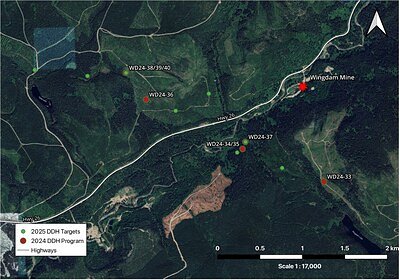
Omineca’s 2024 drill program provided the first concrete evidence supporting its thesis. By drilling downstream (in the modern sense) and deeper than previous efforts, the company began to hit signs of mineralization. The highlight was drill hole WD24-37, which intersected 15.1 meters grading 0.23 g/t gold, including a higher-grade section of 2 meters at 0.87 g/t gold. While not yet economic grades, the presence of gold, copper, lead, and zinc associated with massive sulphides and, most importantly, the Eureka Thrust Fault, was a major validation. It was the geological breadcrumb trail the company had been looking for, confirming that mineralizing systems were active in the exact area its model predicted.
This year's 4,000-meter program is a direct and aggressive follow-up. It is designed to step out from the success of WD24-37, drilling deeper below the known placer workings and further along the strike of the Eureka Thrust Fault. It is a methodical escalation, moving from a broad theory to a targeted hunt for higher-grade structures.
The Eureka Fault: A Regional Gold Highway?
Omineca's focus on the Eureka Thrust Fault places its project within a much larger and increasingly significant regional trend. This major geological structure is not just a local feature at Wingdam; it is emerging as a primary conduit for gold mineralization across the Cariboo district. Success stories from neighboring companies have bolstered the thesis that proximity to this fault system is key to making a major discovery.
Just 33 kilometers to the east, Osisko Development Corp.’s well-advanced Cariboo Gold Project, with its similar vein-type mineralization, serves as a powerful analogue for what a large-scale system in this environment can look like. Furthermore, other significant deposits in the region are spatially associated with the same structure. Spanish Mountain Gold’s 2.34-million-ounce deposit lies 50 kilometers south of Wingdam, west of the fault. Further south, Karus Gold has also reported a high-grade discovery west of the fault. To the north, Golden Cariboo Resources has hit visible gold in multiple holes along the same structural trend.
This regional context is critical for assessing Omineca’s strategy. The company is not operating in a vacuum. Its exploration model is reinforced by a pattern of discovery up and down the Cariboo, suggesting the Eureka Thrust Fault acts as a regional-scale “gold highway.” By proving the fault is mineralized on its property, Omineca has significantly de-risked its geological concept and demonstrated that Wingdam possesses the same fundamental ingredients that have led to multi-million-ounce discoveries for its neighbors.
A Dual Strategy Under Pressure
For a junior explorer, pursuing a high-cost, high-risk exploration play requires a carefully balanced corporate strategy. Omineca is managing this by walking a financial tightrope, balancing its blue-sky exploration with a separate, ongoing placer gold recovery operation. The company has a joint venture for the underground placer project, which, while facing its own operational hurdles, offers the potential for non-dilutive cash flow to help fund the search for the hard rock source.
This dual strategy is both an advantage and a necessity. The capital-intensive nature of deep diamond drilling puts constant pressure on a junior's treasury. As noted in a December 2024 announcement, Omineca sought up to $2.4 million in financing specifically to fund this exploration. Such is the reality for explorers: promising results must be followed by more drilling, which in turn requires more capital. Success is incremental and expensive.
The current drill program, therefore, represents a pivotal moment. Strong results would not only validate the geological model but would significantly enhance the company's ability to attract further investment on favorable terms for subsequent, more extensive drill campaigns. Conversely, lackluster results could make the path forward more challenging. This dynamic is the classic narrative of the junior mining sector, where a single drill program can redefine a company's future.
With crews now on site, the 2025 program is designed for discovery. The plan to test down-dip extensions of the known mineralization, probe the Eureka Thrust Fault along strike toward a magnetic anomaly, and drill deep holes to test the continuity of quartz veins is systematic and aggressive. It’s a clear attempt to move beyond finding smoke and to locate the fire. For Omineca and its investors, the wait for assays early in the new year will be a tense one, as the potential answer to a Cariboo gold rush mystery may lie just a few thousand meters below the frozen ground of Lightning Creek.