
- Reduction in Average Handle Time (AHT): 10-40% - Improvement in First-Call Resolution (FCR): 15-30% - Launch Date: May 13, 2026
Experts agree that Companion Agent represents a significant advancement in AI-assisted customer service, enhancing agent efficiency and customer satisfaction through real-time, context-aware support.
Observe.AI Launches Companion Agent, an AI Co-Pilot for Frontline Teams
REDWOOD CITY, CA – May 13, 2026 – Observe.AI, a company specializing in customer experience (CX) AI, today announced the launch of Companion Agent, a new interface designed to act as an AI-powered partner for frontline customer service teams. The new tool aims to fundamentally reshape the agent's role by providing real-time, intelligent support before, during, and after every customer interaction.
As businesses increasingly deploy AI chatbots and automated systems to handle routine inquiries, the role of the human agent has become more critical and complex. They are now the specialists who manage high-stakes, emotionally charged, and intricate problems that automation cannot solve. However, many support teams are still equipped with legacy tools like static scripts or basic knowledge base search bars, creating a significant gap between the demands of the job and the support provided. Companion Agent is designed to fill this void, operating alongside agents to help them navigate these challenging conversations with more speed and consistency.
"Customer service teams are entering a new era where AI and human agents work together across the entire customer journey," said Swapnil Jain, CEO and Co-Founder of Observe.AI, in a statement. "With Companion Agent, we are giving frontline teams an AI partner that can listen, reason, guide, and act in real time."
The AI Co-Pilot in Action
Unlike traditional agent-assist tools that offer passive suggestions, Companion Agent is designed to be an active participant in the workflow. Its support spans the entire lifecycle of a customer interaction.
Before the call: The tool prepares the agent by surfacing a concise summary of the customer's history, previous interactions, and the stated reason for the current contact. This allows the agent to begin the conversation with full context and confidence, rather than scrambling for information.
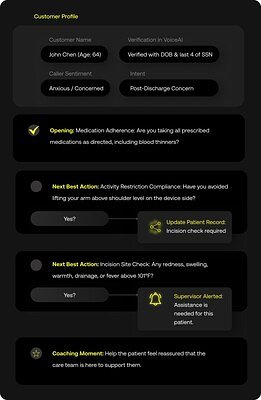
During the call: As the conversation unfolds, Companion Agent listens in real time, providing step-by-step guidance, surfacing relevant articles from deep knowledge bases, and prompting necessary compliance disclosures. It can also detect behavioral cues and support soft-skill coaching, helping agents manage difficult situations more effectively.
After the call: The notoriously time-consuming after-call work is streamlined through automation. Companion Agent generates editable summaries, extracts key details, automatically classifies the interaction's outcome, and can even trigger follow-up actions in other business systems, freeing the agent to move to the next customer.
This comprehensive, real-time support system is intended to reduce the cognitive load on agents, allowing them to focus less on process and more on providing empathetic, effective problem-solving.
Beyond Automation: The Rise of 'Agentic' AI
This launch is a key part of Observe.AI's broader strategy, which centers on the concept of an "agentic platform." This emerging paradigm in AI, known as Agentic AI, refers to systems that can proactively reason, plan, and take autonomous action to achieve goals, rather than simply responding to commands. Companion Agent is one component of a larger ecosystem that includes AI Agents for Customers and AI Agents for Operations.
The key innovation lies in the platform's ability to create a seamless, context-aware experience. When a customer interaction is escalated from an automated AI agent to a human, Companion Agent ensures the context and history of the conversation are passed along, eliminating the customer's dreaded need to repeat themselves. It also connects to operational AI, allowing managers to analyze performance, identify coaching opportunities, and continuously refine processes across the entire team.
This approach marks a departure from older real-time assist tools built on rigid Natural Language Understanding (NLU) models, which often required months of complex configuration. Observe.AI claims that Companion Agent can be configured and adjusted in days using plain-English prompts, drastically reducing the time to value for businesses.
Measuring the Impact: The ROI of Real-Time Guidance
The ultimate test for any new enterprise technology is its return on investment. Observe.AI reports that early customers are already seeing measurable results, including reduced average handle time (AHT), higher first-call resolution (FCR), and improved customer satisfaction (CSAT) scores.
These claims align with broader industry data on the impact of sophisticated agent-assist technologies. Independent analyses have shown that such tools can reduce AHT by 10-40% and improve FCR by 15-30%. By providing instant access to information and automating post-call work, these platforms drive significant operational efficiencies. For one early adopter, the new tool is about empowering their most valuable resource.
"Customer Service teams have invested heavily in automation and self-service, but their human agents are still underserved," noted Cory Ondo of Paycor. "With Companion Agent, we're closing that gap by ensuring every human agent has the agentic intelligence at their fingertips. It's not just about improving productivity; it also delivers better customer experiences."
The business case extends beyond simple efficiency metrics. By empowering agents to resolve issues more effectively and consistently, companies can boost customer loyalty and reduce churn, which are critical drivers of long-term profitability.
Navigating the Human Side of AI Implementation
While the promise of AI co-pilots is compelling, the path to successful adoption is paved with significant challenges that go beyond the technology itself. The integration of powerful AI into complex contact center environments requires careful planning and a focus on the human element.
One of the primary hurdles is change management. Agents may view such tools with skepticism, fearing job displacement or resenting what could feel like an AI-powered micromanager. To counter this, industry experts stress the importance of positioning the technology as a supportive companion, not a supervisor. Agents must feel empowered, with the autonomy to override AI suggestions based on their professional judgment and the unique nuances of a conversation.
Furthermore, data privacy and security remain paramount concerns, as these systems handle vast amounts of sensitive customer information. Organizations must ensure robust governance and compliance frameworks are in place. The effectiveness of the AI is also heavily dependent on the quality of the data it's trained on, requiring a significant upfront and ongoing investment in data hygiene.
Successfully deploying a tool like Companion Agent requires a holistic strategy that addresses technology integration, data governance, and, most importantly, the people and processes that define the customer experience. It represents a fundamental shift in how contact centers operate, requiring a commitment to training, transparency, and fostering a culture of human-AI collaboration.