
- 10,000+ existing commercial ships could potentially adopt AMPERA's thorium-fueled micro-reactors.
- Decades-long operation without refueling, thanks to a hybrid fusion-fission architecture.
- Zero greenhouse gas emissions from vessels powered by AMPERA's nuclear technology.
Experts view AMPERA's thorium-fueled micro-reactors as a promising but high-stakes solution for decarbonizing global shipping, requiring significant regulatory, financial, and public acceptance hurdles to be overcome.
Nuclear at Sea: AMPERA's Bid to Decarbonize Global Shipping
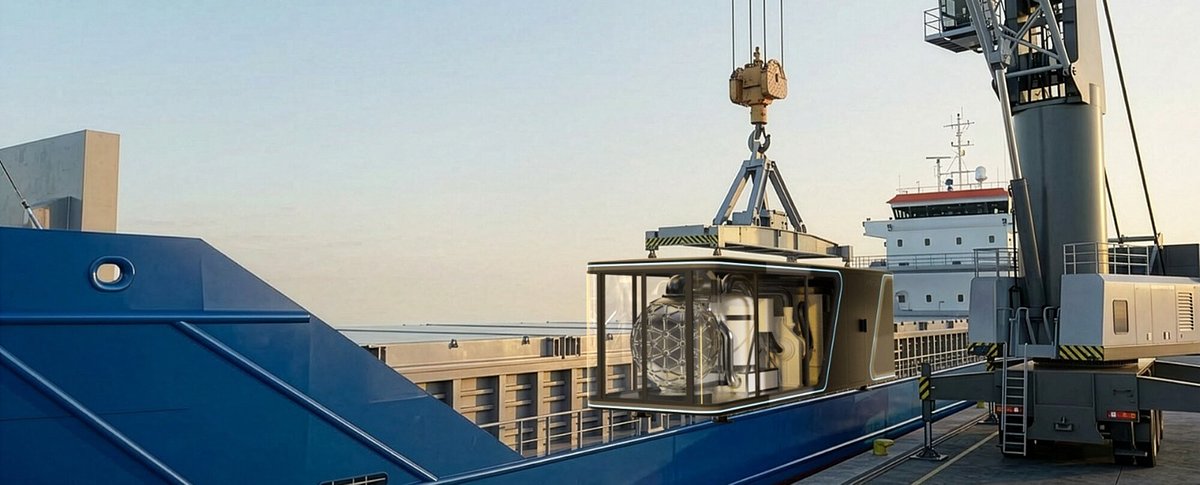
PALM BEACH GARDENS, Fla. – January 26, 2026 – In a bold move aimed at one of the world's most challenging sectors for decarbonization, clean energy firm AMPERA has announced its expansion into the maritime industry. The company is positioning its advanced, subcritical thorium-fueled micro-reactors as a revolutionary power source for commercial and defense vessels, adding a third major vertical to its portfolio alongside data centers and defense applications.
The announcement signals a significant bet that next-generation nuclear technology can provide the power and reliability needed to move global trade while eliminating greenhouse gas emissions. "Our game-changing technology strongly aligns with the business demands for commercial shipping and defense vessels," said Brian Matthews, CEO and Founder of AMPERA, in a statement. He emphasized the value of a power source that provides "consistent, clean and safe energy, while drastically shrinking the engine room footprint and significantly reducing vessel weight."
With the global shipping industry under immense pressure to meet stringent climate targets, AMPERA's proposal enters a complex and competitive landscape of alternative fuels. The company claims its solution could be viable for over 10,000 existing commercial ships, presenting a potentially transformative, albeit challenging, path toward a zero-emission maritime future.
The Thorium Promise
At the heart of AMPERA's strategy is a technology that departs significantly from traditional nuclear power. The company is developing a compact, sealed micro-reactor that uses thorium as its primary fuel. Unlike the uranium used in most of the world's current reactors, thorium is more abundant and is not fissile on its own, making it inherently more resistant to nuclear proliferation.
AMPERA's design is described as a "subcritical" system. This means the reactor cannot sustain a nuclear chain reaction on its own and requires an external neutron source to operate. This design feature provides a powerful layer of inherent safety, as the reaction simply stops if the external source is turned off, eliminating the risk of a runaway reaction or meltdown. Furthermore, the company leverages a proprietary TRISO fuel platform. TRISO (TRi-structural ISOtropic) fuel particles encase the nuclear material in multiple layers of carbon and ceramic, acting as individual, microscopic containment systems that are exceptionally resilient to high temperatures and corrosion.
This hybrid fusion-fission architecture is designed to operate for decades without refueling. This “walk-away safe” system, which the company states requires no water for cooling, minimizes operational complexity and eliminates the need for frequent fuel handling at sea—a major logistical and safety advantage. "Operators we are speaking with are very enthusiastic about the economic and environmental benefits that can be achieved," Matthews added, pointing to applications on large vessels, cruise ships, and port barges.
Navigating a Sea of Hurdles
Despite the technological promise, the journey to place nuclear reactors aboard commercial vessels is fraught with monumental challenges that extend far beyond the engine room. The primary obstacles are regulatory, financial, and societal.
Currently, there is no comprehensive international regulatory framework for licensing, operating, and decommissioning nuclear-powered commercial ships. The International Maritime Organization's (IMO) existing rules in the SOLAS convention are decades old and were designed for a handful of state-run vessels, not a global commercial fleet. Harmonizing the separate worlds of maritime law and nuclear regulation, overseen by bodies like the International Atomic Energy Agency (IAEA), is a herculean task that could take years, if not decades. Initial progress may rely on pioneering bilateral agreements between nations willing to accept such vessels in their ports.
Public perception remains perhaps the most significant barrier. The legacy of nuclear accidents like Chernobyl and Fukushima has created deep-seated public apprehension. Gaining social license to operate will require unprecedented transparency to convince port communities, environmental groups, and the general public that these floating reactors are safe. Concerns about accident scenarios, security from terrorism, and the long-term management of spent fuel—even the less-hazardous waste from thorium reactors—will need to be thoroughly addressed.
Finally, the economic equation is daunting. While operational costs could be lower due to the elimination of conventional fuel, the upfront capital expenditure for a nuclear reactor is substantial. Furthermore, an entire supply chain for thorium fuel and specialized infrastructure for reactor installation, maintenance, and eventual decommissioning would need to be built from the ground up.
The Decarbonization Race
AMPERA's nuclear solution is not entering a vacuum. The maritime industry is actively exploring a range of alternative fuels to replace the heavy fuel oil that powers the global fleet. Ammonia and hydrogen are leading contenders as zero-carbon fuels, but both come with significant drawbacks. Ammonia is highly toxic, while hydrogen is difficult to store onboard due to its low energy density, and both require massive investment in new production and bunkering infrastructure.
Methanol and advanced biofuels are also being considered, but they are not entirely emissions-free or face questions of sustainable sourcing at scale. Battery power is a viable solution for short-sea shipping but lacks the energy density required for long, transoceanic voyages where the bulk of shipping emissions occur.
This is where nuclear power's core advantage lies: unparalleled energy density. A single, small reactor could power a large container ship for its entire 20- to 30-year lifespan, enabling long voyages at high speeds without releasing a single puff of carbon dioxide. For an industry where time is money and range is paramount, this proposition is compelling. AMPERA's push into the maritime sector frames the ultimate choice for the shipping industry: pursue alternative fuels that may require fundamental changes to vessel operations and global logistics, or embrace a high-tech, high-stakes nuclear solution that promises immense power but must first navigate a treacherous course of regulatory approval and public acceptance.
Topics & Related
AI & Machine Learning
Nuclear
Renewable Energy
Hydrogen
Revenue
Related Company Pulse