
- 20,000 participants and 2,500 projects nationwide in the Presidential AI Challenge
- 950,000 Indiana residents (14% of the population) struggle with food insecurity
- 88% of teens believe AI skills will be essential for their future careers
Experts agree that integrating AI education into youth programs like 4-H is crucial for developing digitally literate leaders who can apply technology to solve real-world problems, ensuring future workforce readiness and community impact.
Next-Gen Innovators: 4-H Youth Harness AI for Real-World Impact
WASHINGTON, D.C. – May 28, 2026 – By Alexander Harris
A new generation of problem-solvers is emerging, not from corporate labs, but from community halls and after-school programs. Four members of the 4-H youth development organization are heading to the nation's capital in June, armed with artificial intelligence projects designed to tackle some of America's most pressing local issues. They are national finalists in the prestigious Presidential AI Challenge, selected from a field of 20,000 participants and 2,500 projects nationwide.
Their innovations—addressing disaster relief, food insecurity, and government waste—spotlight a significant shift in youth development. Organizations like 4-H are moving beyond traditional programs to cultivate a generation that is not only digitally literate but also deeply engaged in applying advanced technology for the public good.
The Presidential Mandate and the Young Minds Answering the Call
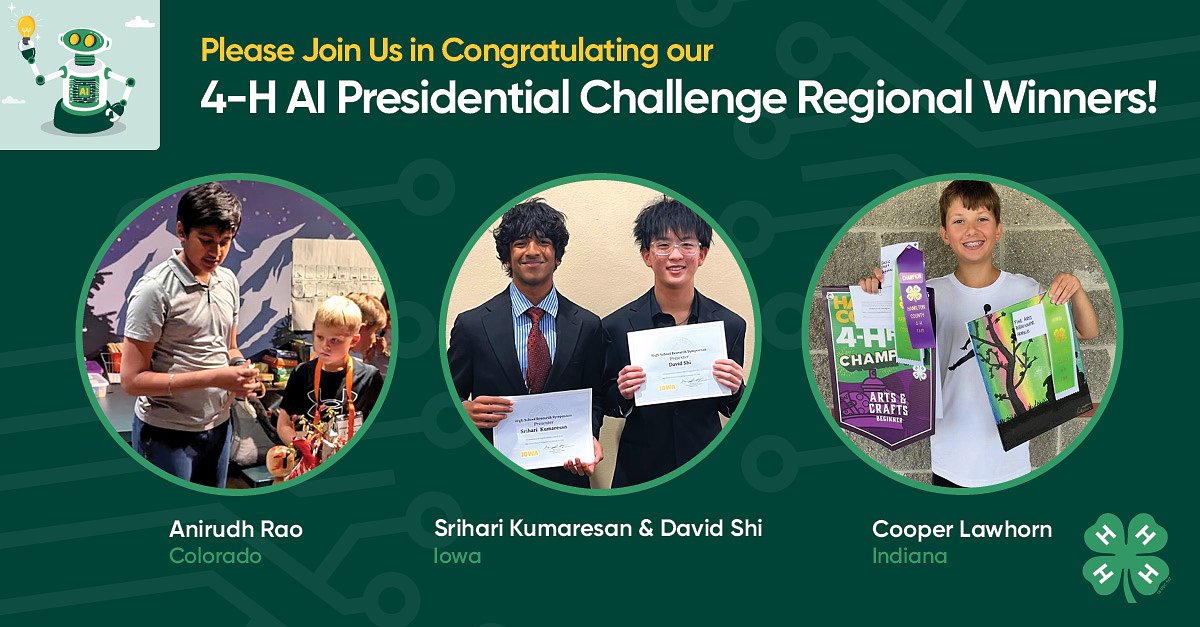
The Presidential AI Challenge is more than a science fair; it's a national strategic initiative. Established by a 2025 executive order to advance AI education, the competition aims to secure America's leadership in technology by inspiring K-12 students to innovate. The four 4-H finalists—Anirudh Rao, 13; Cooper Lawhorn, 12; and the team of Srihari Kumaresan, 15, and David Shi, 16—represent the very ambition of this mandate.
Anirudh Rao of Colorado is focused on community disaster response. His project explores using AI to bolster science education while simultaneously preparing communities for emergencies. Rao, already a National STEM Champion for a separate battery project, leads workshops that teach other young people around the globe fundamental AI skills like pattern recognition and data analysis. “4-H taught me that leadership is about responsibility, consistency and helping others grow,” Rao said. “These experiences make me want to keep finding solutions and inspire more young people to see how technology and innovation can create meaningful impact.”
From Indiana, Cooper Lawhorn’s project, PantryPals, was born from his own community service experience. The 12-year-old is developing an AI-powered solution to improve community health and environmental outcomes by optimizing connections to food pantries. Lawhorn is no stranger to service; a previous 4-H project, "Scribbles and Smiles," collected hundreds of art supplies and learning kits for children in a local hospital. “4-H has taught me that I don’t have to wait until I’m an adult to start making a difference,” Lawhorn stated. “I know how to take an idea and build it into something real, and that makes me feel great.”
Meanwhile, Iowa teenagers Srihari Kumaresan and David Shi have turned their attention to the public purse. Their project, Intelligent Municipal Finance, uses AI to help local governments track spending, flag duplicate payments, review contracts, and predict budget shortfalls. “This project matters to us because it’s not theoretical,” said Kumaresan. “These are real communities facing real problems, and we wanted to create something that could help protect resources for schools, fire departments and community programs.” The team estimates their system could save Iowa communities millions of dollars each year.
From Code to Community: AI for Social Good
The finalists' projects are not just theoretical exercises; they are targeted solutions for complex, real-world challenges. Rao's work in AI for disaster relief taps into a field where technology can save lives. Modern disaster management increasingly relies on AI to analyze satellite imagery for damage assessment, predict weather patterns, optimize evacuation routes for first responders, and manage the distribution of aid, making response efforts faster and more effective.
Lawhorn's PantryPals addresses a crisis of food insecurity that has deepened in his home state. In Indiana, recent data shows that over 950,000 residents, or nearly 14% of the population, struggle with access to food, a rate outpacing the national average. AI systems like the one he envisions can create a vital link, using data to manage inventory, optimize distribution networks, and provide real-time information to those in need via simple interfaces like chatbots, ensuring that available food reaches hungry families with minimal waste.
The 'Intelligent Municipal Finance' project from Kumaresan and Shi tackles the often-invisible but critical issue of government efficiency. By applying machine learning to detect anomalies and predictive analytics to forecast budget issues, their tool promises to safeguard taxpayer money. Even a fractional improvement in efficiency, as they note, can translate into millions of dollars freed up for essential public services—a tangible benefit for every citizen in a community. Their work mirrors a growing trend where local governments are adopting AI to automate routine tasks, enhance accuracy in reporting, and make more strategic financial decisions.
Beyond the Barn: 4-H's Pivot to the Digital Frontier
For nearly 125 years, 4-H has been synonymous with agriculture, home economics, and hands-on learning. Today, the organization is proving its adaptability in an AI-driven world. Through its "Beyond Ready" national initiative, which aims to serve 10 million youth annually by 2030, 4-H is aggressively integrating technology and AI literacy into its core programming.
This strategic pivot is supported by major partnerships, most notably with Microsoft, which has helped launch programs like the "AI in Ag Challenge" and an AI Foundations curriculum built within the popular Minecraft Education platform. These initiatives provide youth with hands-on experience in data analysis, ethical AI use, and problem-solving, demystifying a technology that will shape their futures. A recent 4-H survey underscores the urgency, revealing that 88% of teens believe they will need AI skills for their future careers, and nearly two-thirds feel AI can be a powerful tool for improving lives.
“Young people need opportunities to understand how AI works and how it connects to industries they see every day, including agriculture,” said Rachel Haselby, a Purdue Extension Specialist in 4-H Computer Science. “These national challenges give youth hands-on experience with technology, data and problem-solving skills that will continue to grow in demand and also benefit their everyday community.”
The success of these four finalists in a national competition demonstrates the effectiveness of this approach. By empowering young people with cutting-edge tools and encouraging them to look for problems in their own backyards, 4-H is cultivating a new kind of leader—one who is not only prepared for the future of work but is actively building a better, more efficient, and more compassionate world.