
- 2025-2026: Expected rollout of the Future Railway Mobile Communication System (FRMCS), the 5G-based successor to GSM-R.
- Dual SIM Dual Active (DSDA): Technology enabling two active 5G connections simultaneously for uninterrupted rail connectivity.
- Multi-year process: The full migration from GSM-R to FRMCS is expected to span over a decade.
Experts agree that the NEXCOM-Hytec Inter hybrid 5G solution represents a critical step forward in ensuring reliable, always-on connectivity for modern and future railway systems, addressing the limitations of legacy GSM-R infrastructure and facilitating a smoother transition to FRMCS.
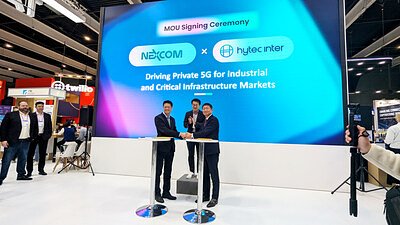
NEXCOM & Hytec Inter Unveil 5G Rail Tech to End Connectivity Gaps
BARCELONA, Spain – March 04, 2026 – At the epicenter of global technology innovation, MWC Barcelona 2026, a landmark partnership was announced today that promises to redefine the backbone of railway communication. Taiwanese network platform leader NEXCOM and Japanese 5G expert Hytec Inter revealed a joint solution designed to deliver uninterrupted, mission-critical connectivity for trains, effectively eliminating the communication blackouts that have long plagued rail operations in tunnels, remote regions, and areas with patchy network coverage.
The collaboration, cemented with the signing of a Memorandum of Understanding (MOU), combines the strengths of both companies to create a unified hybrid 5G architecture. This new system is engineered to keep trains constantly connected, a critical requirement for the safety and efficiency of modern and future railway systems.
The End of the Line for Legacy Systems
For decades, rail operators have grappled with the limitations of aging communication infrastructures. The current industry standard, GSM-R, is based on 2G technology and is rapidly becoming obsolete, unable to support the data-intensive demands of modern rail. Operators face immense pressure to upgrade their networks to support vital systems like Communications-Based Train Control (CBTC), which allows for more frequent and faster train services by tracking their exact position in real-time.
The challenge is twofold: supporting today's critical systems while simultaneously preparing for the industry-wide transition to the Future Railway Mobile Communication System (FRMCS), the 5G-based successor to GSM-R. Legacy architectures are not only difficult to scale but also present significant operational risks. A dropped signal in a tunnel or a failed handover between cell towers is not just an inconvenience; it can disrupt train control, real-time monitoring, and emergency communications.
"Rail communications are moving beyond coverage alone toward deterministic, always-on connectivity," said Allan Chiu, VP of Network & Communication Solutions at NEXCOM, in a statement. This shift reflects a growing industry consensus that predictable, reliable performance is the new benchmark for railway communication.
An Unbreakable Link: Hybrid 5G and Dual SIM Technology
The joint solution from NEXCOM and Hytec Inter directly confronts these challenges with a novel approach. It pairs NEXCOM's rugged ISA 141 dual 5G onboard user equipment with Hytec Inter's private 5G solution. The result is a hybrid system that can intelligently and seamlessly switch between private, railway-owned 5G networks and public 5G networks without any interruption in service.
The technological linchpin of this system is its use of Dual SIM Dual Active (DSDA) operation. Unlike typical dual SIM phones that can only use one data connection at a time, DSDA allows the onboard equipment to maintain two active 5G connections simultaneously. This creates a redundant, resilient link to the network. If one connection weakens or fails—for instance, as a train enters a tunnel where a private network is deployed—the other connection is already active and takes over instantly, ensuring a zero-downtime transition.
"In critical rail infrastructure, every network transition represents a potential point of failure," explained Asao Norihito, President & CEO at Hytec Inter. "Our joint solution is built to eliminate those gaps by enabling mission-critical services to operate on a unified 5G infrastructure engineered for uninterrupted performance and predictable behavior." This unified infrastructure allows safety-critical control signals, real-time video surveillance feeds, and operational voice communications to coexist on a single, robust physical network.
Paving the Way for the Future Railway
The timing of this innovation is crucial as the global rail industry stands on the cusp of the FRMCS transition. The rollout of this new 5G-based standard is expected to begin in earnest around 2025-2026, promising a future of higher data capacity, ultra-low latency, and enhanced security. These capabilities are essential for enabling advanced applications like automated train operation (ATO), predictive maintenance, and sophisticated passenger information systems.
The NEXCOM-Hytec Inter solution is positioned as a key enabler for this future. By providing a reliable and scalable platform today, it offers rail operators a practical migration path. "By deploying dual 5G onboard connectivity, this solution provides a practical foundation for mission-critical rail systems today and future FRMCS evolution," Chiu noted. It allows operators to begin leveraging the benefits of 5G immediately for their existing CBTC systems while ensuring their investment is future-proofed for the FRMCS era.
This forward-looking approach is critical, as the full migration from GSM-R to FRMCS is expected to be a complex, multi-year process spanning over a decade. Solutions that can bridge the gap and facilitate a phased transition will be invaluable to the industry.
A New Contender in a High-Stakes Race
NEXCOM and Hytec Inter are entering a dynamic and competitive market. Established giants like Nokia, Alstom, and Siemens are also heavily invested in developing 5G solutions for rail. Nokia, for example, has already partnered with Deutsche Bahn in Germany to deploy a commercial 5G radio network for FRMCS testing, while Alstom is integrating 5G into its control units for pilot projects across Europe.
However, the specific focus on a unified hybrid architecture powered by DSDA technology gives the NEXCOM-Hytec Inter partnership a distinct edge. While competitors are also exploring hybrid public-private network models, this joint solution’s emphasis on eliminating transition failures through an "always-on," dual-active connection presents a compelling value proposition for operators for whom reliability is paramount.
The solution is designed for broad applicability across metro, regional, intercity, and high-speed rail, positioning it as a versatile platform for intelligent rail operations globally. As digitalization continues to transform the transportation sector, the ability to guarantee a constant stream of data to and from a moving train is no longer just an advantage—it is the foundation upon which the future of safe, efficient, and intelligent rail travel will be built.