
- 0.54% copper equivalent over 180.8 metres in a single drill hole
- 3,100m long x 850m wide x 500m deep alteration system identified
- 1.8km away, visible copper mineralization confirmed
Experts would likely conclude that this discovery represents a significant district-scale copper-gold system with potential to transform Newfoundland into a major mining frontier, driven by favorable geology and strategic proximity advantages.
Newfoundland's Copper Prize: A Discovery Ignites a Regional Resource Rush
VANCOUVER, BC – June 25, 2026 – In the world of mineral exploration, there are discoveries, and then there are discoveries that rewrite the map. Pirate Gold Corp.’s recent announcement from central Newfoundland falls firmly into the latter category. What the company has uncovered at its Moby Dick target is not just a promising drill hole, but the geological signature of a massive mineralizing engine—a copper-gold system of a scale that can redefine a district and ripple through the supply chains powering our global economy.
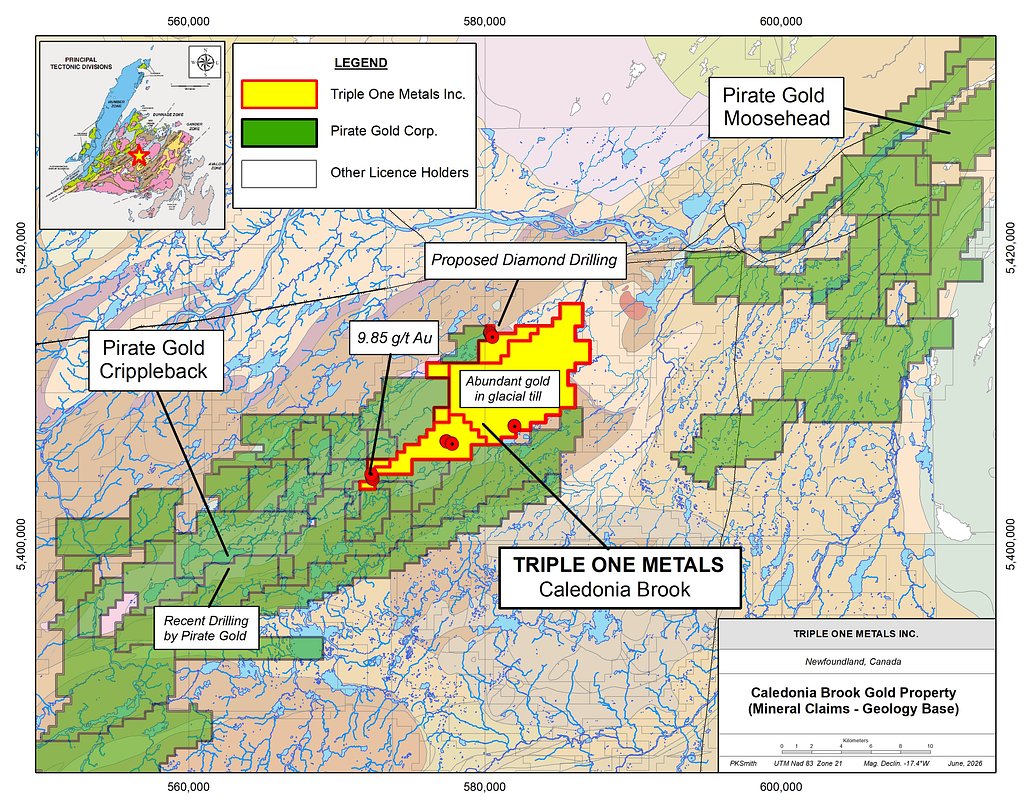
The immediate beneficiary is, of course, Pirate Gold itself. But the true story, the one that signals a structural shift, is the 'halo effect' now radiating across the entire Crippleback-Moosehead trend. For companies like Triple One Metals Inc., which holds a strategic land package next door, the game has fundamentally changed. A neighbor’s discovery has transformed their Caledonia Brook property from a prospective piece of ground into a frontline position in what is rapidly becoming one of Canada’s most exciting new exploration frontiers.
Deconstructing a District-Scale Engine
To understand the excitement, one must look past the headline numbers and into the geological mechanics of the discovery. Pirate Gold reported an intercept in hole PGC-26068 of 0.54% copper equivalent over a remarkable 180.8 metres, including a higher-grade core of 1.48% copper equivalent over 49.4 metres. While impressive, these grades are secondary to the context in which they were found.
The mineralization is hosted within a vast advanced argillic alteration system—a zone of chemically-cooked rock that geologists see as a giant footprint for a copper-gold porphyry or high-sulphidation epithermal deposit. These are not narrow, high-grade veins; they are bulk-tonnage systems, the behemoths of the mining world, responsible for the majority of global copper production. Pirate Gold has already traced this alteration footprint over an area measuring approximately 3,100 metres long, 850 metres wide, and 500 metres deep, and the system remains open in multiple directions.
This is the kind of scale that turns an exploration play into a potential long-life mining operation. The discovery validates a geological model that suggests the Neo-Proterozoic Crippleback Intrusive Suite, a rock package covering over 200 square kilometers, served as the plumbing for a powerful, metal-rich hydrothermal system. Pirate Gold's subsequent step-out drilling, which has hit visible copper mineralization 1.8 kilometers away, reinforces the thesis that Moby Dick isn't an isolated event, but the first major confirmation of a district-scale trend.
From Gold Rush to Copper Frontier
Central Newfoundland is no stranger to exploration headlines. The region, particularly along the Valentine Lake Fault Zone, has been celebrated as Canada’s newest gold district. Pirate Gold itself has been a dominant player in this narrative with its high-grade Moosehead gold discovery. However, the Moby Dick find fundamentally alters and expands this story. It introduces a powerful new dimension: copper.
This pivot from a primarily gold-focused region to a potential copper-gold powerhouse is a systemic transformation. It suggests the underlying geology is prospective for multiple deposit types, attracting a wider range of investment and expertise. The lack of historical exploration for copper porphyry systems in this specific area means that Pirate Gold—and by extension, its neighbors—are exploring virgin territory with a new geological playbook.
This is precisely the kind of structural shift that defines progress. As A. Paul Gill, CEO of Triple One Metals, noted, Pirate Gold's work has "drawn new attention to a district that we believe remains underexplored." His statement underscores a critical point: the discovery provides invaluable regional context, validating the potential for a large-scale copper-gold mineralizing system that could extend well beyond the boundaries of a single property.
The High-Value Game of Proximity
This brings us to Triple One Metals and its Caledonia Brook property. In the junior mining sector, proximity to a major discovery is one of the most powerful value drivers available. While the company prudently cautions that mineralization on an adjacent property is no guarantee of its own success, the market understands the geological logic. Major mineral deposits rarely respect claim boundaries.
For Triple One, Pirate Gold’s discovery acts as a massive, multi-million-dollar geophysical survey conducted on its doorstep. It confirms that the right kind of geological engine exists in the neighborhood. The challenge now shifts from pure greenfield speculation to a more focused, data-driven exploration approach. As Mr. Gill stated, Triple One intends to "evaluate Caledonia Brook with a disciplined exploration approach focused on identifying of its gold targets that may be related to the same broader geological environment."
This strategy is about connecting the dots. Triple One will now review its own historical data, geophysics, and mapping through the new lens provided by the Moby Dick discovery model. The goal is to identify similar geological and structural signatures on its own ground that could point to another expression of the same regional mineralizing event. It's a high-stakes game, but one where the odds have just improved dramatically.
Powering the Future Economy
Ultimately, the significance of the Crippleback discovery extends far beyond the stock charts of junior miners. It plugs directly into the most powerful engine of the 21st-century economy: the global energy transition. Copper is not just an industrial metal; it is the essential conduit for electrification. Every electric vehicle, wind turbine, solar panel, and grid upgrade requires vast amounts of it. A major new copper discovery in a stable, top-tier jurisdiction like Canada is a globally significant event.
What is unfolding in central Newfoundland is a microcosm of the new resource economy. A geological theory, tested with capital and drilling, has revealed a potential new source of the very materials needed to build a decarbonized future. The discovery at Moby Dick is the first tremor, signaling that the tectonic plates of the global resource map are shifting once again, with Newfoundland emerging as a critical new node.