
- $1,805: Average annual savings for an American driver covering 15,000 miles by switching to an EV.
- $3,008: Potential annual savings for high-mileage drivers (25,000 miles/year) compared to gasoline vehicles.
- 30%: Surge in U.S. gasoline prices due to geopolitical disruptions.
Experts agree that the financial benefits of switching to EVs are becoming increasingly compelling, particularly as gasoline prices surge and energy costs remain volatile.
New Tool Calculates EV Savings as Gas Prices Surge Past $4 a Gallon
SEATTLE, WA – March 31, 2026 – As American drivers face sticker shock at the pump with gasoline prices surging past $4 per gallon, a Seattle-based nonprofit has launched a new tool designed to quantify the financial relief of switching to an electric vehicle. Coltura, an organization dedicated to phasing out gasoline use, today released its free, interactive “Weekly EV Cost Savings Index,” offering consumers a personalized look at the potential savings of leaving internal combustion engines behind.
The tool’s launch is starkly timed. A war in Iran that began in late February has severely disrupted global oil supplies through the Strait of Hormuz, causing U.S. gasoline prices to spike by over 30%. For millions of households, this volatility translates directly into budget uncertainty and increased transportation costs. Coltura's index aims to provide a clear, data-driven alternative by illustrating the stability and economic benefits of powering a vehicle with electricity.
A Tool for Tumultuous Times
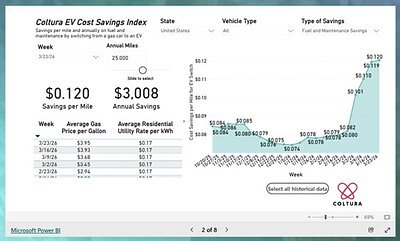
The Weekly EV Cost Savings Index, available on Coltura's website, allows users to generate a customized savings estimate in seconds. By selecting their state, vehicle type (car or SUV/truck), and annual mileage via a simple slider, drivers can see a detailed breakdown of their potential savings per mile, per trip, and on a monthly or annual basis.
Crucially, the index pulls in local gasoline and electricity prices, which are updated weekly, to provide a timely and geographically relevant comparison. According to Coltura's national data, an average American driver covering 15,000 miles a year stands to save approximately $1,805 annually on fuel and maintenance by switching to an EV. The benefits are even more pronounced for high-mileage drivers, with someone logging 25,000 miles a year potentially saving $3,008.
“With gas prices rising every week, drivers are right to ask whether an EV could protect them from the volatility,” said Janelle London, Co-Executive Director of Coltura, in a press release. “The answer is yes — and we built this tool so anyone can see exactly how much protection, in their own state, for their own driving habits. If you're putting 25,000 miles a year on a gasoline vehicle right now, you're losing $3,008 a year compared to what you'd pay in an EV. That's real money.”
The Shifting Economics of the Road
The financial argument for EVs has been supercharged by the recent market turmoil. The national average for a gallon of regular gasoline hit $4.09 today, a threshold not crossed since 2022. This rapid increase from under $3 a gallon just over a month ago underscores the vulnerability of gasoline-powered transportation to geopolitical events thousands of miles away.
In contrast, the cost of electricity is largely insulated from the global oil market. While not entirely immune to price fluctuations—residential electricity rates have seen a modest year-over-year increase of around 5-9% due to rising natural gas costs and grid demand—they lack the dramatic, day-to-day volatility of gasoline. This relative stability provides EV owners with a more predictable and manageable cost per mile.
The Coltura index captures this dynamic by comparing these two fluctuating energy sources in near real-time. While other EV savings calculators exist, many rely on national averages or less frequent data updates. Coltura's emphasis on weekly, localized data makes its tool particularly useful for consumers trying to make decisions during a period of extreme price instability.
More Than a Calculator: An Advocacy Instrument
For Coltura, the EV Cost Savings Index is more than just a consumer resource; it is a strategic instrument in its broader mission. As a 501(c)(3) nonprofit, Coltura has a long history of using data-driven approaches to advocate for policies that accelerate the transition away from gasoline. The organization previously coined the term “gasoline superusers” to identify the top 10% of drivers who consume nearly a third of all gasoline in the U.S., arguing that converting this specific group would have an outsized impact on emissions and fuel consumption.
Coltura has been an influential force behind clean transportation legislation in states like Washington, which set a 2030 target for all new vehicles to be electric, and California, where it supported the 2035 gasoline car phaseout. By putting a clear dollar figure on the “gasoline penalty,” the new index serves as a powerful public persuasion tool. It reframes the decision to switch to an EV from a purely environmental choice to a pragmatic financial one, empowering individuals to see how macro-level energy policy directly affects their personal finances.
Navigating the Roadblocks to Adoption
While the operational savings highlighted by the index are compelling, the journey to widespread EV adoption is not without its hurdles. The total cost of ownership—which includes the initial purchase price, fuel, maintenance, insurance, and depreciation—presents a more complex picture.
Although the upfront price gap between EVs and their gasoline counterparts has narrowed significantly, with some EVs becoming cheaper after federal tax credits, the initial sticker price remains a primary barrier for many buyers. Furthermore, the charging infrastructure, while growing rapidly, still presents challenges. Reliability issues, a lack of chargers in rural areas and apartment complexes, and the high cost of installing public fast-charging stations are persistent concerns that can fuel range anxiety and deter potential buyers.
Tools like the Weekly EV Cost Savings Index effectively illuminate one of the most powerful motivators for change: personal economic benefit. As drivers continue to watch gas prices climb, the clear and personalized data provided by such resources makes the financial case for electrification stronger than ever, even as the industry works to overcome the remaining infrastructural and economic barriers on the road ahead.