
- Photon Detection Efficiency (PDE): 84.4% at 785 nm wavelength
- Dark Count Rate: 260 counts per second at 268 K (-5°C)
- Timing Jitter: 360 picoseconds
Experts agree that this breakthrough positions silicon as a cost-effective, high-performance alternative to more exotic quantum detection technologies, accelerating advancements in quantum computing, secure communications, and medical diagnostics.
New Silicon Detector Shatters Efficiency Record, Boosts Quantum Tech
NEW YORK, NY – January 15, 2026 – In a significant leap forward for quantum technology, researchers have developed a novel silicon single-photon detector (Si SPD) that breaks a long-standing performance barrier, achieving over 84% photon detection efficiency. The breakthrough, led by Mr. Dong An and his team at the renowned University of Science and Technology of China (USTC), offers a compact, flexible, and powerful tool poised to accelerate advancements in quantum computing, secure communications, and advanced medical diagnostics.
The study, published in the IEEE Journal of Selected Topics in Quantum Electronics, details a device that overcomes previous limitations of silicon-based detectors, which have struggled for years to surpass the 80% efficiency threshold. By achieving this milestone, the new detector positions silicon—a ubiquitous and cost-effective material—as a formidable competitor to more exotic and expensive technologies.
Shattering the Silicon Ceiling
Single-photon detectors are the bedrock of quantum photonics, acting as hyper-sensitive eyes capable of registering the faintest possible signal of light: a single photon. Their efficiency, or Photon Detection Efficiency (PDE), dictates how well they can perform this crucial task. While silicon detectors have long been valued for their compact size and operational simplicity, their PDE has typically hovered around 70%, limiting their use in the most demanding applications.
This new device shatters that ceiling, boasting a remarkable PDE of up to 84.4% at a wavelength of 785 nanometers. This was accomplished through a meticulous redesign of both the detector's core architecture and its supporting electronics.
The team engineered a thick-junction silicon single-photon avalanche diode (SPAD) featuring a unique doping-compensated avalanche region. This design minimizes internal electronic "noise" and creates a more uniform electric field, ensuring that when a photon strikes the detector, it reliably triggers a detectable signal. Furthermore, a backside-illumination architecture ensures that incoming photons have the maximum possible chance of being absorbed and counted.
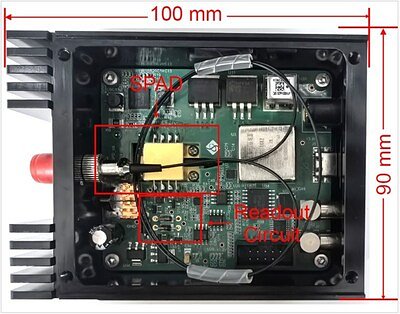
Supporting this innovative SPAD is a custom-built 50-volt active-quenching readout circuit. This circuit rapidly switches the detector between its "armed" and "idle" states, maximizing its readiness to detect photons and enabling versatile operation. The entire module, which includes the SPAD, readout circuit, temperature stabilization, and USB control, is housed in a compact 9 × 10 × 3 cm package.
"Our new design with a remarkable PDE of up to 84.4% at 785 nm helps silicon detectors achieve their highest detection efficiency while preserving its compact module, enable flexible operation in free-running, gating, and hybrid modes," says Mr. An.
Beyond its record-setting efficiency, the detector maintains strong all-around performance. At an operating temperature of 268 K (-5°C), it exhibits a low dark count rate—a measure of false positive signals—of just 260 counts per second and a timing jitter of 360 picoseconds. While the researchers note that improving timing precision is a goal for future work, these specifications already make the device highly practical for a wide array of uses.
From Quantum Labs to Real-World Industries
The impact of a high-efficiency, practical single-photon detector extends far beyond the research lab. This breakthrough is set to fuel innovation across multiple high-growth sectors, with the global market for single-photon detectors projected to exceed $2 billion by 2032.
In the race to build fault-tolerant quantum computers, the ability to reliably detect single photons is essential for reading the state of photonic qubits. Higher efficiency translates directly to lower error rates and more powerful computational capabilities. Similarly, the field of quantum cryptography, which promises unhackable communication channels through Quantum Key Distribution (QKD), depends entirely on detecting the single photons that encode secret keys. A more efficient detector makes these systems more robust and capable of operating over longer distances.
Perhaps the most immediate impact will be felt in industries already using single-photon detection. In medicine, advanced imaging techniques like Positron Emission Tomography (PET) and Fluorescence Lifetime Imaging (FLIM) rely on SPDs to create high-resolution maps of biological processes. Higher PDE means clearer images, lower required doses of radioactive tracers, and earlier, more accurate disease diagnoses.
For the automotive industry, this technology could revolutionize LiDAR (Light Detection and Ranging) systems for autonomous vehicles. A detector that can reliably sense weak, single-photon returns from distant objects would dramatically improve the range and resolution of these crucial safety systems, enabling self-driving cars to see farther and react faster.
A New Contender in a Competitive Field
Until now, achieving efficiency levels above 80% often required turning to alternative technologies, each with significant trade-offs. Superconducting Nanowire Single-Photon Detectors (SNSPDs), for example, can exceed 95% efficiency with near-perfect noise performance, but they demand complex and expensive cryogenic cooling systems, restricting their use to well-funded laboratories.
Other materials like Indium Gallium Arsenide (InGaAs) are effective in the infrared spectrum but typically suffer from higher noise and lower efficiency compared to this new silicon device. Traditional Photomultiplier Tubes (PMTs) are sensitive but are also bulky, fragile, and require high operating voltages.
This new silicon SPD carves out a critical middle ground. It delivers performance that rivals more complex systems but in a compact, robust, and silicon-based package that is inherently easier to manufacture and integrate. Its ability to operate with moderate cooling makes it far more accessible for commercial and industrial applications where cost and practicality are paramount.
This achievement is a testament to the expertise housed at the University of Science and Technology of China, a global epicenter for quantum information science. USTC has been at the forefront of numerous quantum milestones, and this work further solidifies its reputation as a leader in translating fundamental physics into practical technology.
By providing a powerful and accessible new tool, this research not only marks a major engineering victory but also helps democratize access to high-performance quantum sensing. As Mr. An concludes, "Our study through the development of a high-efficiency Si SPD module provides a practical solution for quantum photonics and single-photon imaging applications demanding ultra-high-efficiency Si SPDs with flexible operation modes."