
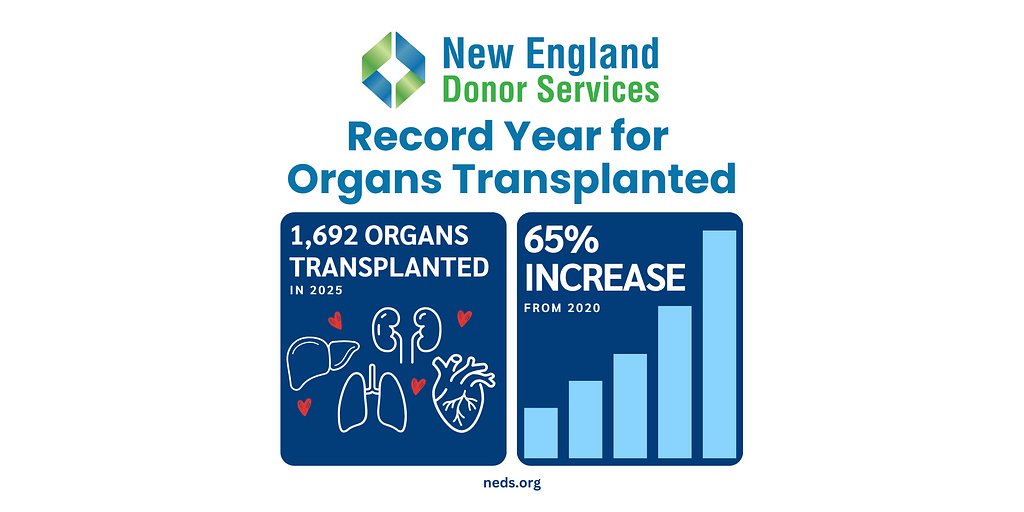
- 1,692 organ transplants coordinated by New England Donor Services in 2025, a 65% increase since 2020.
- 640 deceased donors contributed to the record-breaking year.
- Up to 42% of OPOs could face decertification under new federal regulations, per AOPO analysis.
Experts warn that while New England Donor Services has achieved remarkable success in organ transplants through medical innovation, poorly designed federal regulations threaten to destabilize the national donation system, risking lives of thousands on transplant waiting lists.
New England's Transplant Record Faces Federal Headwinds
WALTHAM, MA – January 15, 2026 – New England Donor Services (NEDS) announced a landmark achievement for 2025, coordinating a record 1,692 life-saving organ transplants. This figure, resulting from the generosity of 640 deceased donors, marks the fifth consecutive year of growth for the organization and solidifies its position among the top three organ procurement organizations (OPOs) in the United States by volume. Since 2020, the number of transplants from New England donors has surged by an impressive 65 percent.
However, this story of unprecedented success is shadowed by a gathering storm. While celebrating the lives saved through medical innovation and community generosity, the organization is also sounding the alarm about impending federal regulations that it warns could destabilize the nation's organ donation system, putting thousands of patients at risk.
A Surge Driven by Medical Innovation
A key factor in the 8 percent increase in transplants in 2025, even as the number of donors remained steady, was the aggressive adoption of cutting-edge medical technology. NEDS has become a leader in utilizing advanced organ perfusion techniques that dramatically increase the viability of donated organs that might have been discarded in the past.
At the forefront of this technological leap is Abdominal Normothermic Regional Perfusion (A-NRP). This procedure restores warm, oxygenated blood flow to abdominal organs after a donor's circulation has stopped. By mitigating the cellular damage that occurs from a lack of oxygen, A-NRP makes organs from donors after circulatory determination of death (DCD) significantly more likely to be successfully transplanted. Research shows the technique can increase the odds of all abdominal organs being transplanted by threefold and reduce the chances of post-transplant complications.
“Previously, these organs may not have been accepted for transplant, but now they are used routinely to the benefit of transplant patients and offers the opportunity for donation to more families,” said Alexandra K. Glazier, President and CEO of New England Donor Services.
This in-situ technique is often combined with transportable ex vivo perfusion devices, which act like portable life-support systems for organs, keeping them warm and functional during transport to a recipient. This combination is particularly effective for organs from older or more medically complex donors, expanding the potential donor pool and giving more families the chance to see their loved one's legacy live on.
The Human Impact of a Second Chance
The numbers represent more than just data points; they represent renewed lives and families made whole. For Ashley Stanger of East Haddam, CT, it meant her five-year-old son, Lincoln, could finally leave the hospital after 327 consecutive days of treatment for dilated cardiomyopathy.
“Lincoln received a new heart in March 2025, thanks to the generosity of his deceased donor,” Stanger said. “We extend our deepest gratitude to Lincoln’s donor. Thanks to this selfless choice, Lincoln is now able to attend kindergarten, spend time with his younger sister, and dreams of becoming a firefighter one day.”
That sentiment is echoed by Sean Moore of Grafton, MA, who received a kidney transplant in July 2025. “I am incredibly grateful and humbled to have received the gift of life,” Moore stated. “My transplant has given me renewed health and the opportunity to spend many more years with my wife and three children.”
The organization’s impact also extends to tissue donation, which saw a record 1,861 donors in 2025. While one organ donor can save up to eight lives, a single tissue donor can heal and restore the quality of life for more than 75 people. Tissues such as skin for burn victims, bone for reconstructive surgery, ligaments for injured athletes, and corneas to restore sight contribute to over 100,000 tissue transplants annually from donations coordinated by NEDS.
A Record Year Under a Gathering Storm
Despite these historic achievements, NEDS and other OPOs across the country are bracing for what Glazier describes as a significant “disruption of the donation and transplant system.” The source of this anxiety is a set of revised performance metrics from the Centers for Medicare & Medicaid Services (CMS), which are set to be fully enforced for OPO recertification in 2026.
Finalized in 2020, the new rules aim to increase accountability and boost performance across the nation. However, critics within the industry argue the metrics are flawed and could have devastating unintended consequences. According to analyses by the Association of Organ Procurement Organizations (AOPO), the new regulations could lead to the automatic decertification of up to 42% of the country's 55 OPOs.
“Poorly designed federal regulatory metrics may force the closure of up to half of the community-based non-profits coordinating organ donation for transplant in the United States with no clear plan for how the system will deliver services for these areas,” Glazier warned. She urged federal policymakers to reform the regulatory structure before it threatens the stability of the system.
This potential disruption looms over a system that is already struggling to meet overwhelming demand. Any loss of operational capacity could have dire consequences for the thousands of patients waiting for a second chance at life.
The Unrelenting Need for Donation
NEDS's record-breaking year is a significant victory in the ongoing battle against the organ shortage, but the need remains immense. More than 100,000 people are on the national transplant waiting list, with a new name added every eight minutes. Tragically, about 16 people die each day while waiting.
In New England alone, over 5,000 residents are waiting for a life-saving organ. The wait can be agonizingly long. In Massachusetts, for example, the wait time for a kidney transplant can stretch from five to nearly eleven years, depending on the transplant center and blood type. This stark reality underscores the critical importance of every single donation and the efficiency of the organizations that facilitate them.
While NEDS is positioned to maintain its high performance, the uncertainty facing the national network places a greater emphasis on public participation. New England residents can give hope to those on the waiting list by registering as an organ and tissue donor on their driver’s license, through the Apple iPhone health app, or on the national registry at www.RegisterMe.org.