
- Global STEM toy market valued at over $21 billion in 2025, projected to reach $32 billion by 2030
- Educational board games market valued at $9.2 billion in 2025, projected to nearly double by 2034
- Over 100 circuit puzzles included in the game
Experts in education and STEM fields would likely conclude that Reactor Rescue effectively bridges entertainment and learning, offering a tangible, screen-free approach to developing critical engineering skills that aligns with growing market demand for hands-on educational tools.
New Board Game Sparks Real Engineering Skills with Live Circuits
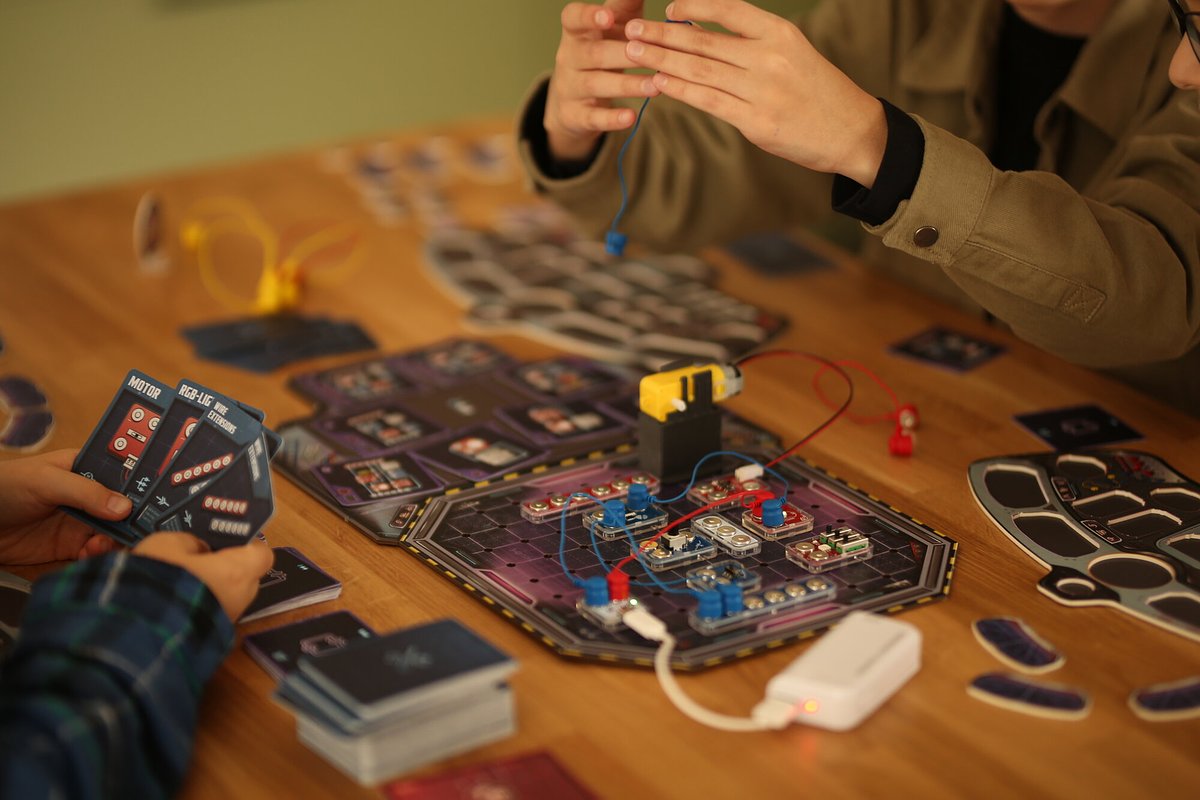
MILWAUKEE, April 08, 2026 – In a move that could redefine family game night, global educational toy leader Hape Holding AG and STEM education specialist Labbox Education have announced Reactor Rescue, a board game that challenges players to build working electronic circuits against the clock. The game represents a significant push into tangible, screen-free learning, aiming to cultivate real-world engineering skills in a market increasingly saturated with digital entertainment.
Set in the futuristic floating city of Electra, the game casts players as engineers aboard a spacecraft crippled by a meteoroid storm. To win, they must race to restore power by completing circuit-building missions using real electronic components like LEDs, motors, and sensors. It’s a high-stakes blend of strategy, speed, and hands-on problem-solving designed for players aged 10 and up.
This launch comes as the global STEM toy market is experiencing explosive growth, with some analysts valuing it at over $21 billion in 2025 and projecting a rise to over $32 billion by 2030. The trend is fueled by parents and educators actively seeking alternatives to passive screen time that can develop critical 21st-century skills.
The Future of Family Game Night?
Reactor Rescue fundamentally changes the board game dynamic. Instead of simply moving a pawn around a board, players physically construct and test circuits based on challenge cards. Each round is timed, giving players just two minutes to successfully complete their circuit. Failure means a frantic scramble to troubleshoot and debug their creation, adding a level of tension and excitement rarely seen in educational products.
The game is designed to be accessible yet challenging, with over 100 circuit puzzles and multiple gameplay modes that cater to different skill levels. Beginners can ease into the concepts through learning scenarios, while advanced players can tackle complex challenges. This scalability makes it engaging for a mixed-age family, a group of curious friends, or even adults looking to demystify the world of electronics.
The use of tangible, physical components is central to the experience. Players aren't simulating a circuit on a screen; they are connecting wires, inserting components, and seeing the immediate result—a light blinking, a motor spinning. This direct, tactile feedback is what developers believe will create a deeper, more lasting understanding of engineering principles.
From Classroom to Kickstarter: The Minds Behind the Machine
Behind Reactor Rescue are sisters and computer science engineers Arta and Fiona Shehu, the co-founders of Labbox Education. Their venture was born from years of hands-on experience teaching thousands of students at jCoders Academy, a coding school they also helped build. It was in the classroom that they identified a critical need for better tools to teach complex concepts.
They observed that the most profound learning moments—what they call the 'click'—happened when students moved from abstract theory to building something that actually worked. Labbox Education was founded on the philosophy of turning technology consumers into creators. Their electronic building blocks are designed to be intuitive and, crucially, mistake-friendly, with built-in indicators that help learners debug their own work without frustration. This fosters resilience and an understanding that experimentation and failure are integral parts of the engineering process.
"With Reactor Rescue, we set out to create a learning experience that builds on what makes board games so engaging, and combines it with real, hands-on circuit building," said co-founder Arta Shehu. "By bringing together competition, strategy, and the thrill of winning with building and solving real circuits, players don't just play—they experience what it's like to be an engineer. We've seen firsthand how powerful it is when someone builds something that actually works for a mission that matters. This game brings that experience to families in a way that's fun, competitive, and deeply rewarding."
A Strategic Play in a Booming Market
The partnership between Hape and Labbox is a calculated move. Hape, a German company founded in 1986, is a titan in the educational toy world, known for its high-quality wooden toys and commitment to sustainability. Their existing "Junior Inventor" line already introduces children to basic engineering concepts with pulleys and levers. Reactor Rescue represents a strategic expansion into a more sophisticated, electronics-focused category for an older demographic.
By partnering with the Shehu sisters and Labbox, Hape is leveraging specialized expertise to enter a niche but rapidly growing segment. The educational board games market alone was valued at $9.2 billion in 2025 and is projected to nearly double by 2034. Within that, STEM-focused games hold the largest share, making Reactor Rescue a well-timed entry.
Choosing to launch on Kickstarter on April 21, 2026, is another key part of the strategy. The crowdfunding platform has become a powerful proving ground for innovative board games, allowing creators to connect directly with an enthusiastic audience and validate market demand before committing to mass production. For backers, it offers a chance to be part of the launch with early-bird pricing and exclusive rewards.
More Than Just a Game: Building the Next Generation of Innovators
While Reactor Rescue is designed for entertainment, its pedagogical value is undeniable. Child development experts and educators increasingly emphasize the importance of hands-on, screen-free play for cognitive development. Engaging multiple senses by manipulating physical objects creates stronger neural pathways, enhancing memory retention and deepening comprehension. It’s this principle that underpins the game's entire design.
When a player successfully builds a circuit to light an LED, they are not just winning a point in a game; they are learning about polarity, current flow, and conductivity. When a circuit fails, they are learning the invaluable engineering skill of troubleshooting. This process develops logical reasoning, spatial awareness, and, perhaps most importantly, resilience. The satisfaction of overcoming a challenge and making something work builds a unique form of confidence that can spark a lifelong interest in science and technology.
The game aims to demystify engineering, transforming it from an intimidating, abstract field into an accessible and exciting process of discovery. By embedding real learning within the competitive fun of a board game, Hape and Labbox are betting they can do more than just sell a product—they can inspire a new generation of problem-solvers and innovators.