
- Delivery Ahead of Schedule: Neros completed its first delivery under the U.S. Army’s PBAS program ahead of schedule.
- Cost-Effective Design: Archer Block 2 drones have a unit cost target of under $2,000, making them attritable for high-risk scenarios.
- Funding Boost: Neros secured $75 million in Series B funding to scale manufacturing and R&D.
Experts would likely conclude that Neros' Archer Block 2 system represents a significant advancement in modular, cost-effective drone technology for modern battlefield operations, aligning with the U.S. Army's strategic goals for attritable and domestically produced unmanned systems.
Neros Speeds Army Drone Delivery, Unveils Modular Archer Block 2 System
EL SEGUNDO, CA – March 09, 2026 – Neros Technologies announced a dual milestone today that signals a significant step forward in the U.S. military's adoption of next-generation unmanned systems. The defense technology firm confirmed it has completed its first delivery under the U.S. Army’s Purpose Built Attritable Systems (PBAS) program ahead of schedule, while simultaneously debuting its Archer Block 2, a highly modular First Person View (FPV) drone system designed for the modern battlefield.
The announcement positions Neros as a key partner in the Army's push to equip soldiers with low-cost, effective, and domestically produced drone technology, reflecting lessons learned from recent global conflicts where small, agile drones have reshaped tactical engagements.
A New Era of Battlefield Modularity
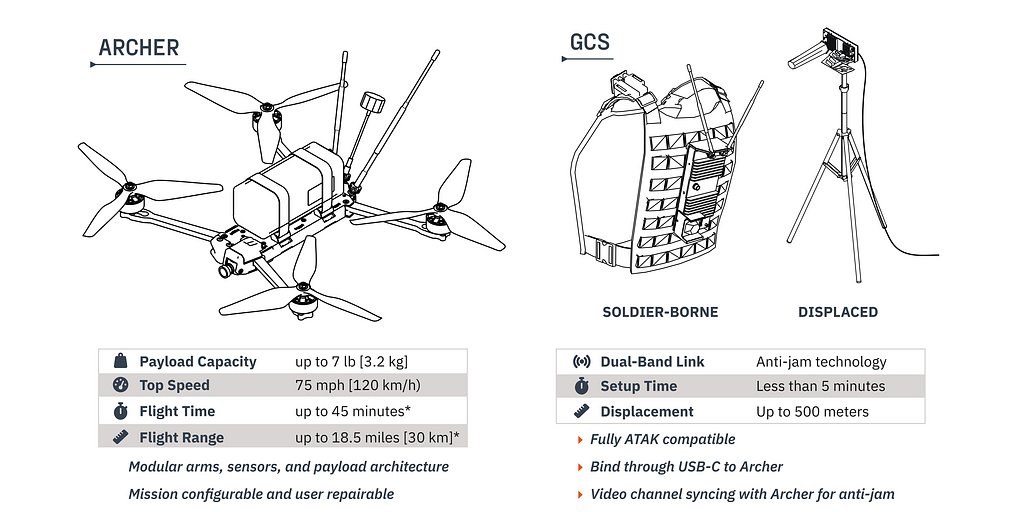
At the heart of the announcement is the Archer Block 2, a system that moves beyond the concept of a single-purpose drone. It introduces a modular, field-reconfigurable design intended to provide unprecedented flexibility to warfighters. According to the company, soldiers can swap critical components like arms, motors, and propellers in the field, allowing them to configure the drone for different missions. The platform can be adapted into five-, eight-, or ten-inch configurations to balance speed, endurance, and payload capacity as mission demands change.
This modularity extends to its sensor and payload systems. The Archer Block 2 features an interchangeable suite of sensors that can be swapped in minutes. This includes electro-optical (EO) and thermal cameras for day and night operations, downward-facing cameras for detailed surveillance, and both EO and infrared (IR) illuminators. This capability allows a single drone platform to be adapted for reconnaissance, surveillance, or direct action roles without needing to field multiple distinct aircraft.
“Swappable sensors fundamentally change how FPV systems are employed,” said Soren Monroe-Anderson, Neros’ CEO, in the company's announcement. “Instead of fielding multiple platforms for different missions, operators can reconfigure Block 2 on the ground to match the task at hand—day, night, urban, or extended-range—without slowing down or compromising capability.” This design philosophy not only enhances operational flexibility but also aims to reduce lifecycle costs by allowing for field repairs and upgrades rather than wholesale system replacement.
Strengthening the Domestic Supply Chain
The early delivery under the PBAS program is as significant as the new technology itself. The Army's PBAS initiative was established to rapidly field effective, mission-adaptable, and attritable drone capabilities to platoon-level units. The term "attritable" is key, referring to systems that are effective enough to be decisive but inexpensive enough—with unit cost targets reportedly under $2,000—to be used in high-risk scenarios without the operational or financial impact of losing a more expensive asset.
Neros Technologies' ability to deliver ahead of schedule underscores the readiness of its production lines and the security of its supply chain. This is a critical component of the PBAS program, which heavily emphasizes the use of National Defense Authorization Act (NDAA)-compliant systems. NDAA compliance prohibits the Department of Defense from using drones or critical components—such as flight controllers, cameras, and data transmission systems—manufactured in covered foreign countries, most notably China.
By designing, engineering, and manufacturing its systems entirely in the United States, Neros helps the Army mitigate risks of espionage, sabotage, and supply chain disruptions from strategic competitors. This commitment to a secure, domestic industrial base was a core requirement for the PBAS program, which selected Neros as one of three primary manufacturers for its first tranche of FPV drones. The company's success reinforces a broader strategic shift within the Pentagon to cultivate a resilient domestic manufacturing base for critical defense technologies.
Empowering the Soldier on the Ground
For the dismounted infantry soldier, these advancements translate into tangible tactical advantages and increased survivability. The Archer Block 2 system is integrated with Flatbow, a rugged, soldier-borne Ground Control System (GCS). A single infantry unit can carry a field pack containing up to three FPV drones, allowing for rapid deployment and sustained operations.
Crucially, the Flatbow GCS features a displaced antenna that allows the drone pilot to operate from a standoff distance of up to 150 meters from the antenna's location. This tactical flexibility is a game-changer in urban or contested environments, enabling operators to remain under cover and concealed from enemy observation or direct fire while launching and controlling the drone. This capability directly enhances soldier safety by reducing their exposure on the front line.
The system's design is heavily influenced by the evolution of drone warfare in conflicts like Ukraine, where FPV drones have become indispensable tools for reconnaissance and direct action. The Archer platform itself has variants for both Intelligence, Surveillance, and Reconnaissance (ISR) and strike missions, with the Archer Strike variant capable of integrating with anti-armor and anti-personnel payloads to engage targets at extended ranges.
The Future is Autonomous and Iterative
Neros is not stopping at modular hardware. The company has laid out a clear roadmap for future enhancements that lean heavily into artificial intelligence and autonomy. Planned upgrades for the Archer Block 2 system include AI-enabled terminal guidance for improved targeting precision, autonomous mission features to reduce operator workload, and aerial repeater capabilities to extend operational range even further, particularly in electronically contested environments where jamming is a constant threat.
This vision aligns with the Army's broader goals for the PBAS program, which include exploring capabilities like autonomous flight, waypoint navigation, and even drone swarming formations. The ultimate goal is a multi-functional system that can adapt as quickly as the threats it faces.
“At Neros, we don’t build static products—we build evolving combat systems,” Monroe-Anderson stated. “Block 2 reflects our commitment to continuous iteration, rapid integration of new capabilities, and deep partnership with American and allied warfighters.”
This iterative approach is backed by significant investment. The company recently secured $75 million in a Series B funding round led by Sequoia Capital, with the explicit goal of scaling its manufacturing capabilities and accelerating research and development. With orders for the Archer Block 2 system now being accepted, Neros Technologies is capitalizing on the momentum from its early Army delivery to solidify its role in shaping the future of unmanned systems for the American warfighter.