
- 40 million: Namibox's existing user base in China's EdTech space.
- $22 billion: Projected global AR/VR in Education market size by 2030.
- 10x: Forecasted growth of the AR/VR in Education market by 2030.
Experts view Namibox's AI learning glasses as a high-risk, high-reward bet on specialized education technology, with potential to redefine learning tools but facing significant adoption and ethical challenges.
Namibox Debuts AI Glasses, Betting Big on the Classroom of the Future
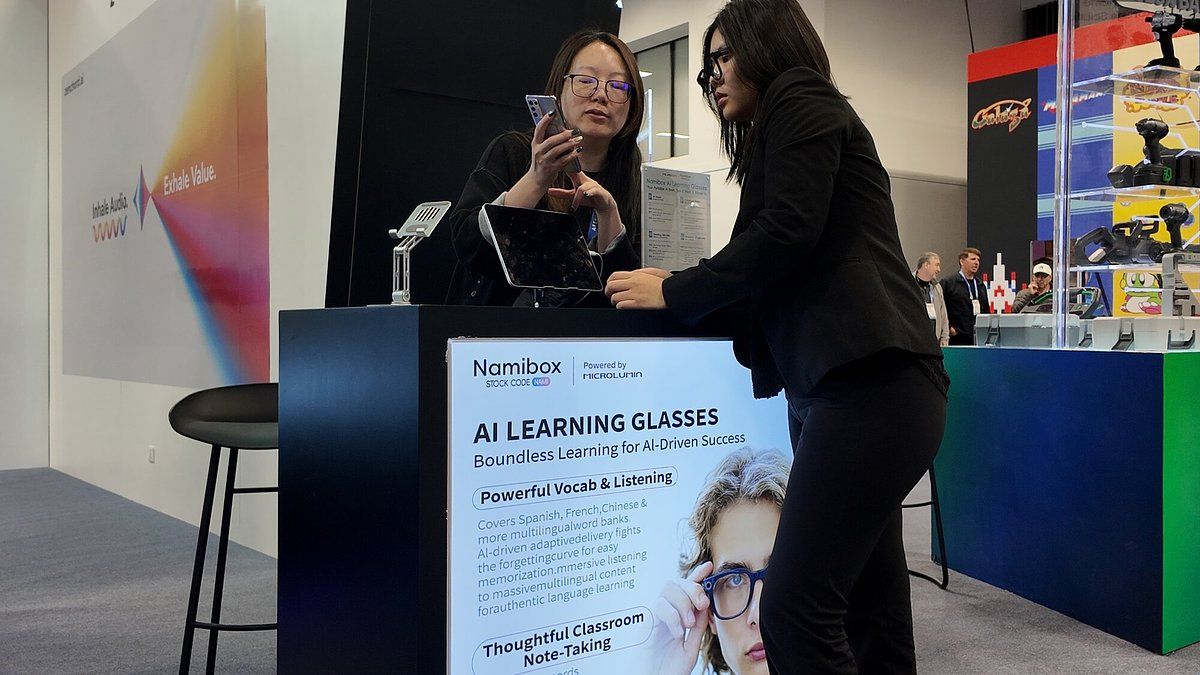
LAS VEGAS, NV – January 09, 2026 – Amid the dazzling spectacle of next-generation televisions and futuristic concept cars at the 2026 Consumer Electronics Show, a quieter but potentially more profound revolution was unveiled. Namibox, the education technology arm of Shanghai-based Jinxin Technology Holding Company (Nasdaq: NAMI), officially debuted NAMI INSIGHT One, a device it bills as the world's first AI learning glasses purpose-built for the classroom.
The launch marks a bold declaration of intent, positioning the company at the critical intersection of artificial intelligence, wearable technology, and education. In a market saturated with general-purpose AR headsets focused on entertainment and productivity, Namibox is making a high-stakes wager on a vertical strategy: that the future of learning is not on a screen, but seen through a specialized, intelligent lens.
A New Vision for Learning
At its core, NAMI INSIGHT One is more than just a piece of lightweight AR hardware; it is an integrated learning ecosystem. The device eschews the 'one-size-fits-all' approach of its competitors by embedding a proprietary, education-specific large AI model trained on years of curriculum-aligned content and real user learning data from Namibox's existing platform.
This deep integration enables a suite of features meticulously designed for structured learning scenarios. A 'Classroom Mode' provides students with real-time, AI-generated notes, aiming to improve focus and comprehension during lectures. The 'Smart Vocabulary Mode' leverages an anti-forgetting algorithm to schedule personalized reviews, turning fragmented moments on a commute or between classes into effective study sessions. For auditory learning and language education, a 'Listening Mode' utilizes bone conduction technology for clear audio without blocking out ambient sounds, complemented by a built-in 'Translation Mode' to support cross-border learning.
Unlike general-purpose AI, which draws from the vast and unstructured internet, the intelligence inside NAMI INSIGHT One is curated and contextual. It is designed to understand pedagogical principles and align with specific K-9 subjects like Chinese and English, drawing from the same mainstream textbooks students use in school. This focus on curriculum-specific intelligence, rather than raw hardware specifications, is what Namibox believes will give it a defensible moat in a competitive market.
Jinxin's Strategic Pivot to Hardware
The introduction of NAMI INSIGHT One represents a pivotal strategic shift for its parent company, Jinxin Technology. For years, the company has operated primarily as a digital content provider, building its Namibox platform into a significant force in China's EdTech space with a reported user base of over 40 million. Now, it is transitioning into a 'content + hardware' platform company.
This move is both ambitious and fraught with risk. By creating its own hardware, Jinxin aims to control the entire user experience, creating a powerful new entry point for user acquisition and monetization. The glasses serve as the front-end terminal, while the true long-term value lies in the recurring revenue streams from AI-driven content, personalized services, and valuable data insights. This strategy leverages the company's key structural advantage: a massive library of curriculum-aligned content that new, hardware-only entrants would struggle to replicate.
However, the financial picture presents a more complex narrative. While Jinxin has seen modest revenue growth, the company is not currently profitable, and its stock has experienced significant volatility. The company has signaled a strategy of 'disruptive pricing' for the hardware to broaden access, which will likely compress hardware margins. The success of this model hinges on achieving high-volume sales to subsidize the platform's backend, a classic 'razor and blades' model adapted for the digital age. Investor feedback at CES was cautiously optimistic, with one European education technology investor noting that the vertical strategy offers "stronger commercial defensibility and a clearer monetisation pathway than competing on hardware specifications alone."
Navigating the EdTech Frontier
Namibox is entering a market ripe with potential. The global AR/VR in Education market is projected to explode, with some analysts forecasting a tenfold increase to over $22 billion by 2030, driven by the demand for more immersive, engaging, and personalized learning experiences. The Asia-Pacific region, Jinxin's home turf, is expected to be the fastest-growing market.
NAMI INSIGHT One's debut is a clear indicator of a broader industry trend: the rise of specialized, vertical AI. While general-purpose wearables from tech giants dominate headlines, smaller, more focused players are finding that deep optimization for high-value sectors like education, healthcare, and industrial training can create more sustainable business models. By creating a tool built exclusively for learning, Namibox avoids a direct feature-for-feature battle with consumer electronics behemoths, instead changing the battlefield to one of content depth and pedagogical effectiveness.
This specialized approach, however, does not guarantee success. Widespread adoption faces a gauntlet of practical and ethical challenges that have long plagued the EdTech industry. The high cost of new hardware remains a significant barrier for budget-constrained school districts, and the successful integration of such a novel tool requires robust network infrastructure and, most importantly, comprehensive teacher training and support. There are also health considerations, with some parents and educators expressing concern over the long-term effects of screen time and wearable devices on children's development.
The Unseen Curriculum: Data, Privacy, and Ethics
Beyond the logistical hurdles lies a more profound set of questions surrounding data, privacy, and ethics. An AI-powered device that watches what a student sees and listens to what they hear collects an unprecedented volume of sensitive data. This includes not only academic performance but also behavioral patterns, attention levels, and potentially biometric information.
This data collection immediately runs into a complex web of regulations, including the Family Educational Rights and Privacy Act (FERPA) and the Children's Online Privacy Protection Act (COPPA) in the United States, and similar laws globally. Ensuring compliance while harnessing the power of AI for personalization is a delicate balancing act. Schools, parents, and regulators will demand transparency about what data is collected, how it is used, and who owns it. The risk of data breaches, algorithmic bias that could unfairly label students, or the use of student data for commercial purposes presents a significant ethical minefield.
The success of NAMI INSIGHT One and devices like it will ultimately depend on building trust. Jinxin Technology must not only deliver a technologically impressive product but also demonstrate an unwavering commitment to ethical AI and data stewardship. The launch at CES 2026 is the first step on a long road, one that could redefine the tools of education but also requires navigating the immense responsibility that comes with placing artificial intelligence directly into the hands—and onto the faces—of students.