
- 50% reduction in time and resource costs reported by early adopters like Swiss design company FREITAG
- 80% improvement in data analysis speed, cutting workshop evaluation times from weeks to days
- 82% of global business leaders seek AI solutions that drive team productivity, not just individual efficiency
Experts agree that Miro's AI Workflows represent a significant shift toward collaborative AI, addressing the growing need for team-focused productivity tools that reduce workflow bottlenecks and enhance collective intelligence.
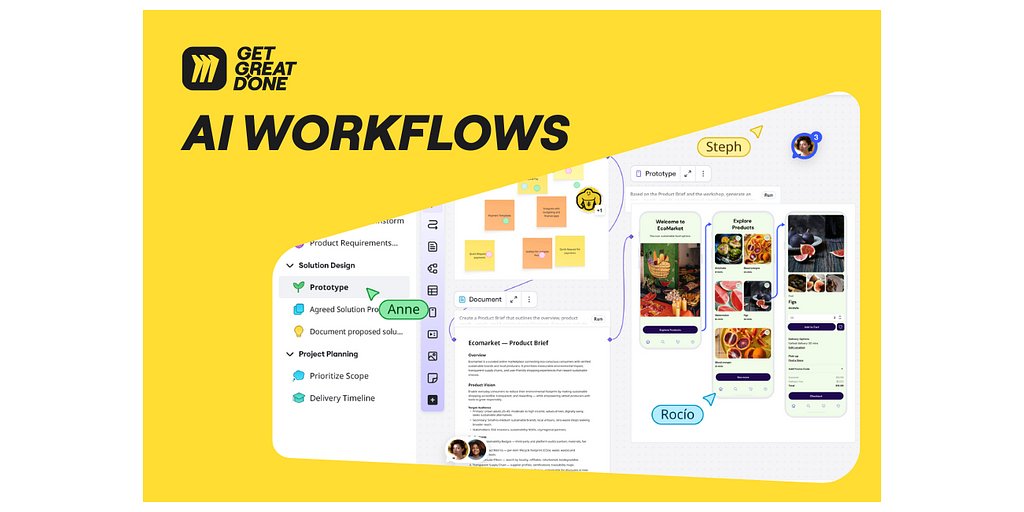
Miro’s AI Workflows: AI as a Team Player, Not Just a Solo Act
SAN FRANCISCO & AMSTERDAM – January 12, 2026 – Miro, a dominant force in the visual collaboration market, today launched AI Workflows, an ambitious new offering for its enterprise customers aimed at fundamentally reshaping how teams innovate. The new suite of tools embeds artificial intelligence directly into the company's shared digital canvas, seeking to transform AI from a personal productivity assistant into an active participant in team collaboration.
Moving beyond simple text generation or summarization, Miro's platform now allows teams to build, customize, and share multi-step AI processes that automate complex tasks. The company claims that this integration can shrink innovation cycles from weeks to mere hours, a bold assertion backed by early adopter reports of cutting project delivery times and costs by over 50%. The launch positions Miro to address a growing sentiment in the enterprise world: that the first wave of AI tools has focused too heavily on the individual, inadvertently creating new information silos and workflow bottlenecks.
The Shift from Individual to Collaborative AI
The prevailing narrative of AI in the workplace has largely centered on individual efficiency—automating personal tasks, drafting emails, or summarizing documents for a single user. However, a recent survey indicates that three-quarters of global business leaders believe this focus is misplaced, creating more fragmented work, not less. An overwhelming 82% of these leaders are actively seeking AI solutions that drive team productivity.
Miro's AI Workflows are designed to meet this demand head-on. By embedding AI into the shared canvas where teams are already brainstorming, planning, and designing, the platform aims to eliminate the context-switching and handoff delays that plague modern projects. Instead of individuals prompting an AI in isolation and then pasting the results into a shared document, the AI works alongside the team, visible to everyone.
“Teams shouldn't have to choose between AI and collaboration,” said Jeff Chow, Chief Product and Technology Officer at Miro, in the company's official announcement. “Collaborative AI Workflows lets teams work with AI the same way they work with each other - visually, in real-time, on a shared canvas where everyone can contribute. Our customers are proving that when you bring AI and teams together on a shared canvas, you don't just work faster - you transform how work gets done.”
This approach represents a philosophical shift toward collective intelligence. The goal is not just to make individual workers faster but to make the entire team's workflow more fluid and intelligent, turning messy brainstorming sessions and disparate inputs into coherent, actionable deliverables with minimal manual intervention.
From Ideas to Deliverables: Tangible Business Impact
Beyond the strategic vision, Miro is emphasizing the concrete return on investment its new AI capabilities can deliver. The company is highlighting significant efficiency gains reported by early enterprise clients who have integrated AI Workflows into their core processes.
For example, Swiss design company FREITAG, in collaboration with Miro Solution Partner Smart System Guild, utilized the new tools for a complex ERP replacement project. “Using AI directly in a collaborative workspace brings big gains,” stated Rainer Grau, Managing Director at Smart System Guild. He reported a “50% reduction in time and resource costs” and an 80% improvement in the speed of data analysis, cutting workshop evaluation times from weeks down to days. The Miro board used during the project now serves as living documentation for the next phase, reducing project risk and eliminating redundant work.
Similarly, global consulting firm EPAM leveraged AI Workflows to accelerate its new product discovery and validation process. Macy Donaway, Client Lead for Innovation at EPAM, noted that while generating ideas with AI is easy, the real bottleneck is validating them and securing organizational buy-in. “By embedding Sidekicks as context-aware agents in our workflows, and AI-assisted workflows, we automate repetitive elements of the discovery work and free our teams to focus on validation, rapid iteration and prototyping, and organizational alignment,” Donaway explained. “The result? We're moving from initial ideas to proven hypotheses in weeks rather than months.”
These testimonials underscore key benefits Miro is promoting, including the ability to slash manual documentation, instantly convert visual ideas into structured deliverables like roadmaps or prototypes, and scale best practices by turning an expert's process into a reusable, shareable AI workflow for the entire organization.
The Technology Behind the Transformation
Powering this new collaborative experience are three core technical capabilities: Flows, Sidekicks, and Visual Context Processing.
- Flows are visual, multi-step AI workflows that users can build on the canvas to automate a sequence of actions, such as taking a collection of digital sticky notes, clustering them by theme, summarizing each cluster, and then generating a draft strategy document.
- Sidekicks are conversational AI agents that act as on-demand teammates. They can be tasked with specific jobs within the context of the board, such as analyzing a diagram for inefficiencies or generating user personas from research data.
- Visual Context Processing is perhaps the most critical innovation. This technology allows the AI to perceive and understand the existing work on the canvas—the diagrams, the sticky notes, the journey maps—and use it as the primary context for its prompts. The canvas itself becomes the prompt, eliminating the need for users to manually re-type or describe the visual information they want the AI to process.
To power these features, Miro is taking a model-agnostic approach, integrating with leading AI providers including OpenAI, Anthropic, and Google. This gives enterprises the flexibility to choose the right model for the right task. Furthermore, AI Workflows can connect to company-specific knowledge systems like Microsoft Copilot, Glean, Gemini Enterprise, and Amazon Q. This grounds the AI's outputs in the organization's actual data, preventing generic responses and ensuring that generated content is relevant, accurate, and secure.
Navigating a Crowded and Cautious Market
Miro is launching its advanced AI features into an intensely competitive landscape. It faces direct rivals in the visual collaboration space like Mural and Figma's FigJam, both of which have integrated their own AI features for tasks like idea generation and summarization. The broader market for Collaborative Work Management (CWM) is also saturated with AI-powered tools from giants like Atlassian, Microsoft, and Google, whose platforms (Jira, Loop, and Workspace, respectively) are deeply embedded in enterprise ecosystems.
While Miro’s visual-first approach and unique context-processing technology offer a clear differentiator, widespread adoption will depend on navigating several significant enterprise challenges. Data privacy remains a paramount concern; organizations will require stringent guarantees about how their proprietary information on Miro boards is handled, stored, and used by the integrated AI models.
Furthermore, the risk of AI “hallucinations”—the generation of plausible but incorrect information—necessitates that teams implement rigorous verification processes, adding a layer of human oversight that must be factored into any time-saving calculations. The complexity of integrating these new workflows with legacy IT systems and the potential learning curve for employees represent additional hurdles. Enterprises will demand clear ROI justification to invest in the platform's AI credits and add-ons, moving beyond anecdotal success stories to hard financial models. Successfully addressing these security, accuracy, and integration concerns will be crucial as Miro attempts to position its AI-powered canvas not just as a tool for brainstorming, but as the central hub for enterprise innovation.