
- 95% of AI pilot projects fail to reach full production, highlighting a critical bottleneck in AI adoption.
- 40% of agentic AI projects may be cancelled by 2027 due to escalating costs and inadequate risk controls, according to Gartner.
- mimik's platform supports heterogeneous hardware, including Linux, Windows, macOS, Android, iOS, and QNX, enabling distributed AI execution across diverse environments.
Experts agree that while agentic AI holds transformative potential, the industry faces significant operational challenges, and solutions like mimik's platform are critical to bridging the gap between pilot projects and scalable, production-ready AI systems.
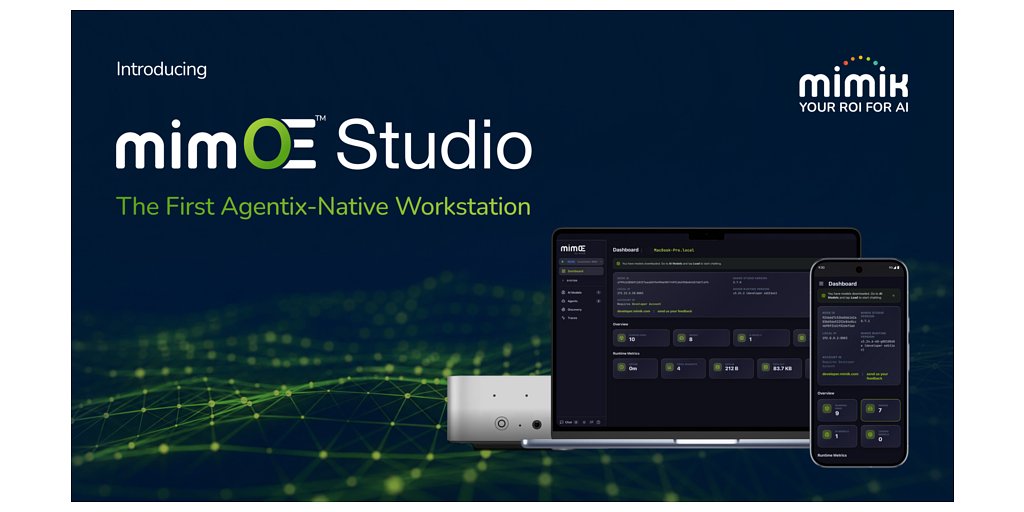
mimik's New Platform Aims to Solve AI's 95% Pilot Failure Rate
OAKLAND, CA – May 27, 2026 – As enterprises pour billions into artificial intelligence, a stark reality looms: an estimated 95% of AI pilot projects never make it to full production. Addressing this critical bottleneck, Oakland-based mimik today launched mimOE Studio, a new workstation designed to help companies build, operate, and scale the next wave of AI—autonomous 'agentic' systems—with greater certainty and cost control.
The Rise of Agents and the Wall of Production
The AI landscape is rapidly evolving beyond simple chatbots and data analysis tools. The new frontier is 'Agentic AI'—systems composed of autonomous AI agents capable of perceiving their environment, reasoning through complex problems, and taking action to achieve goals. Unlike traditional models that require human prompts for every task, these agents can use tools, access APIs, and execute multi-step plans with minimal intervention, from automatically deploying marketing campaigns to managing complex industrial supply chains.
This powerful new paradigm, which analysts at Gartner have placed at the "Peak of Inflated Expectations" on their latest Hype Cycle, promises to revolutionize how businesses operate. However, the path from a promising pilot to a reliable, production-scale system is fraught with peril. The '95% failure rate' often cited by industry experts points to a persistent gap between AI's potential and its practical implementation.
Key challenges include the immense difficulty of operationalizing agents across diverse and often disconnected hardware, the unpredictability of costs associated with cloud services and API calls, and the lack of a unified framework to manage these systems securely. As projects attempt to scale, they often crumble under the weight of these complexities, failing to deliver tangible business value and leading to what Gartner predicts could be the cancellation of over 40% of agentic AI projects by the end of 2027 due to escalating costs and inadequate risk controls.
An Operating System for the Agentic Economy
mimik's answer to this challenge is a two-part solution: mimOE Studio, a visual development environment, and mimOE, the underlying 'Agentix Operating Engine'. The company argues that just as operating systems like Windows and macOS provided a stable foundation for personal computing, a new kind of operating engine is needed for the agentic era.
"In the SaaS era, businesses adapted to the services they subscribed to. Agentix-Native systems invert that. They adapt to the business," said Fay Arjomandi, founder and CEO of mimik, in the company's announcement. "But for enterprises to trust that inversion at production scale, AI has to deliver three things SaaS never did: experimentation with controlled spend, unit economics that hold up from pilot to production, and a future-proof path to scale with full flexibility, without ripping out what’s already there."
mimOE Studio is designed to be the entry point for developers. It allows teams to set up a live 'Agentix-Native' infrastructure in minutes, providing a sandbox to experiment with agents, models, and policies without incurring cloud or token costs. This gives organizations a clear view of performance and cost before committing to a full-scale rollout. Crucially, agents and workflows validated in the Studio can be deployed to production on the full mimOE engine without rewriting code.
A 'Device-First Continuum' Architecture
The core innovation behind mimik's platform is its 'Device-First Continuum AI' architecture. Instead of a purely cloud-centric model where all data and processing are sent to a central server, mimik's mimOE enables a distributed mesh of agents that can run anywhere—from tiny sensors and smartphones to on-premise servers and public clouds.
This engine is built for heterogeneity, supporting a wide array of operating systems including Linux, Windows, macOS, Android, iOS, and the real-time operating system QNX, which is common in automotive and industrial settings. It is also optimized for all major GPU stacks, including CUDA, ROCm, and Vulkan, allowing it to intelligently distribute workloads across available hardware for maximum efficiency, whether online or offline.
This distributed approach is underpinned by built-in Zero-Trust security and a concept mimik calls 'Sovereignty in Execution'. This ensures that every task runs under the organization's own authority and policies, a critical feature for industries like healthcare and finance that handle sensitive data. By decoupling the agent's logic from the underlying hardware, mimik aims to provide a consistent operational guarantee, allowing enterprises to scale their AI initiatives with confidence.
Carving a Niche in a Crowded Field
mimik enters a competitive market populated by cloud giants like AWS, Google, and Microsoft, which offer their own extensive AI platforms, as well as a growing ecosystem of MLOps tools and agent-building frameworks like LangChain. However, mimik is differentiating itself by focusing specifically on the operational fabric for distributed, autonomous agentic systems.
While cloud providers offer powerful tools, they often tether developers to their specific ecosystems. mimik's strategy is to be the agnostic layer that connects everything. This is exemplified by its strategic collaboration with chipmaker AMD, announced in 2025, which aims to integrate mimOE across AMD platforms to enable ubiquitous AI execution from small cameras to large servers. This focus on hardware-level integration and dynamic "choreography" of agents, rather than rigid top-down "orchestration," sets it apart from many cloud-native solutions.
With a free developer tier available to encourage experimentation, mimik is betting that by solving the difficult, unglamorous problem of operationalization, it can become the essential plumbing for the emerging agentic economy, empowering businesses in manufacturing, transportation, and beyond to finally move their AI ambitions from the lab into the real world.