
- 1.44 MW Charging System: Autel’s setup combines three MaxiCharger DS480 cabinets to deliver 1,440 kW (1.44 MW) of power.
- 1.2 MW Power Delivery: The MaxiCharger DT1500 MCS dispenser can deliver up to 1.2 MW of power through the MCS interface.
- 30-45 Minute Charge Time: MCS technology aims to fully charge a heavy-duty truck’s battery in 30 to 45 minutes, aligning with mandatory rest breaks for truck drivers in Europe.
Experts view this breakthrough as a crucial step in overcoming the long charging times that have historically limited the operational range and efficiency of battery-powered trucks, making long-haul electric freight commercially viable.
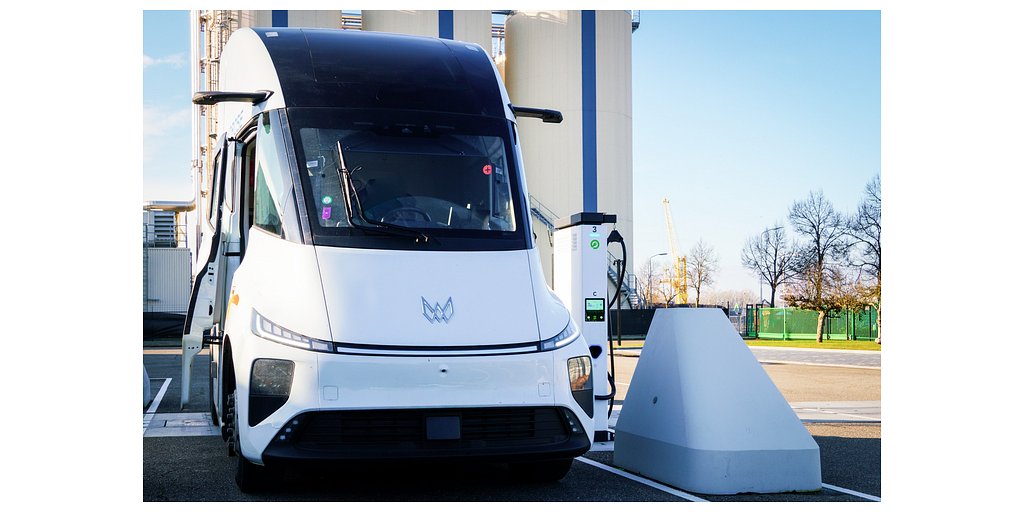
Megawatt Charging Breakthrough Signals New Era for Electric Trucks
ROOSENDAAL, the Netherlands – March 17, 2026 – In a pivotal development for the future of sustainable logistics, charging technology specialist Autel Europe and electric truck developer Windrose have successfully validated a real-world Megawatt Charging System (MCS) session. The demonstration, held at a commercial charging hub in Roosendaal, marks a critical milestone, proving that the ultra-fast charging required to make long-haul electric freight commercially viable is no longer a theoretical concept but an operational reality.
The test saw a Windrose electric truck successfully draw power from Autel’s advanced charging infrastructure, demonstrating seamless interoperability under live site conditions. This achievement is seen by industry experts as a crucial step in overcoming the most significant barrier to electrifying heavy-duty transport: the long charging times that have historically limited the operational range and efficiency of battery-powered trucks.
The Megawatt Milestone: A Leap in Charging Technology
Megawatt-level charging represents a monumental leap from the existing Combined Charging System (CCS) standard, which typically tops out below 400 kW. The system deployed in the Netherlands showcases the sheer scale of this advancement. Autel’s setup features a modular configuration that combines three of its MaxiCharger DS480 high-power cabinets to form a single, 1,440 kW (1.44 MW) system. This powerhouse is paired with the MaxiCharger DT1500 MCS dispenser, which is capable of delivering a staggering 1.2 MW of power through the specialized MCS interface at a current of 1,500 amperes.
To put this into perspective, MCS technology aims to fully charge a heavy-duty truck’s massive battery pack in 30 to 45 minutes—a timeframe that aligns perfectly with the mandatory 45-minute rest break for truck drivers in Europe after 4.5 hours of driving. This capability effectively eliminates charging as a source of unproductive downtime, allowing electric fleets to maintain duty cycles comparable to their diesel counterparts.
Achieving this is a complex engineering feat. “Megawatt charging is not defined solely by higher power levels,” said Andreas Lastei, Vice President of Autel Smart Energy Europe. “It requires coordinated system design across power conversion, thermal management, communication stability, and site integration.” The successful validation confirms that the system’s liquid-cooled cable technology, power conversion architecture, and adherence to the ISO 15118-20 communication standard work in harmony to deliver stable, high-current power safely and reliably.
Unlocking Green Freight for European Highways
The implications of this technological success for the logistics industry are profound. For years, the high upfront cost of electric trucks and concerns over range and charging have slowed adoption. By proving that rapid en-route charging is feasible, MCS directly addresses these concerns and strengthens the economic case for electrification. While electric trucks can cost two to three times more than diesel models, their Total Cost of Ownership (TCO) is significantly lower due to reduced fuel and maintenance expenses. Faster charging maximizes vehicle uptime and revenue-generating potential, accelerating the point at which fleet operators achieve TCO parity and begin to realize substantial savings.
“MCS will be a cornerstone of next-generation long-haul electrification, enabling scalable and ultra-fast charging for the future of zero-emission freight,” said Wen Han, CEO of Windrose. The collaboration between a vehicle manufacturer and an infrastructure provider is essential, as it ensures that the technology is not developed in a vacuum. As Lastei noted, “Collaborating with vehicle manufacturers such as Windrose allows us to validate interoperability under real operating conditions and align infrastructure architecture with actual heavy-duty vehicle requirements.”
This validation contributes directly to improving fleet efficiency, reducing reliance on volatile diesel prices, and advancing the commercial viability of a truly zero-emission supply chain. For companies like Kuehne+Nagel and Decathlon, who are already working with Windrose, this development signals that their sustainability goals are becoming increasingly attainable.
Building Europe's Electric Backbone
The successful test in Roosendaal does not exist in isolation; it is a vital proof point in a continent-wide push to build the infrastructure backbone for electric freight. The European Union’s Alternative Fuels Infrastructure Regulation (AFIR) has set ambitious, legally binding targets for its member states. The regulation mandates the installation of fast-charging stations of at least 350 kW every 60 kilometers along the TEN-T core transport network by 2025, with full network coverage by 2030. While these targets are a crucial first step, the industry widely acknowledges that megawatt-level charging will be necessary to support a fully electrified long-haul sector.
The Autel and Windrose validation provides confidence to investors, policymakers, and logistics operators that the technology is ready for wider deployment. It helps de-risk the significant capital investment required to build out a pan-European MCS network. Other major players, including truck manufacturers like Volvo and MAN and network operators like Milence, are also racing to deploy MCS technology, creating a competitive and innovative ecosystem that is rapidly accelerating the transition. This test adds another key data point showing that the industry is on track to meet and even exceed regulatory timelines.
A Global Race for Electric Dominance
The collaboration between Belgium-headquartered Windrose and charging giant Autel also highlights the global nature of this industrial transformation. Windrose, founded in 2022, has quickly expanded its operations to four continents, demonstrating the global ambitions of new players in the electric vehicle space. The successful European test is being used as a springboard for further international expansion, with the two companies already planning similar heavy-duty charging deployments in Australia.
This move comes as the European market braces for increased competition. A wave of Chinese electric truck manufacturers are poised to enter the European market, often leveraging a highly electrified domestic market, advanced battery supply chains, and competitive pricing to gain a foothold. Windrose itself is an example of this new breed of global company, combining international leadership with deep manufacturing and technological roots. By partnering to validate cutting-edge technology on European soil, Autel and Windrose are not only advancing the state of the art but also positioning themselves at the forefront of a rapidly evolving and increasingly global market.
As the industry moves from laboratory tests to commercial deployments, these real-world validations are the final, critical hurdle. The successful charging session in the Netherlands is more than just a technical demonstration; it is a clear signal that the era of clean, efficient, and economically viable electric long-haul freight is finally dawning.