
- €18.6 million ESA contract for MBRYONICS to build a high-speed optical network in orbit.
- 40,000-square-foot manufacturing facility (Photon 2) to be built in Shannon, Ireland, to scale production of optical terminals.
- Terabit-per-second capacity for the HydRON program, enabling seamless data transfer in space.
Experts view MBRYONICS's ESA deal and expansion as a critical step toward solving interoperability challenges in space communications, paving the way for a unified, high-capacity network spanning multiple orbits.
MBRYONICS to Build Space Internet with ESA Deal, Major Expansion
GALWAY, Ireland – April 20, 2026 – Irish deep-tech firm MBRYONICS is poised to become a central architect of the future "internet in space," following a dual announcement of a major European Space Agency (ESA) contract and a significant manufacturing expansion in Ireland. The company has secured a key role in a €18.6 million project to build a high-speed optical network in orbit, while simultaneously preparing a new facility to meet soaring global demand for its technology.
These moves position MBRYONICS not just as a hardware supplier, but as a critical enabler of interoperability—solving the longstanding problem of different satellite constellations being unable to communicate with each other. By creating a "universal translator" for space-based data, the company is laying the groundwork for a seamless, high-capacity network stretching from low Earth orbit to the Moon.
The HydRON Mission: Weaving a "Fibre in the Sky"
At the heart of the announcement is MBRYONICS's selection for Element 3 of ESA's ambitious High-throughput Optical Network (HydRON) program. The initiative aims to create what ESA calls a "fibre in the sky"—an all-optical, multi-orbit network capable of transferring data at terabits per second, effectively extending the Earth's terrestrial fiber grid into space.
The €18.6M award, part of a team led by Canadian satellite operator Kepler Communications, will see MBRYONICS's technology demonstrated in orbit. The company's StarCom optical terminal and its ground station testbed will be tasked with proving full interoperability with hardware from other providers. This is a crucial step in validating that a truly integrated space network, composed of technologies from multiple vendors, is not just possible but practical.
"HydRON will serve as the world’s first multi-orbital optical communications network with a terabit per second capacity, offering resilient and efficient data transfer to address the challenges of bringing connectivity to multiple users securely, quickly and reliably,” said Laurent Jaffart, ESA's Director of Resilience, Navigation and Connectivity.
This mission builds on MBRYONICS's prior success within the HydRON program, where it delivered essential optical testbed facilities for system reliability checks in Element 2. Its role in Element 3 now moves from ground-based validation to a live, in-orbit demonstration, a critical milestone for the entire program.
Solving Space's "Tower of Babel" Problem
For decades, the expansion of satellite services has created a digital "Tower of Babel" in orbit. Different commercial and government constellations have been launched using proprietary communication standards, operating in isolated silos, unable to share data directly. This fragmentation creates inefficiency, limits capabilities, and poses a significant challenge to building a resilient, unified space infrastructure.
MBRYONICS has built its strategy around solving this exact problem. The company's technology is designed to function as a universal adapter, capable of operating across all major optical communication standards.
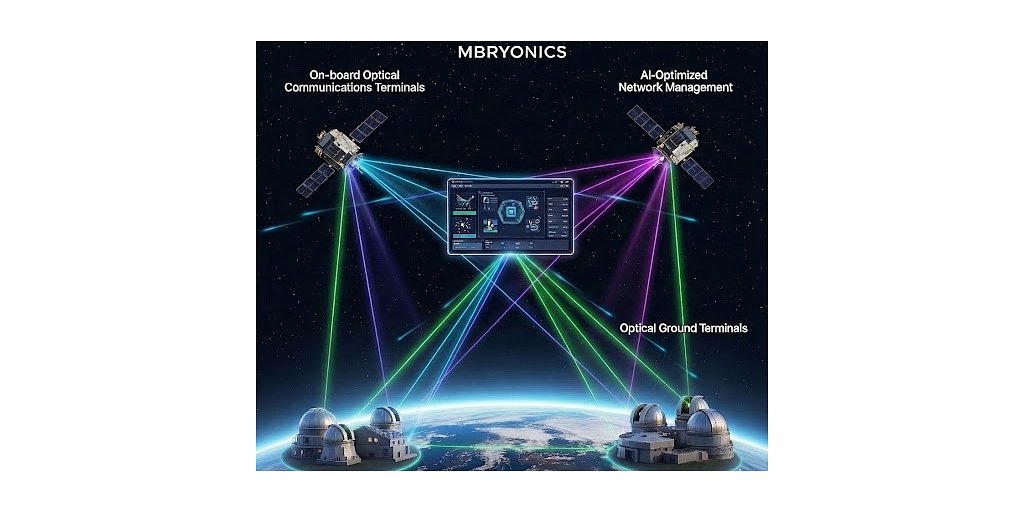
"The internet was built by making different networks talk to each other, and that’s exactly what we’re enabling in space," says John Mackey, CEO of MBRYONICS. "By combining our Optical Terminals with AI-optimized SDN platforms and OGS-1 ground stations, we are turning fragmented constellations into a single, seamless, and interoperable network."
This capability has been proven before. The company's selection by ESA follows its successful participation in the U.S. Defense Advanced Research Projects Agency's (DARPA) Space-BACN program. In that project, MBRYONICS was tasked with developing an optical terminal to bridge the communication gap between disparate government and commercial satellite systems. This track record provides strong validation for its claims and likely played a role in its selection for the equally ambitious European program.
The collaborative nature of the HydRON mission underscores the industry-wide shift toward interoperability. "We look forward to working with Mbryonics on this initiative," said Mina Mitry, CEO and Co-Founder of Kepler Communications. "Interoperability is central to the success of HydRON, and bringing together multiple optical communication technologies on a shared platform is a critical step toward enabling operational, multi-vendor networks in space."
From Lab to Orbit: Scaling Production in Ireland
To support its central role in these global initiatives, MBRYONICS is dramatically scaling up its production capabilities. The company is building a second manufacturing facility, dubbed Photon 2, in Shannon, Ireland. The new 40,000-square-foot plant is a direct response to what the company describes as "rapidly increasing demand" for its optical communications platform from customers in both Europe and the United States.
The Photon 2 facility is projected to be producing thousands of optical terminals by 2027, a massive increase in production velocity. This expansion follows the recent opening of its Photon 1 production site in Galway, signaling a period of aggressive growth and cementing Ireland's status as an emerging hub in the European space industry.
This ramp-up is critical for MBRYONICS to fulfill its vision of proliferating its solutions across the space ecosystem. By increasing the availability of its standardized terminals, the company aims to accelerate the creation of a 'network of networks' that can support the next generation of space-based services, from high-resolution Earth observation and global telecommunications to complex missions in deep space.
A Unified Network from LEO to Cislunar Space
The convergence of the ESA contract and the manufacturing expansion marks a pivotal moment for the future of space communications. The industry is moving beyond the era of isolated systems and toward an integrated architecture where data can flow as freely in orbit as it does on Earth's internet.
MBRYONICS's stated mission is to be the infrastructure layer upon which this space internet is built. By ensuring its technology can handle all standards, it allows disparate constellations in low Earth orbit (LEO), medium Earth orbit (MEO), and geostationary orbit (GEO) to operate as a single, cohesive network. This capability is essential for providing the high-capacity, low-latency connectivity required for everything from national security applications to the future data-heavy economy in cislunar space.
As programs like HydRON and Space-BACN mature, the technologies they validate will form the backbone of this new era. With its proven expertise in interoperability and a rapidly expanding industrial footprint, MBRYONICS is positioning itself not just to participate in this transformation, but to actively drive it, building the universal connections needed for humanity's expanding presence beyond Earth.