
- 70% of CMOs lack confidence in creative performance before launch
- $245 billion in global ad spend wasted annually on non-resonant campaigns
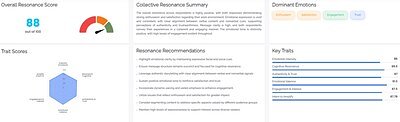
- Predictive Resonance Score (PRS) ranges from 0-100, analyzing 6 behavioral dimensions
Experts view MahaloHub's Predictive Resonance Score as a significant advancement in pre-launch creative validation, offering data-driven insights to reduce marketing waste and improve campaign effectiveness, though they caution that human creativity remains essential for strategic interpretation.
MahaloHub's New AI Predicts Ad Success Before You Spend a Dime
CHICAGO, IL – January 15, 2026 – In a marketing landscape where confidence is currency, Chicago-based MahaloHub today launched a tool it claims can turn creative guesswork into data-backed certainty. The new Predictive Resonance Score™ (PRS), an AI-powered metric, promises to tell marketers how well their creative will perform before they commit to costly production and media buys.
For an industry where an estimated 70% of Chief Marketing Officers express a lack of confidence in creative performance before launch, this represents a significant development. The annual cost of advertising that fails to resonate with audiences is staggering, with global research from Kantar and WARC estimating losses climb as high as $245 billion. MahaloHub’s new platform, Clarity, which houses the PRS, is designed to directly address this costly uncertainty.
From 'We Think' to 'We Know'
The traditional creative process has long been a mix of art, experience, and intuition. But as budgets tighten and the demand for measurable ROI intensifies, relying on a gut feeling is becoming a high-stakes gamble. MahaloHub aims to replace that gamble with a validated, pre-market insight.
"Creative decisions used to be driven by intuition: 'we think this will work,'" said Patrick Rooney, Founder & CEO of MahaloHub, in the company's announcement. "The Predictive Resonance Score gives teams an independent, third-party resource to more accurately understand how people react to their message – before they launch, commit budget, or lose the chance to adjust. That's the difference between launching campaigns with the confidence they'll be successful, versus hoping they will."
The system works by analyzing short video or audio reactions from real respondents who are exposed to a message, concept, or ad. It then distills these complex human reactions into a single, composite score from 0-100. This score is not just a number; it’s a prediction of resonance, supported by actionable recommendations on how to improve the creative to connect more deeply with the intended audience.
How Multimodal AI Reads the Room
At the heart of the Predictive Resonance Score is a technology known as multimodal AI. Unlike traditional text-based surveys that only capture what people say, this approach analyzes the unspoken cues that reveal how they truly feel. It simultaneously processes visual signals (facial expressions, gestures), vocal signals (tone, pitch, energy, hesitation), and linguistic signals (word choice, sentiment).
This method allows for a far richer and more accurate interpretation of human emotion. Industry experts note that text-only analysis can easily miss sarcasm, subtle confusion, or fleeting moments of genuine delight that are clearly visible in a person's face or audible in their voice. By integrating these multiple data streams, the platform aims to provide a holistic view of a person’s response.
MahaloHub's PRS is built on six scientifically validated dimensions grounded in behavioral research:
- Cognitive Resonance: How clear and easy to understand is the message?
- Emotional Intensity: How strong is the emotional reaction it provokes?
- Authenticity & Trust: Does the audience find the message credible and believable?
- Intent to Amplify: How likely are they to share or recommend it?
- Engagement & Interest: Does the creative capture and hold attention?
- Emotional Valence: Is the overall emotional response positive or negative?
By breaking down the score into these sub-dimensions, the platform provides diagnostics that pinpoint specific weaknesses. A low score in Cognitive Resonance, for example, might trigger a recommendation to simplify language, while a dip in Authenticity & Trust could suggest a tonal mismatch with the brand's voice. This transforms the slow, often subjective feedback of traditional focus groups into a rapid, scalable, and data-driven process that can deliver insights in hours, not weeks.
A New Front in the MarTech Arms Race
The launch of PRS places MahaloHub in an increasingly competitive field of AI-driven marketing tools. The industry is rapidly shifting toward pre-launch optimization, with various platforms offering solutions for everything from predictive eye-tracking to AI-generated copy testing. Competitors include specialized AI platforms that focus on emotional optimization of language and general-purpose AI that can generate ad variations for A/B testing.
Where MahaloHub seeks to differentiate itself is with its focus on analyzing real human video reactions at scale to generate its predictive score. Instead of simulating user behavior or relying on synthetic data, PRS is designed to capture the authentic, unfiltered responses of target audience members. This positions it as a direct disruptor to traditional qualitative research, offering the depth of a focus group with the speed and scale of a digital survey.
For brands, the value proposition is clear: validate messaging before sinking millions into production, reduce wasted media spend, and accelerate time-to-market. For advertising agencies, the tool is being positioned as a competitive advantage—a way to win pitches with data-backed creative concepts and strengthen client trust with validated performance predictions.
The Ethical Algorithm and the Human Element
As AI becomes more deeply embedded in marketing, its ability to interpret and influence human emotion raises important ethical questions. The effectiveness of a tool like PRS hinges on the quality and diversity of its training data. Experts in AI ethics warn that if models are trained on biased data, they can perpetuate stereotypes or misinterpret the emotional expressions of certain demographic groups, leading to flawed insights and potentially exclusionary creative.
Furthermore, the collection and analysis of personal video reactions brings data privacy to the forefront. Ensuring transparent user consent, robust data security, and clear policies on how this sensitive information is used will be critical for building and maintaining trust with both respondents and clients.
While AI can process data at a scale humans cannot, industry analysts emphasize that it is not a replacement for human creativity, empathy, or strategic judgment. The most effective approach is a hybrid model where AI provides the data-driven 'what,' while human marketers interpret the 'why.' AI can flag that a message isn't resonating, but it takes human insight to understand the cultural context, brand values, and strategic imperatives needed to craft a truly breakthrough campaign. The Predictive Resonance Score, therefore, is best viewed not as a creative oracle, but as a powerful instrument for informing the artists who still need to make the final masterpiece.